



Note: A new drive belt side seal and a new valve cover gasket may be used during installation. The camshaft bearing caps will require sealant and the bearing cap bolts will require tackifier.
Removal
1. Remove the camshaft timing gear as described in Section Removal and installation of drive belt gears and tensioner mechanism.
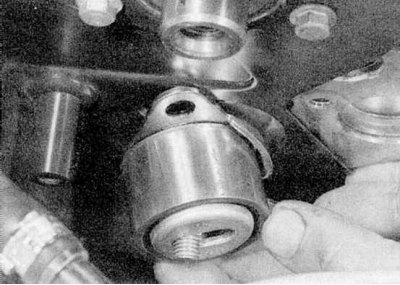
2. Remove the timing belt tensioner mechanism as described in Section Removal and installation of drive belt gears and tensioner mechanism (refer to the accompanying illustration).
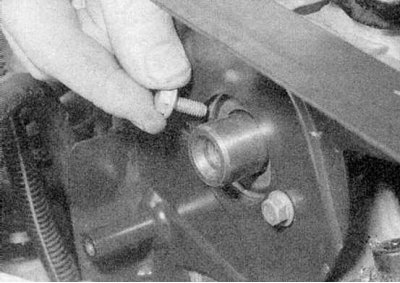
3. Remove the two bolts securing the inner timing belt cover to the cylinder block (refer to the accompanying illustration).
4. Remove the lower bolts securing the inner upper timing belt cover to the cylinder block.
5. Unscrew the bolt securing the intermediate pulley of the toothed drive belt, which also passes through the inner cover.
6. Separate the inner cover and remove it if possible.
7. Remove the vacuum pump as described in Chapter Brake system.
8. For better access, unclip the hoses that run along the top of the valve cover and move them to the side. If the fuel lines are disconnected, plug the open ends to prevent dirt from entering.
9. Loosen the nuts or bolts and remove the valve cover. Remove the gasket.
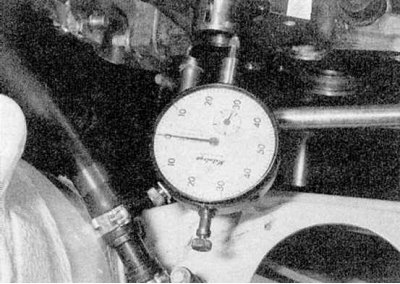
10. Using a micrometer, measure the axial clearance of the camshaft and compare it with the value given in Specifications (refer to the accompanying illustration).
11. If the old camshaft is being installed, it is recommended that the valve clearances be measured at this stage as described in Section Checking and adjusting valve clearances.
12. Check the camshaft bearing caps for marks to avoid confusion during installation; if necessary, mark them so that they can be installed in their original locations. Number the caps.
13. Gradually loosen the bearing cap mounting bolts and posts, evenly reducing the valve spring pressure. Remove the bolts and posts (remembering their location) and then the bearing caps. Note that bearing cap #1 is secured with two posts and two additional bolts.
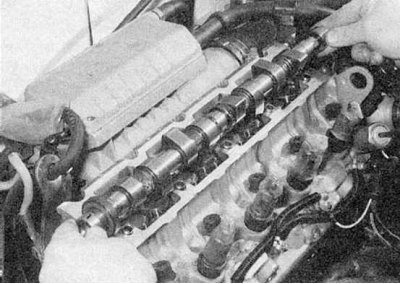
14. Lift the camshaft together with the oil seal (refer to the accompanying illustration). Place them in boxes with compartments, or on a clean piece of cardboard, divided into eight parts. Write down the thickness of the adjusting shims - this data will be needed later when adjusting the valve clearances. The thickness of the shim is indicated on the underside, but it is better to measure it with a micrometer, as due to wear the thickness of the shim may be less than indicated on it.
Inspection
1. Inspect the camshaft bearing running surfaces and cam lobe running surfaces for wear, corrosion, or scratches. Replace the camshaft if such damage is found.
2. Replace the camshaft oil seal on the drive belt side after each removal. Before installing a new oil seal, lubricate its sealing lips.
3. Inspect the camshaft bearing surfaces in the cylinder head and bearing caps. If there are deep scratches or other damage, the cylinder head must be replaced.
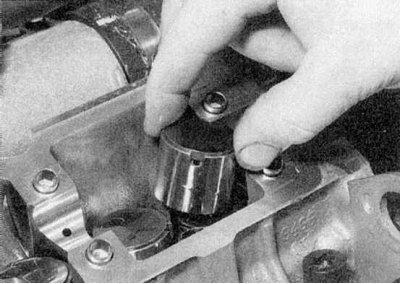
4. Inspect the tappets and adjusting washers for scratches, corrosion, and worn areas. Replace as necessary.
Installation
1. Install all pistons in the middle of the cylinders as described for removing the gear in Section Removal and installation of drive belt gears and tensioner mechanism.
You can find the original at this link renaultbook.ru
2. Lubricate the tappets and install them in their places. Install the washers, marked side down.
3. Lubricate the camshaft bearings. Place the camshaft together with the oil seal on the cylinder head. The oil seal should be placed so that it is flush with the surface of the cylinder head.
4. Apply sealant (CAF 4/60 THIXO, Rhodorseal 5661 or other suitable) on the mating surfaces of the cylinder head at the installation locations of the right and left camshaft bearing caps (No. 1 and No.5).
5. Install the covers in their places, ensuring that the right oil seal is correctly positioned in the bearing cover.
6. Apply a few drops of tackifying compound to the threads of the bearing cap mounting bolts and struts. Install the bolts and struts and tighten them gradually to the specified Specifications effort.
7. If a new camshaft is installed, measure the end clearance and ensure that it complies with the data given in Specifications.
8. Install the vacuum pump as described in Chapter Brake system.
9. Install the inner upper timing belt cover, then install and tighten the bolts securing it to the cylinder block and head.
10. Install and tighten the timing belt idler pulley assembly bolt.
11. Install the timing belt tensioner, ensuring that the protrusion on the cylinder block fits into the hole in the tensioner bracket.
12. Install the camshaft timing gear as described in Section Removal and installation of drive belt gears and tensioner mechanism.
13. Check the valve clearances as described in Section Checking and adjusting valve clearances, and if necessary, adjust them by selecting washers of the required thickness.
14. Install the valve cover, using a new gasket if necessary, and tighten the mounting nuts or bolts to the specifications given Specifications effort.
15. Install/connect hoses that have been moved for better access. If fuel lines have been disconnected, reconnect them and then bleed the fuel system as described in Chapter Power and exhaust systems.
16. Connect the ground cable to the battery.