



Contents: Removal 🠛 Installation 🠛 Initialization of electric motors of…🠛 Initializing the sunroof drive motor 🠛 Examination 🠛 For batteries with removable plugs 🠛 Precautionary measures 🠛 Precautions when working with…🠛 Precautions to prevent battery…🠛
Removal
Before disconnecting the battery, insert the Renault card into the reader 8 position "ignition". Pull the card out to the position "accessories", now the electric lock is unlocked.
Disconnect the wires from the battery terminals, starting with the negative terminal.
To remove the battery, remove the covers and unscrew the mounting bolt A.
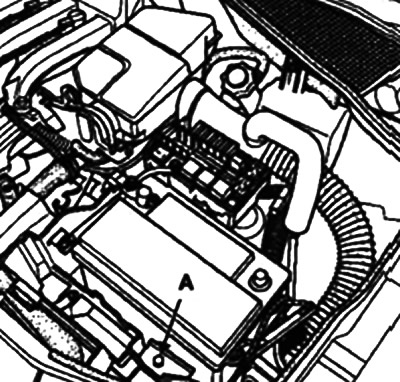
Note: When the airbag ECU is locked, the electric steering column lock is unlocked.
Installation
During installation or whenever the battery is disconnected, a few simple programming steps may need to be performed (without using a diagnostic device) to ensure normal operation of the vehicle:
- setting the time on the clock;
- entering a four-digit code for a car radio (using the remote control buttons on the steering wheel).
Original article is on the portal www.RENAULTBOOK.ru
Initialization of electric motors of pulse electric windows
Close the windows completely, the windows jerk up to the stop.
Press the switch keys and hold them in this position for a few seconds,
Lower the windows all the way.
Press and hold the buttons for a few seconds.
Electric motors are initialized.
Initializing the sunroof drive motor
Set the sunroof switch to the position corresponding to the uppermost position of the sunroof.
Press the switch and hold it in this position. After two seconds, the sunroof opens to the uppermost position in an intermittent mode, then lowers a few centimeters.
Release the switch.
Within five seconds, press the switch again.
Keep the switch pressed, the sunroof opens and then closes longitudinally.
The electric motor has been initialized.
Set the switch to the off position.
Examination
You should check and make sure that:
there are no cracks or signs of damage on the battery case or cover;
- there are no traces of dirt on the top of the battery;
- the terminals are in good condition.
Necessary:
- make sure there are no salt deposits (sulfation) on the terminals;
- if necessary, clean and lubricate the terminals;
- check the reliability of tightening the nuts of the wire clamps on the terminals. If the contact between the wire clamps and the terminals is poor, the engine may not start and the efficiency of charging the battery will decrease. In addition, if the contact is unreliable, sparking occurs, which can lead to an explosion of the battery;
- check electrolyte level;
For batteries with removable plugs
Remove the cover manually or with a tool (for example a hard spatula).
Check that the electrolyte level in all elements is above the separators (approximately 1.5 cm).
Add distilled water if necessary.
Note: Some batteries have a translucent casing, which allows you to monitor the electrolyte level.
Never add electrolyte, acid or other liquids to the battery.
Precautionary measures
It should be remembered that the battery:
- contains sulfuric acid, which is a hazardous substance;
- releases oxygen and hydrogen during the charging process. The mixture of these gases is explosive.
Precautions when working with sulfuric acid
Sulfuric acid solution (electrolyte) is an aggressive, highly toxic substance that also causes severe corrosion. It corrodes skin, clothing, concrete, and also causes corrosion of most metals.
Therefore, when servicing a battery, it is very important to observe the following precautions:
- use protective glasses;
- wear acid-resistant gloves and acid-resistant protective clothing.
If sulfuric acid gets into your eyes, rinse the affected area with plenty of water. If sulfuric acid gets into your eyes, seek medical attention immediately.
Precautions to prevent battery explosion
When charging the battery (by car or indoors) oxygen and hydrogen are released. The gases are released most intensively when the battery is fully charged, and the amount of gas released is proportional to the magnitude of the charging current.
Oxygen and hydrogen mix at the surface of the plates and form an explosive mixture.
The slightest spark from a burning cigarette or a match that has just been extinguished is enough to cause an explosion. This destroys the battery and releases sulfuric acid. People nearby may be injured by fragments of the battery case or splashes of sulfuric acid. The latter are especially dangerous if they come into contact with the eyes, face or hands. In addition, clothing is damaged.
If the battery is not properly maintained, the risk of explosion increases dramatically. Make sure that there are no sources of sparks near the battery.
Before disconnecting or connecting the battery, turn off all power consumers.
When charging the battery indoors, be sure to turn off the charger before disconnecting or connecting the battery.
Do not place metal objects on the surface of the battery that may cause a short circuit between the battery terminals.
Do not bring open flames, blowtorches, gas burners, burning cigarettes or lighted matches near the battery.