



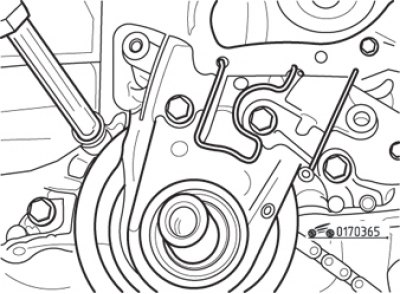
Fig. 3.65. Removing the front crankshaft oil seal housing
Loosen the bolts securing the front crankshaft oil seal housing and remove it (Fig. 3.65). Remove both crankshaft oil seals.
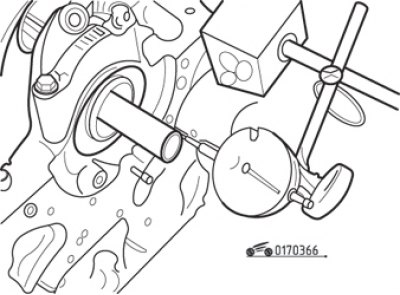
Fig. 3.66. Measuring the axial clearance of the crankshaft
Before removing the crankshaft, its axial clearance should be checked. To perform the measurement, use a dial indicator, the leg of which rests against the nose of the crankshaft (Fig. 3.66). Move the shaft as far as it will go along its axis, set the indicator pointer to zero, and move the shaft as far as it will go in the opposite direction. Record the indicator reading and compare it with that given in Table 3.3.
If you don't have a dial indicator, use a set of flat feeler gauges. To do this, move the crankshaft toward the flywheel, and then use feeler gauges to measure the gap between the side surface of the second crank pin and the half ring in the central support of the crankshaft.
Removal procedure:
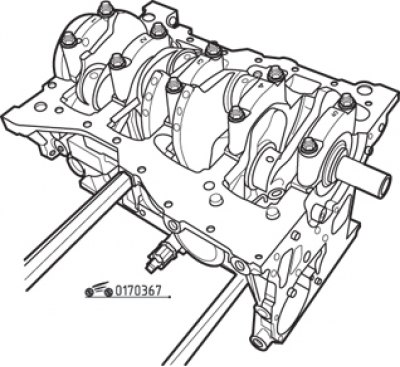
Fig. 3.67. Marking of crankshaft main bearing caps
- make sure that the main bearing caps are clearly marked. The number indicates the position of the bearing in the crankcase, counted from the flywheel side (Fig. 3.67);
- carefully loosen the main bearing cap bolts a half turn at a time until they can be removed by hand. Remove the bolts, then separate the caps from the crankcase. Remove the lower main bearing shells and save for later inspection;
- remove the crankshaft from the engine block, being careful not to drop any upper main bearing shells that may be on the crankshaft. Then remove the remaining upper main bearing shells from the journals on the cylinder block and save them for later inspection;
- remove the thrust half rings on both sides of the third main journal.
Inspection
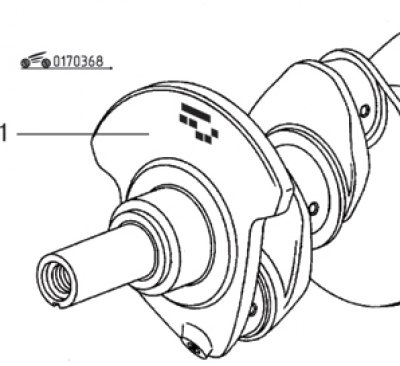
Fig. 3.68. Marking of the diameters of the main bearing journals on the crankshaft counterweight (1)
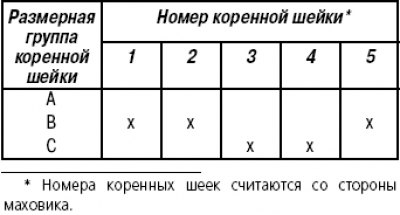
Wash the crankshaft with kerosene or another suitable solvent. Dry it with compressed air if possible. Clean the lubrication holes with wire and blow them out with compressed air. There is a marking on the counterweight on the side of the shaft nose, by which you can determine the diameters of the main bearing journals (Fig. 3.68). The markings are decoded in Table 3.5.
Table 3.5. Decoding markings on the crankshaft
Inspect the main and connecting rod journals for wear, cracks, scoring, and electrochemical corrosion. If such signs are found, have the crankshaft ground at a specialized service station.
In this case, it will be necessary to install new liners of the appropriate repair size.
Using a micrometer, measure the diameter of each bearing journal in several places. Compare the results with the values given in table 3.3if the journal wear is more than 0.025 mm, the crankshaft should be reground to the repair size.
If measurements taken at 90° intervals yield different diameter values, this means that the main journal is oval. If the diameters measured at different points along the main journal are not the same, this indicates that the journal is taper. As in the previous case, grinding is required, followed by installation of repair-size liners.
Check the surfaces mating with the crankshaft seals. If they are significantly scored or damaged, consult a specialist for advice on the suitability of the crankshaft for further use.
Using a V-shaped prism and a dial indicator, measure the radial runout of the crankshaft. The maximum permissible radial runout is no more than 0.05 mm. If the runout exceeds this value, consult a specialist for advice on the suitability of the crankshaft for further use.
Inspection of main and connecting rod bearing shells
Even if you plan to use new liners, which is highly recommended, do not throw away the old ones immediately after removal, as their careful inspection can provide valuable information about the condition of the engine and the causes of any malfunctions. Signs of major defects can be seen in Fig. 3.69.
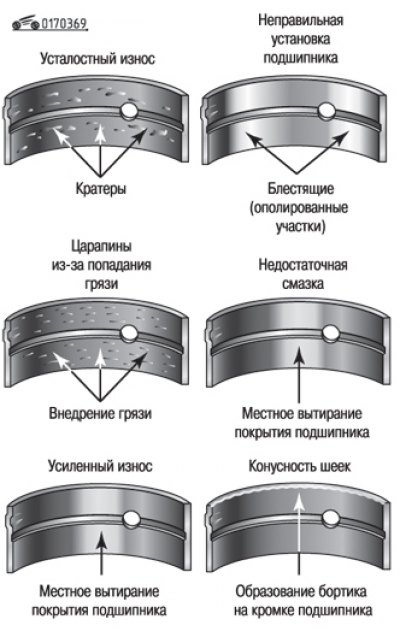
Fig. 3.69. Main types of damage to bearing shells
Damage caused by foreign particles entering the engine appears as longitudinal scratches on the main and connecting rod bearings. Abrasive particles sometimes remain in engine parts after reconditioning, especially if the parts have not been thoroughly cleaned using the proper methods. Often these are metal particles that have appeared after mechanical processing and as a result of engine wear during operation. They can get into the oil, and from there, after passing through filters, into the bearings. The best way to prevent such damage is to ensure that all engine parts are impeccably clean, both during assembly and during engine operation.
Change the engine oil and filter regularly as specified in the operating instructions.
Damage due to lack of lubrication looks like the bearing material has been worn through, chipped, or squeezed out of the steel base. This is caused by overheating, which causes the oil to liquefy (often the liners get a bluish tint), excessive load (which leads to the squeezing of oil from the bearing coating and, as a result, chipping and cracking). Insufficient lubrication can also be caused by excessive clearances in the oil pump or constant operation of the engine at high speed, blockage of the lubrication system channels (use of inappropriate oil, untimely replacement).
Electrochemical corrosion of bearing shells can be caused by repeated short-distance driving. In this case, the heat generated by the engine during a short drive is not enough to remove water vapor and corrosive gases. These substances accumulate in the engine oil, forming acid and sludge. As the oil flows to the engine bearings, the acid attacks the bearing material and causes corrosion.
Incorrect installation of the bearing during assembly also leads to its failure. Bearings that are installed too tightly leave insufficient working clearances, which leads to a lack of lubrication. Dirt or foreign particles that get on the back of the bearing lead to its bulging and wear. Therefore, do not touch the inner working surface of the bearings with your fingers during assembly - you can scratch the surface, which requires careful handling, or leave dirt particles on it.
As mentioned, it is recommended to replace the bearings whenever the engine is disassembled; by doing otherwise, you only get apparent savings.
Installation
Installation procedure:
- place the cylinder block on a clean horizontal surface with the crankcase facing up;
- wipe dry the backs of the inserts and their beds in the block and covers with a lint-free cloth;
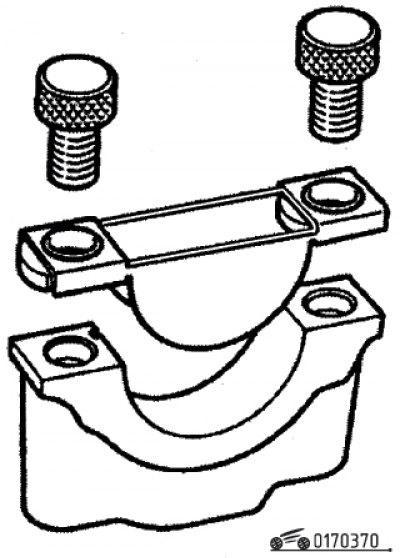
Fig. 3.70. Renault tool Mot. 1493-01 for pressing in bearing shells into the bed
- place the liners in the appropriate beds using the Renault tool Mot. 1493-01 (Fig. 3.70);
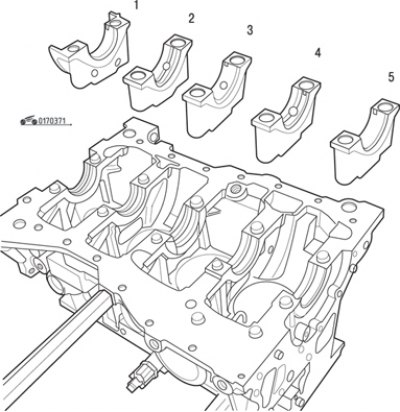
Fig. 3.71. Installing the crankshaft main bearing shells
- install liners with grooves in the cylinder block bed. Install liners without grooves in bearing caps 1, 3, 5 (Fig. 3.71), and with grooves in caps 2 and 4;
- install thrust half rings on both sides of the 3rd cylinder block support. The lubrication grooves must face outward;
- check the clearances in the crankshaft bearings before final installation using a special Plastigage kit. The kit is a calibrated plastic rod of round cross-section. If a piece of the rod is clamped between two parts, then by its deformation, using the attached scale, you can determine the clearance between these parts;
- carefully place the crankshaft into the cylinder block. Do not use grease on either the shaft or the bearings;
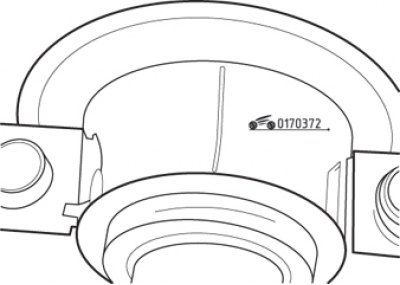
Fig. 3.72. A piece of Plastigage plastic rod placed on the crankshaft main journal
- cut five pieces of plastic rod and place them on each main journal of the shaft, as shown in Fig. 3.72;
- carefully, without moving the rods, place the corresponding covers with the inserts installed in them on the supports;
- starting from the 3rd support, tighten the cover mounting bolts in the prescribed order to the specified torque; do not rotate the crankshaft while tightening the caps;
- unscrew the cover mounting bolts and carefully remove them without moving the flattened rod from the surface of the shaft journal;
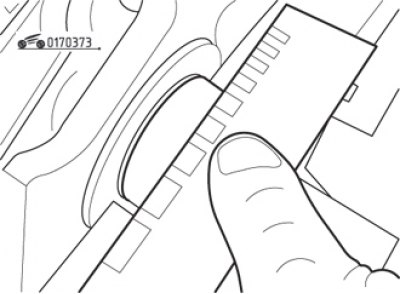
Fig. 3.73. Determining the bearing clearance using the Plastigage scale
- using the scale included with the kit, determine the clearances in each bearing (Fig. 3.73). Compare the results obtained with those given in Table 3.3;
- if the gaps exceed the permissible limits, the bearings may be the wrong size (or too worn if the previous ones were installed during the measurement). Before deciding on the crankshaft, make sure that no oil or dirt has entered the gap where the measuring rod was installed. If the flattened rod is wider at one end than the other, the journal is probably tapered. Consult an engine rebuilder to determine whether to rebuild the worn parts or replace them with new ones;
- after completing the operation, scrape off any remaining rod from the bearing and shaft surfaces with a soft scraper, being careful not to damage the bearings;
- carefully remove the crankshaft from the cylinder block;
- wipe the bearing shells and crankshaft journals again with a rag. Make sure that there is no dirt, dust, or Plastigage residue in the lubrication holes or on the crankshaft surfaces, as this dirt will end up in the bearings after the first engine start;
- lightly lubricate the thrust half rings on the 3rd support side with grease and install them outward with the lubrication grooves;
- lubricate the bearing shells with clean engine oil, then carefully install the crankshaft on the bearing journals;
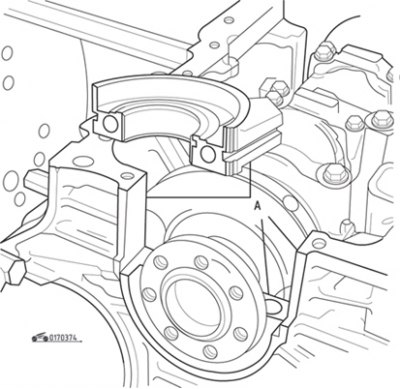
Fig. 3.74. Before applying the sealant, clean the contact surfaces (A) of the 1st support cover
- make sure that the bearing caps are correctly installed, lubricate them with clean engine oil and install them on the block in the required order with the correct orientation, while applying a thin layer of PHODORSEAL 5661 sealant to the entire contact surface of the 1st bearing cap (fig. 3.74 and 3.75);
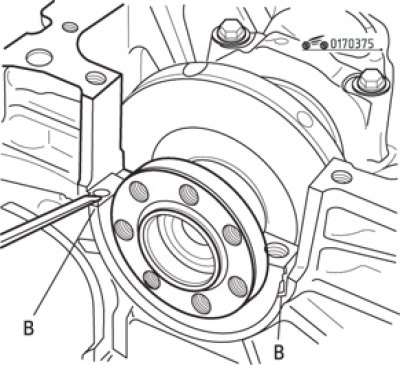
Fig. 3.75. Applying sealant to the lower surface (B) of the cylinder block
- install the bolts on the support caps and tighten them diagonally from the middle outwards in a specific order to the specified torque;
- check the crankshaft rotation - it should be easy, without jamming. If force is required to rotate, find out the reason for it before continuing further assembly;
- check the crankshaft end clearance as described above;
- install the crankshaft oil seal from the flywheel side;
- install the lower rear timing belt cover.