



Contents: Inspection 🠛 Assembly 🠛
After removing the cylinder head, sump and oil pump from the engine, proceed to remove the connecting rod and piston group, which includes the pistons assembled with rings, piston pins and connecting rods assembled with liners and covers.
Please do the following:
- place the cylinder block on the workbench with the crankcase facing up;
- install the piston of the first cylinder (from the flywheel side) to the BDC position;
- apply paint to mark the connecting rod and its cap (in the absence of numbering) for correct installation during assembly;
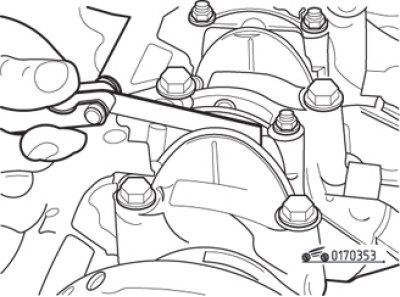
Fig. 3.53. Measuring the side clearance of the lower connecting rod cap
- using a flat feeler gauge, check the lateral clearance of the lower connecting rod head (Fig. 3.53) and compare the result with the dimensions given in Table 3.3;
Table 3.3. Technical data of the crankshaft and connecting rod and piston group components
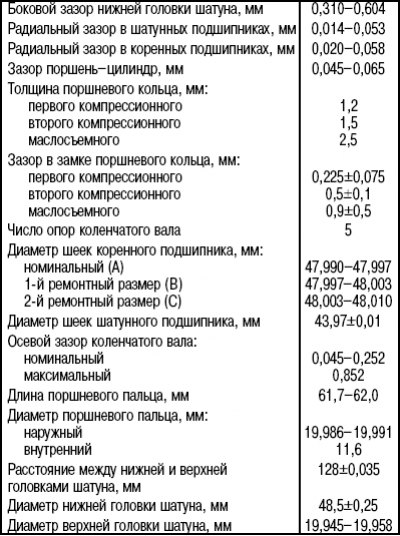
- loosen the connecting rod lower cap nuts and remove the cap together with the bearing. Tape the bearing to the cap for storage. Reusing bearings is not recommended, but if they are to be used again, they should be installed in their original position;
- place plastic tubes or tape over the connecting rod cap mounting bolts to prevent damage to the cylinder surface when removing the piston from the block;
- inspect the top of the cylinder bore. If there is a significant ledge, it must be removed, as the piston and its rings may be damaged when removed;
- paint numbers on the bottoms of all pistons;
- carefully remove the piston through the top of the cylinder block by pushing down on the piston head with a suitable wooden dowel. Once the piston and connecting rod are out, remove the upper bearing shell and tape it to the connecting rod for storage;
- turning the crankshaft half a turn, remove the pistons and connecting rods of the remaining cylinders in the same way. Before removing the parts, mark them (or make sure it is available);
Attention! Piston pins are tightly pressed into the upper heads of the connecting rods and have a floating fit in the piston bosses. Circlips are not used.
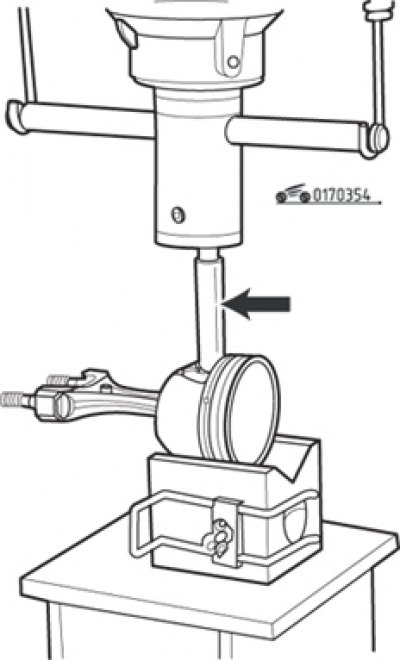
Fig. 3.54. Removing the piston pin from the piston using a mandrel (arrow)
- install the piston in the V-shaped support so that the piston pin coincides with the hole for its extraction (Fig. 3.54);
- using a piston pin extractor, remove the piston pin from the piston using a press.
Inspection
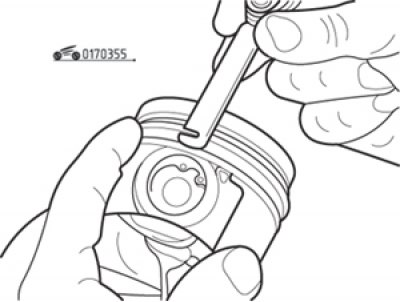
Fig. 3.55. Removing piston rings using a feeler gauge
Clean the pistons and connecting rods from dirt and carbon deposits. Using two or three flat feeler gauges, remove the rings from the pistons upwards (towards the piston bottom) (Fig. 3.55). Clean the piston crown from carbon deposits using an aluminum scraper. Do not use sandpaper for this purpose, as the abrasive grains penetrate the piston aluminum and subsequently cause scratches. Remove carbon deposits from the piston grooves using a suitable piece of piston ring, being careful not to scratch the groove surface.
Wash the pistons from the removed carbon deposits. Make sure that the holes in the oil scraper grooves are not clogged with dirt.
Inspect the rubbing surfaces of the pistons. Wear in the form of vertical "bald spots" on the pressure-bearing surface of the piston skirt and a small gap in the fit of the upper compression ring in the groove are considered acceptable. Scoring and scratches on the piston skirt may indicate that the engine was overheated for some reason: poor cooling, lubrication, too high a combustion temperature. Traces of burning on the skirt are a sign of gas leakage from the combustion chamber, possibly caused by wear of the cylinder walls or piston rings. Traces of burning or chipping on the piston crown are usually signs of engine operation with detonation caused by early ignition or the use of low-quality gasoline. In some cases, the piston head may be melted for the same reason. An over-lean mixture due to air leakage at the intake can also cause piston overheating.
[Original version on our portal: www.RenaultBook.ru]
All causes of the listed damage must be eliminated before the engine is put into operation, otherwise similar damage to the piston group will occur again.
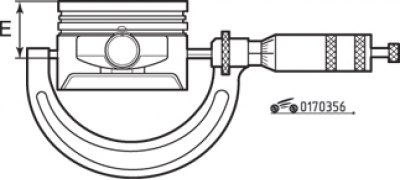
Fig. 3.56. Measuring the piston diameter using a micrometer: E=(42±0.01) mm
Using a micrometer, measure the diameters of all four pistons at a distance of (42±0.01) mm from the piston bottom (Fig. 3.56) perpendicular to the piston pin axis. Compare the measurement results with those indicated in Table 3.4.
Table 3.4. Dependence of piston diameter on cylinder diameter
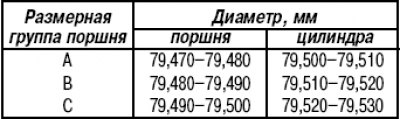
If the piston diameter is out of tolerance, replace the entire piston set. Keep in mind that the cylinder block may have been bored during a previous overhaul, and oversized pistons may have been installed. Record the measurements and use them to check the clearances later when the cylinder diameters are measured.
Measure the gaps between the piston rings and the piston grooves by installing the rings in the grooves and using a set of flat feeler gauges, take the appropriate measurements in three or four places in each groove. The measured dimensions should not exceed 0.1 mm, otherwise the pistons will need to be replaced.
Carefully inspect the connecting rods, pins and caps for wear, cracks and other surface damage. Visually inspect the following:
- condition of connecting rods (they may be twisted or bent);
- tightness of bearing caps fit on connecting rods (if necessary, use a sanding block to remove burrs to ensure proper seating of the caps).
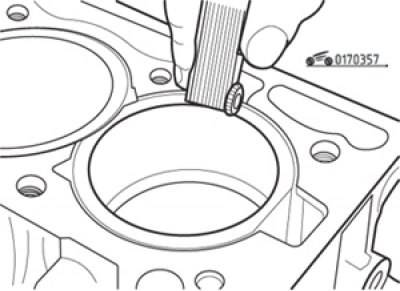
Fig. 3.57. Measuring the gap in the piston ring lock
Before putting the rings on the pistons, install them one by one in their cylinder and check the gap in the ring lock. Push the ring into the cylinder with the piston so that the plane of the ring is parallel to the upper plane of the block (Fig. 3.57). Compare the measurement results with those indicated in Table 3.3.
Assembly
Assembly order:
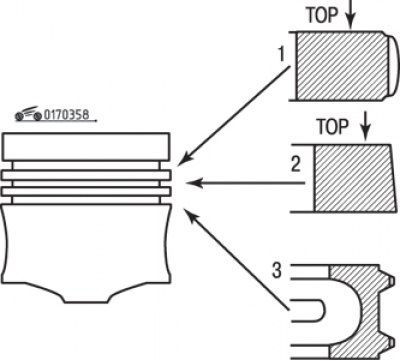
Fig. 3.58. Piston ring profiles
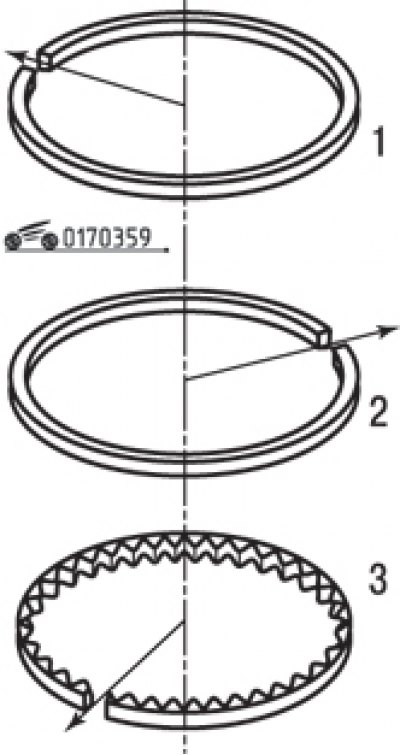
Fig. 3.59. Location of piston ring locks at an angle of 120° relative to each other
- install the rings on the pistons - put them on through the piston bottom, starting with the oil scraper ring and using the same flat feeler gauges that were used to remove the rings. The piston ring profiles are shown in Fig. 3.58. The compression rings are installed with the "TOP" inscription facing up. They are very fragile, so be careful when installing them. Spread the piston ring locks at an angle of 120° relative to each other (Fig. 3.59);
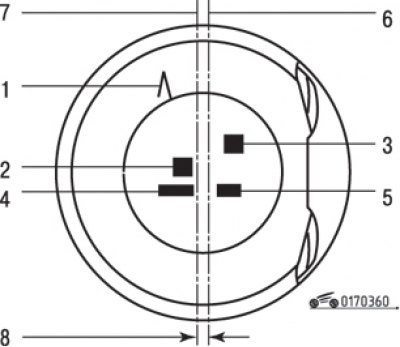
Fig. 3.60. Piston marking: 1 – direction of piston installation with the "L" mark towards the flywheel; 2, 4, 5 – supplier marking; 3 – piston size group (A–B–C); 6 – axis of symmetry of the piston; 7 – piston pin bore axis; 8 – the offset of the axis (7) of the hole for the piston pin relative to the plane of symmetry (6) of the piston is 0.9 mm
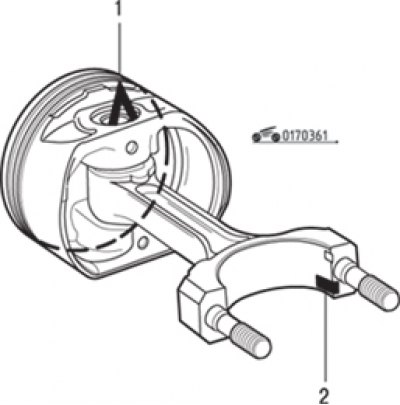
Fig. 3.61. Position of the connecting rod relative to the piston: the "L" mark (1) on the piston bottom should be at the top, and the locking protrusion of the bearing shell (2) of the lower connecting rod head should be at the bottom
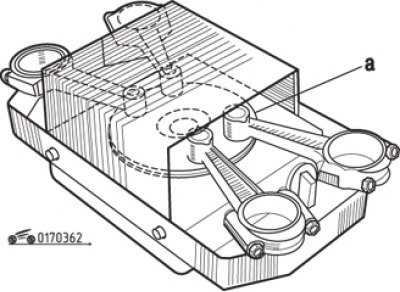
Fig. 3.62. Heating the upper heads of the connecting rods on an electric stove: a - a piece of tin solder
- assemble the piston with the connecting rod. The "L" mark on the piston crown (Fig. 3.60) should be directed towards the flywheel, and the locking lug of the connecting rod lower head bearing shell should be as shown in Fig. 3.61. Place the connecting rod upper heads on a 1500 W heating plate, as shown in Fig. 3.62. To control the heating temperature of the connecting rods, place a small piece of tin solder with a melting point of approximately 250°C on the upper head of each connecting rod in area a;
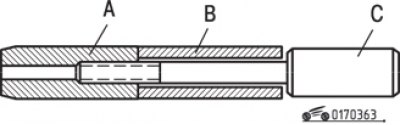
Fig. 3.63. Installing the piston pin (B) on the mounting rod (C) and connecting it to the centering device (A)
- prepare the piston pins. Make sure that they fit freely into their respective pistons. Install the piston pin on the installation rod, screw the centering device in until it stops, and then back it out 1/4 turn (Fig. 3.63);
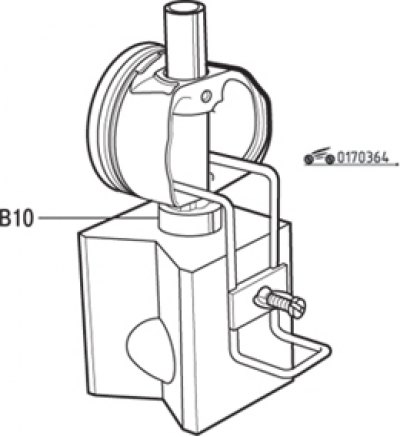
Fig. 3.64. Installing the piston on the assembly fixture with the connecting rod: B 10 - limiter sleeve
- install the piston on the support, orienting it as shown in Fig. 3.61. Between the piston and the support, place a bushing that limits the movement of the centering device when pressing in the piston pin (Fig. 3.64);
- lubricate the centering device and piston pin with engine oil;
Caution! The following operations must be performed as quickly as possible to avoid cooling the connecting rod.
- when the solder temperature reaches the melting point (the solder will turn into a drop), wipe off a drop of solder;
- insert the connecting rod into the piston;
- insert the piston pin as quickly as possible until the centering device stops in the support;
- remove the centering device from the pin;
- make sure that the piston pin does not extend beyond the piston bosses in any position of the connecting rod.