



- We are talking about a pump that is switched on when the engine is started via the fuel pump relay.
- The pump is equipped with a check valve that maintains pressure in the system when the ignition is off. This makes it easier to start the engine.
- A pressure damper installed at the pump inlet to the pipeline prevents sudden pressure surges that may occur when starting the engine.
Fuel pump malfunctions
The fuel pump receives electrical power through a relay installed in the engine compartment. Thus, the pump only operates when the engine is running or when the ignition key is turned to the engine start position.
The second relay, via a safety switch in the engine control unit, interrupts the supply of electrical current if the engine stops running when the ignition is on, i.e. electrical impulses are no longer sent to the control unit.
The safety switch prevents a fire from igniting leaking gasoline in an accident. Therefore, troubleshooting the pump is quite difficult, and if the fault cannot be found as described below, it is best to contact an auto repair shop. There is a necessary tester for the electronic engine control device, with which the fault can be quickly detected.
1. Turn off the ignition (see chapter Ignition system).
2. Disconnect the high pressure fuel lines from the pressure regulator (single point injection system) or distribution pipeline (multi-point injection system) - Keep a rag handy to avoid gasoline splashing.
3. Even when the engine is not running, a small amount of gasoline should leak out, since the fuel system is under pressure.
4. If gasoline does not flow out, have an assistant turn the key to turn on the ignition (but not the starter!).
5. If gasoline does not flow, check the pump fuse or relay.
6. If the relay and, accordingly, the fuse are in good condition, check whether the pump itself is working: ask an assistant to turn on the ignition and listen to see if the pump is making noise.
7. If the fuse is faulty, replace it.
8. If the pump starts working, then you must find the reason for the fuse defect.
9. After removing the boot cover, lightly tap the pump body, this sometimes helps. If the pump was slightly blocked, it will work again.
10. Is the electrical wire connector on the pump securely fastened?
11. If the pump still does not work, check the voltage with a diode indicator (a regular test lamp will not work here, as it can damage the ignition control device), whether there is current in the circuit. In this case, turn on the ignition.
12. If there is voltage, the pump may be faulty or the wire may be broken.
13. If the pump is running but no fuel is reaching the pressure regulator, the fuel filter or hose is clogged or the fuel line is bent.
14. If after all the checks the pump does not work, all that remains is to remove the tank to check the pump itself and replace it if necessary.
Checking the amount of fuel pumped by the pump
If the engine does not develop sufficient power at high speeds or "chokes" when driving at a steady pace, this may be due to insufficient fuel being pumped by the pump. In this case, it is necessary to check the amount of fuel supplied by the fuel pump.
1. Remove the fuel line from the pressure regulator to the injection system and plug it with a suitable screw.
2. Attach the spare hose to the pressure regulator and have an assistant lower it into the measuring container.
3. Remove the fuel pump relay from its location in the engine compartment and short terminals #3 and #5.
4. With a battery voltage of 12 V, the pump should pump 830 cm³ of fuel after operating for one minute with a single-point injection system, and more than 1000 cm³ of fuel with a multi-point injection system.
5. If too little fuel is pumped, measure the battery voltage and, if necessary, replace the fuel filter and measure the amount of fuel pumped again.
6. If the amount of fuel being pumped is still insufficient, replace the fuel pump.
If the fuel supply is insufficient, remove the hose clamp (4) and the pump from the fuel tank. First, disconnect the wires (2 and 3) and the hose (1).
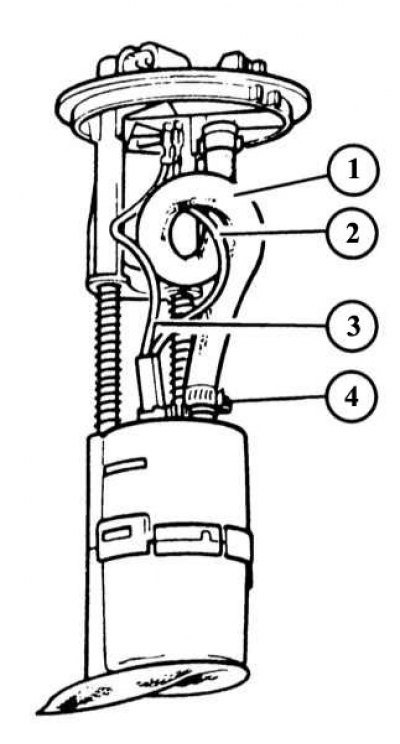
Removal the fuel pump
If the electric fuel pump is faulty, it must be replaced as it cannot be repaired.
1. Remove the tank as described.
2. Remove the thrust ring using a gas wrench or two screwdrivers (note: left hand thread).
3. Replace the fuel pump flange gasket as it is damaged when the pump is removed and therefore cannot be reinstalled.
4. Before installing the fuel pump, clean the intake screen and also clean all contact surfaces of the tank and the pump.
5. Before installing the fuel and vent hoses, clean all pump connections.