
English Русский
Български
Беларускі
Український
Српски
Hrvatski
Română
Polski
Slovenský
Magyar
Bookmark Contacts Articles Sitemap
Company vehicles Peugeot Company vehicles Opel Company vehicles Skoda Company vehicles Land Rover Company vehicles Mitsubishi Company vehicles Volkswagen Company vehicles Honda
RenaultBook.ru


Duster   Fluence   Kangoo   Laguna   Logan   Megane   Sandero   Scenic   Symbol   Clio   Other
Renault 19 (1988-1996) Espace I and II (1984-1996) Espace III (1996-2002)

Fuel tank and fuel line (Renault 19)

  • Main
  • Renault
  • Renault 19 (1988-1996)
  • Power unit
  • Supply system
  • Fuel tank and fuel line
0
Contents: Tank 🠛 Precautions when handling fuel 🠛 Fuel drain 🠛 Removal the fuel tank 🠛

Fuel tank


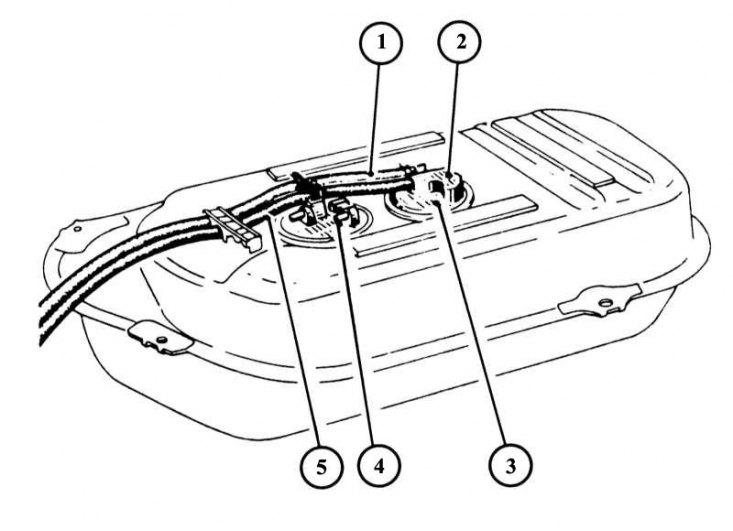
1 - fuel supply hose; 2 - fuel pump connector block; 3 - fuel pump; 4 - fuel level sensor; 5 - fuel…

1 - fuel supply hose; 2 - fuel pump connector block; 3 - fuel pump; 4 - fuel level sensor; 5 - fuel return hose.


The Renault engine is supplied with fuel through a network of pipes. For this purpose, a fuel tank is installed at the rear under the bottom of the car. From this tank, a fuel pump supplies fuel to the engine.

Tank


The fuel tank is installed in a well-protected place - between the rear wheels behind the rear axle beam. It is made of sheet steel and has a capacity of 55 liters. In the upper part of the fuel tank, in combination with the pipelines, a fuel sensor is installed, which shows the amount of fuel in the tank. The tank ventilation hoses are routed to the rubber part of the filler neck.

Precautions when handling fuel


When performing repair work on fuel system components, and especially when draining fuel from the tank, you must be extremely careful. Therefore, you should not undertake work without studying the following precautions:
  • Always disconnect the cables from the battery terminals.
  • Always drain fuel from the tank in the open air and only with a suitable pumping device. Never drain fuel through the fuel gauge opening, by turning the tank upside down or by sucking it out with your mouth through a hose - this can cause poisoning.
  • Always keep CO₂ powder or foam fire extinguisher close to the work area.
  • Never drain fuel from the tank over an inspection ditch. The toxic gases produced when removing fuel are heavier than air and can remain in the inspection ditch for several hours. Inhaling these gases for a long time can cause poisoning, and they are also explosive.
  • Before starting work, make sure that there are no working electrical appliances or open fire sources nearby.
  • An empty fuel tank is especially dangerous due to residual gases. Therefore, carry out all work with special care.
  • The recommendations given here are only a small part of the safety rules and should therefore be considered only as a starting point when handling fuel.


Fuel drain


Filler neck of the tank with a lid
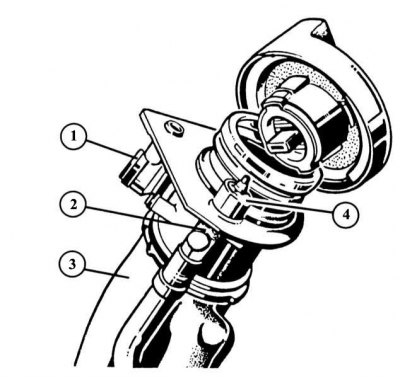


1 - safety valve; 2 - inlet limiting valve; 3 - filler neck; 4 - air valve, operating when the tank…

1 - safety valve; 2 - inlet limiting valve; 3 - filler neck; 4 - air valve, operating when the tank lid is closed.


There is no drain plug in the tank. Since the fuel lines are located at the top of the tank, you cannot simply remove the fuel line and drain the fuel.

1. If the tank is full enough, insert the hose into the tank through the filler neck as far as possible.

2. Pinch the top opening of the hose with your fingers. Pull the hose out a little again and lower its end into a container located below the bottom of the tank.

3. If the hose is sufficiently immersed in the tank, the fuel will begin to flow into the container you placed underneath.

4. If the tank is almost empty, it is impossible to use this method, so pump out the fuel with a suitable device.

5. Sucking fuel of any kind with your mouth is dangerous to your health!

Removal the fuel tank
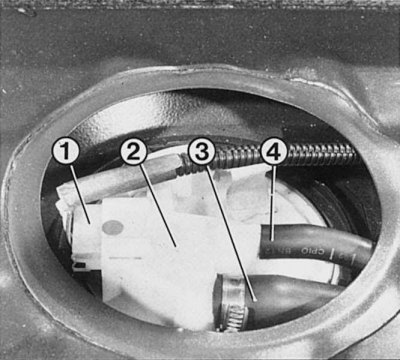


3 - fuel tank filler neck ventilation hose; 4 - air valve hose in the fuel tank filler neck.

3 - fuel tank filler neck ventilation hose; 4 - air valve hose in the fuel tank filler neck.


After removing the boot flooring, you can remove the fuel level sensor housing (2) from the recess in the body. When troubleshooting electrical problems, you can check whether there is a passage in the supply pipe (1) and in the sensor itself.

1. Disconnect the ground wire from the battery terminal.

2. Drain the fuel.

3. Fold back the trunk cover and remove the fuel level sensor casing.

4. Disconnect the fuel level sensor connector in the tank.

5. Mark both vent hoses on the fuel level sensor and disconnect them.

6. Raise the rear of the vehicle.

7. Unscrew the spare wheel mount and remove the wheel. Then remove the spare wheel mount from the bottom of the car.

Original publication on the portal RENAULTBOOK.ru

8. Clean the bottom around the tank to avoid clogging the fuel system.

9. Remove the filler neck clamps.

10. Disconnect the filler neck from the body.

11. Support or secure the fuel tank.

12. Loosen the fuel tank mounting bolts.

13. Lower the tank slightly and remove the safety clamp and fuel lines from the fuel pump.

14. Remove the tank completely and pull it out from under the car.

15. When installing the fuel tank, ensure that all fuel lines are free and not pinched or bent.

16. After finishing the work, fill the tank with fresh fuel and check all connections for leaks.
This article is available on: russian, bulgarian, belarusian, ukrainian, serbian, croatian, romanian, polish, slovak, hungarian
Article has been reviewed by editor: Trofimova Anastasia
Share with friends:
Previous
19: Supply system
Next

How to choose the right fuel
Turbocharger Troubleshooting
Charge air cooling radiator
Removal and installation a turbocharger
Turbocharger — design description
Fuel level sensor in the tank
Fuel tank ventilation
Removal fuel lines and hoses
Checking the power supply system for leaks
Fuel pump — removal, inspection and installation
Other articles on other Renault models

➽ Fuel tank Renault Duster 1 (2009-2017)
➽ Fuel tank (all engines) Renault Fluence 1 (2009-2020, petrol)
➽ Fuel tank Renault Kangoo 1 (1997-2007)
➽ Fuel tank — design description Renault Laguna 2 (2001-2007)
➽ Removal and installation the fuel tank filler pipe hatch cover Renault Logan 1 (2004-2012, petrol)
Link to this article in different formats
Reviews and comments of visitors
No comments yet


Add two numbers 28 + 49


Renault 19 (1988-1996) 
  • General information
  • Maintenance
  • Power unit
  • Engine repair
  • Exhaust system
  • Cooling system
  • Supply system
  • Single-point injection
  • Multi-point injection
  • Diesel injection system
  • Transmission
  • Clutch
  • Car gearbox
  • Chassis, running gear
  • Car suspension
  • Steering
  • Brake system
  • Wheels and tires
  • Body and interior
  • Exterior (external elements)
  • Interior (internal elements)
  • Heating and ventilation
  • Electrical equipment
  • Equipment and devices
  • Headlights and lighting
  • Ignition system
  • Power devices
  • Electrical circuits
Espace I and II (1984-1996) 
  • General information
  • Introduction to the guide
  • Troubleshooting
  • Power unit
  • Engine repair
  • Cooling system
  • Carburetor fuel system
  • Injection fuel system
  • Diesel fuel system
  • Ignition system
  • Transmission
  • Clutch
  • Car gearbox
  • Drive shafts
  • Chassis, running gear
  • Brake system
  • Steering
  • Front suspension
  • Rear suspension
  • Body and interior
  • Exterior (external elements)
  • Interior (internal elements)
  • Doors, locks and windows
  • Electrical equipment
  • Equipment and devices
  • Electrical circuits
Espace III (1996-2002) 
  • General information
  • Introduction to the manual
  • User manual
  • Power unit
  • Petrol engines F3R
  • Petrol engines Z7X
  • Diesel engines G8T
  • Diesel engines G9T
  • Transmission
  • Clutch
  • Mechanical gearbox
  • Automatic gearbox
  • Drive shafts
  • Chassis, running gear
  • Steering
  • Front suspension
  • Rear suspension
  • Brake system
  • Body and interior
  • Exterior (external elements)
  • Interior (internal elements)
  • Doors, locks and windows
  • Heating and ventilation
  • Electrical equipment
  • Equipment and instruments
  • Power devices
  • Electrical circuits
RenaultBook.ru © 2018–2026 | Mobile version | News and articles | Sitemap: EN BG BY UA RS HR RO PL SK HU | Administration | Site search | Bookmark
Duster 1 (2009-2017) | Fluence 1 (2009-2020, petrol) | Kangoo 1 (1997-2007) | Laguna 2 (2001-2007) | Logan 1 (2004-2012, petrol) | Logan 2 (2012-2020) | Megane 1 (1995-2002) | Megan 2 (2002-2009, petrol) | Sandero 1 (2007-2012, petrol) | Scenic 1 (1996-2003) | Symbol 1 (1999-2008, petrol) | Symbol 2 (2008-2013, petrol) | Renault 19 (1988-1996) | Espace I and II (1984-1996) | Espace III (1996-2002) | Clio 1 (1990-1998) |
We want your visit to be comfortable 😌 and use cookies 🍪 to do so.