
English Русский
Български
Беларускі
Український
Српски
Hrvatski
Română
Polski
Slovenský
Magyar
Bookmark Contacts Articles Sitemap
Company vehicles Peugeot Company vehicles Opel Company vehicles Skoda Company vehicles Land Rover Company vehicles Mitsubishi Company vehicles Volkswagen Company vehicles Honda
RenaultBook.ru


Duster   Fluence   Kangoo   Laguna   Logan   Megane   Sandero   Scenic   Symbol   Clio   Other
Symbol 1 (1999-2008, petrol) Symbol 2 (2008-2013, petrol)

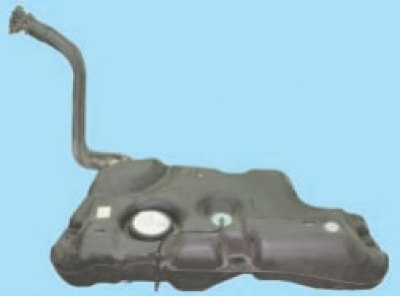
Fuel tank — removal and installation (Renault Symbol 2)

  • Main
  • Symbol
  • Symbol 2 (2008-2013, petrol)
  • Power unit
  • Fuel system
  • Fuel tank — removal and installation
0
Contents: Description 🠛 Fuel drain 🠛 Removal the fuel tank 🠛 Installing a fuel tank 🠛
Fuel tank — removal and installation


Attention! When working with fuel system components, observe fire safety precautions.
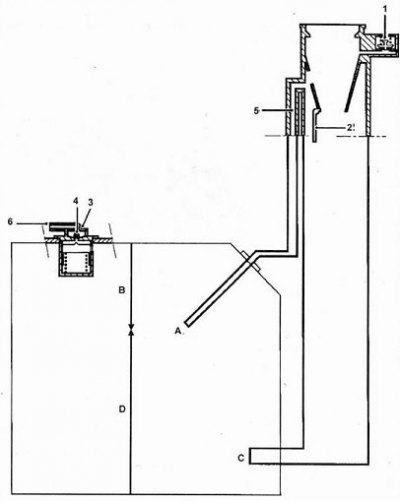

Fuel tank diagram. 1 - Fuel tank ventilation valve, 2 - Limiting valve, 3 - Overflow and fuel…

Fuel tank diagram. 1 - Fuel tank ventilation valve, 2 - Limiting valve, 3 - Overflow and fuel cut-off valve in case of tipping over, 4 - Overflow valve ball, 5 - Tank ventilation nipple when refueling, 6 - Nipple for connection to the fuel vapor recovery system, A - Tank ventilation hose when refueling, B - Free volume for expansion, C - Filler neck with check valve, D - Useful filling volume.


Description


1. Fuel tank ventilation valve. When the fuel vapor removal lines from the tank to the fuel vapor recovery system are blocked, the valve releases excess pressure when the engine is off or eliminates the vacuum in the tank when the engine is running. This prevents deformation of the tank.


2. Restrictor valve: This valve prevents the tank from being filled with leaded petrol or diesel fuel.

3. Overflow and fuel cut-off valve in case of overturning. Overflow of the tank is prevented by blocking the pressure relief line with a valve ball. Filling the tank occurs in such a way that there is free volume in it for thermal expansion of the fuel. In case of overturning of the car, the ball closes the pressure relief line and prevents fuel from leaking through the fuel vapor accumulator.

4. The fuel tank has a sealed filler cap.

5. The filler neck of the tank for using unleaded gasoline has the following features: - Smaller size of the neck, into which the nozzle used for dispensing leaded gasoline cannot be installed.
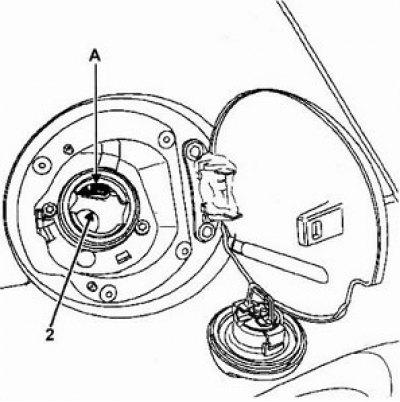
5. The filler neck of the tank for using unleaded gasoline has the following features: - Smaller…


Valve (2) closing the tank neck when overfilled (preventing fuel spillage during refueling).

Fuel drain


1. Remove the fuel pump/fuel level sensor assembly access cover.

2. Disconnect the fuel supply hose quick connector (green color).
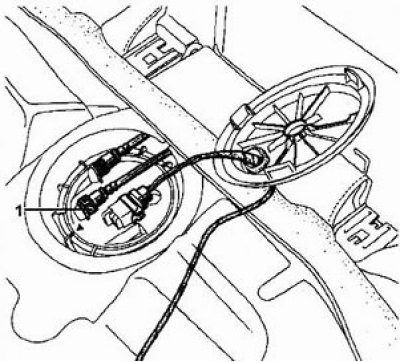
2. Disconnect the fuel supply hose quick connector (green color).


3. Connect a process hose of sufficient length to the fitting of the removed hose and insert it into a container for collecting fuel.


4. To avoid discharging the battery, connect it to a charger.

5. Remove the fuel pump relay (in the fuse box in the engine compartment).

6. Install a jumper across terminals 3 and 5 of the relay base to start the fuel pump.

7. After draining the fuel, remove the jumper and reinstall the fuel pump relay.

Removal the fuel tank


1. Disconnect the battery.

2. Place the vehicle on a lift.

3. Disconnect the connector (2) and hoses of the pump/fuel level sensor unit.
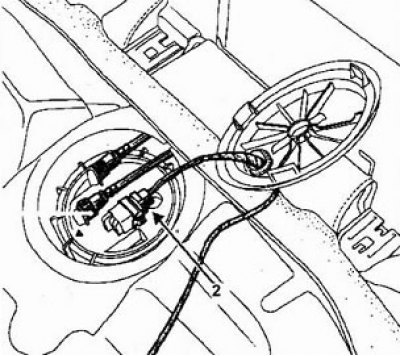
3. Disconnect the connector (2) and hoses of the pump/fuel level sensor unit.


4. Raise the vehicle.

5. Disconnect the auxiliary muffler from the neutralizer.

Original article is on the portal: RENAULTBOOK.ru

6. Hang the exhaust pipe on the wire.

7. Disconnect the fuel return hose from the tank.

8. Remove the heat shield from the tank and parking brake cables.

9. Loosen the parking brake control lever and cables (3) and (4). The cable tension is adjusted from inside the vehicle. Carefully remove the plastic stoppers (6).
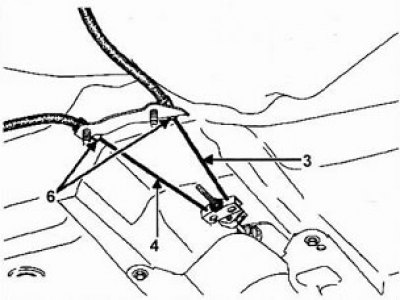
9. Loosen the parking brake control lever and cables (3) and (4). The cable tension is adjusted…


10. Disconnect the overfill protection tube from the tank.


11. Disconnect the filler neck from the tank.

12. Release the parking brake cables from the clamps located under the tank.

13. Place a jack under the tank.

14. Unscrew the four tank mounting bolts.

15. Tilt the tank to the right and up, remove the tank.

Installing a fuel tank


The fuel tank has three oval holes for mounting bolts (two on the side and one on the back) to adjust the position of the tank relative to the subframe.

The tank is installed in the reverse order of removal. Avoid pinching or bending the fuel system tubes and/or hoses. Install heat shields correctly.
  • Tightening torque of fuel tank mounting bolts: 21 Nm
This article is available on: russian, bulgarian, belarusian, ukrainian, serbian, croatian, romanian, polish, slovak, hungarian
Article has been reviewed by editor: Kupriyanov Sergey
Share with friends:
Previous
Symbol 2: Fuel system
Next

Checking and adjusting the injection system
Removal and installation the exhaust manifold
Removal and installation the intake manifold
Removal and installation of the electronic control unit (ECU)
Removal and installation of various sensors
Fuel pump and fuel level sensor
Fuel manifold and injectors for K4J engine
Throttle body of the K4J engine
Manifolds and throttle body (K7J engine)
Engine air filter
Other articles on other Renault models

➽ Fuel tank Renault Duster 1 (2009-2017)
➽ Fuel tank (all engines) Renault Fluence 1 (2009-2020, petrol)
➽ Fuel tank Renault Kangoo 1 (1997-2007)
➽ Fuel tank — design description Renault Laguna 2 (2001-2007)
➽ Removal and installation the fuel tank filler pipe hatch cover Renault Logan 1 (2004-2012, petrol)
Link to this article in different formats
Reviews and comments of visitors
No comments yet


Add two numbers 50 + 32


Symbol 2 (2008-2013, petrol) 
  • General information
  • User manual
  • Maintenance
  • Power unit
  • Engine repair
  • Cooling system
  • Fuel system
  • Exhaust system
  • Ignition system
  • Transmission
  • Clutch
  • Mechanical gearbox
  • Automatic gearbox
  • Drive shafts
  • Chassis, running gear
  • Front suspension
  • Rear suspension
  • Steering
  • Brake system
  • Body and interior
  • Exterior (external elements)
  • Interior (internal elements)
  • Doors, locks and windows
  • Heating and ventilation
  • Electrical equipment
  • Equipment and devices
  • Headlights and lighting
  • Power devices
  • Electrical circuits
Symbol 1 (1999-2008, petrol) 
  • General information
  • User manual
  • Car care
  • Maintenance
  • Power unit
  • Engine repair
  • Cooling and lubrication system
  • Supply system
  • Exhaust system
  • Ignition system
  • Transmission
  • Clutch
  • Mechanical gearbox
  • Automatic gearbox
  • Drive shafts
  • Chassis, running gear
  • Car suspension
  • Steering
  • Brake system
  • Body and interior
  • Exterior (external elements)
  • Interior (internal elements)
  • Doors, locks and windows
  • Restoration and repair
  • Electrical equipment
  • Equipment and devices
  • Headlights and lighting
  • Power devices
  • Heating and ventilation
  • Electrical circuits
RenaultBook.ru © 2018–2026 | Mobile version | News and articles | Sitemap: EN BG BY UA RS HR RO PL SK HU | Administration | Site search | Bookmark
Duster 1 (2009-2017) | Fluence 1 (2009-2020, petrol) | Kangoo 1 (1997-2007) | Laguna 2 (2001-2007) | Logan 1 (2004-2012, petrol) | Logan 2 (2012-2020) | Megane 1 (1995-2002) | Megan 2 (2002-2009, petrol) | Sandero 1 (2007-2012, petrol) | Scenic 1 (1996-2003) | Symbol 1 (1999-2008, petrol) | Symbol 2 (2008-2013, petrol) | Renault 19 (1988-1996) | Espace I and II (1984-1996) | Espace III (1996-2002) | Clio 1 (1990-1998) |
We want your visit to be comfortable 😌 and use cookies 🍪 to do so.