



Contents: Regular or high octane gasoline? 🠛 Ringing and noises in the engine 🠛 What fuel to use for Renault 19? 🠛 Diesel fuel 🠛 Diesel fuel and temperature 🠛 Winter fuel 🠛 Anti-thickening agent 🠛 How to prevent fuel from thickening…🠛
The variety of fuels confuses some car owners. However, at the gas station you must finally decide what fuel you will fill your car's tank.
Regular or high octane gasoline?
A significant difference between different grades of gasoline is detonation resistance. It is designated by the octane number and is higher in high-grade gasoline.
High-octane gasoline can withstand higher compression pressures without spontaneous combustion. Such pressures would result in detonation if regular gasoline was used. When compressed, the working mixture, consisting of fuel vapors mixed with air, heats up.
The higher the compression ratio, the higher the probability of spontaneous combustion of the working mixture in the combustion chamber if the fuel does not have sufficient detonation resistance. The octane number is used to characterize detonation resistance. This is a comparative parameter that is determined in a test engine for a specific fuel. The term often used is "research octane rating" "Research-Oktanzahl", abbreviated ROZ. Less commonly used is the more meaningful term "engine octane number", or MOZ.
The octane number for unleaded petrol in the Federal Republic of Germany is determined by DIN 51607, which sets out the minimum requirements for fuel. Thus, for regular petrol the octane number is 91, for Euro Super petrol it is 95, and Super Plus petrol has a minimum octane number of 98.
Ringing and noises in the engine
These malfunctions are almost never encountered on our engines, as they have detonation control in the ignition system. However, it is necessary to describe the cause of this process.
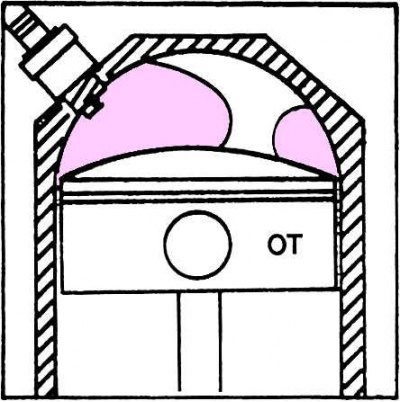
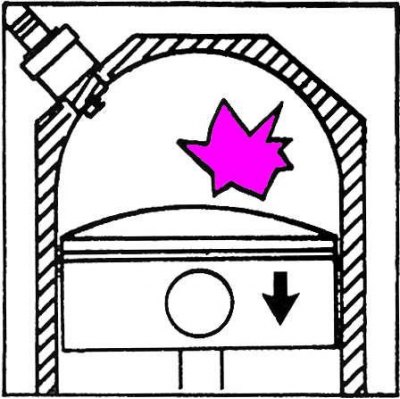
Normally, the working mixture is ignited in the cylinder by the spark discharge of the spark plug in a wave-like manner - as if you were to throw a stone into calm water: the waves spread out in a circle. Due to the spreading ignition of the working mixture, the gases in the cylinder expand. If this expansion is too strong, the remaining unburned gas can be pressed against the cylinder walls. This increase in pressure leads to the heating of the unburned remaining working mixture, which can cause it to ignite spontaneously. In this case, it detonates towards the flame front from the spark plug. This leads to a strong increase in pressure in the cylinder. The piston receives a blow to the base and transmits it further through the connecting rod to the crankshaft bearing.
If this effect occurs at high engine speeds, the noise created by the combustion process is drowned out by the noise of the car's movement. This is very dangerous for engines with a conventional ignition system. Such detonation at high speeds leads to significant engine overheating and can cause the piston base to melt. Better known, since they are more audible, are detonation noises during acceleration. They occur if you accelerate the car on low-octane gasoline. However, this does not harm the engine.
What fuel to use for Renault 19?
The following fuel types are used for our Renault 19 models:
| Engine | Brief designation | Compression | Regular unleaded gasoline 91 | Petrol Euro Super unleaded 95 | Gasoline Super Plus unleaded 98 | Diesel fuel 45 CZ |
| 1.4 liter 1.7 liter 1.7 liter 1.8 liter 16-valve Diesel Diesel with turbocharger | C3J F3N-L F3N-N F3P F7P F8Q F8Q | 9,0 9,5 9,5 9,8 10,01 21,5 20,5 | + + — — — — — | + ¹ + ¹ + + + — — | + ¹ + ¹ +² +² +² — — | — — — — — + + |
¹can be used;
²used at full load and high outside air temperature.
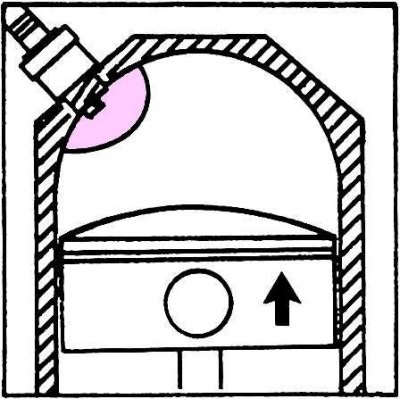
During detonation, in addition to the working mixture ignited by the spark plug, its remainder in the corner of the combustion chamber spontaneously ignites.
 |
 |
Diesel fuel
Diesel Renault 19 You must fill up only with diesel fuel that complies with State Standard DIN 51601 with a cetane number (CZ) of at least 45. The cetane number characterizes the flammability of the fuel. It is a parameter that is determined in the standard test diesel.
Diesel fuel and temperature
Fuel consists of a large number of different hydrocarbons. In diesel fuel, this is mainly paraffin, which determines the degree of flammability. Its negative property is the tendency of paraffin to crystallize when the temperature drops. The crystals quickly combine and form whole complexes of lattice compounds together.
Starting from a certain negative temperature, such a quantity of crystal lattices is formed that the fuel no longer passes through the fuel filter.
Winter fuel
So-called flow improvers maintain the fluidity of the fuel even at sub-zero temperatures. Diesel fuel at filling stations is divided into:
- Summer diesel fuel is the most "unprocessed". It thickens already at a temperature of -2°C.
- Transitional diesel fuel is sold in spring and autumn. It maintains good fluidity at temperatures from -8 to -10°C.
- Winter diesel fuel, according to the standard requirements, must be suitable for use at temperatures down to -12°C. As a rule, its quality is improved by adding flow-supporting additives, so that winter diesel fuel retains its properties down to -22°C, but further addition of additives does not bring any improvements. The same is stated in the recommendations of mineral oil manufacturers.
Anti-thickening agent
If you have summer diesel fuel in your tank during the cold season, you can improve its characteristics yourself by adding a suitable agent, such as, "Autol Desolite D/DW", "LM fliessfit", "Valvoline Winterfit" or "Veedol Diesel Aktiv". Be careful, read the information on the label!
The formation of paraffin crystals cannot be prevented by flow improvers. They only prevent the formation of networks of these crystals, since the crystals themselves are small enough to pass through the cells of the fuel filter. In this way, the fuel enters the high-pressure fuel pump.
The negative property of flow improvers is that they do not act on all types of diesel fuel in the same way. In addition, you can never be sure at what temperature the fuel poured into your tank will thicken. Anyone who wants to be sure to avoid problems with thickened fuel should mentally increase the data promised on the label of the product used by a few degrees.
How to prevent fuel from thickening in the cold
If diesel fuel has already thickened, pouring a flow improver into the tank will not help, especially if it was stored in a frozen glove compartment. If the air temperature is significantly lower than the fuel thickening temperature, the best way to make the fuel liquid again is to park the car in a heated garage.
To avoid this, pour in a flow improver before a cold night (if possible it should be at room temperature), then fill the tank to the brim with fuel. The temperature of the fuel in the underground tanks at the gas station is always above zero, so the flow improver mixes well with the fuel. It is good if the tank is empty when you fill it up, then the fuel from the underground tanks at the gas station will warm up the rest of the fuel in the tank, dissolving the paraffin crystals there. During the trip, the contents of the tank will mix well, and then you can calmly survive the Siberian frost.