



Contents: Container with activated carbon 🠛 Checking the ventilation system 🠛 Safety valve 🠛 Checking the safety valve 🠛
- A vent hose is attached to the fuel tank filler neck and is connected to the top of the fuel level sensor in the tank. This hose allows air to escape when fuel is added to the tank.
- A thin ventilation hose carries the resulting vapors to a container with activated carbon.
- During movement, air enters through this hose when the fuel level decreases, which prevents the formation of a vacuum in the tank. Therefore, when installing the tank, pay special attention to the hose not being twisted or pinched.
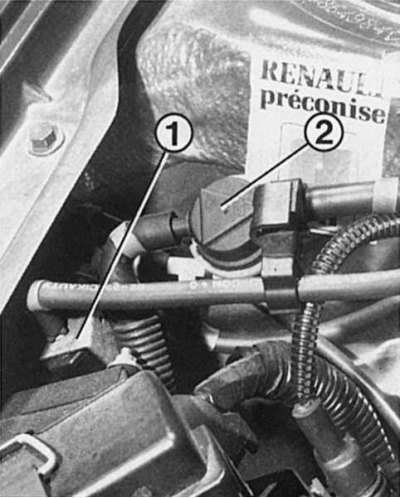
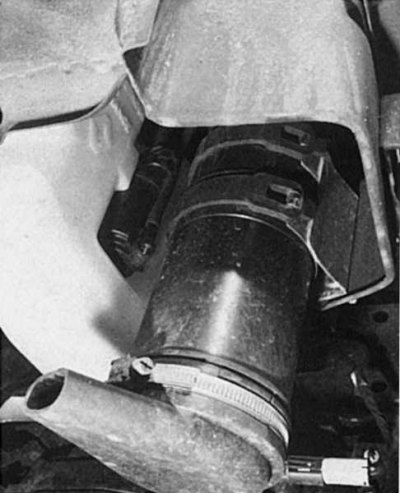
The figure shows the important elements of a closed fuel vapor recovery system. At a certain coolant temperature and engine load, the diaphragm valve (1) opens, to which the reduced pressure from the intake manifold is transmitted, and a vacuum is also created in the diaphragm valve (2). As a result, the gases collected in the container with activated carbon (drawing on the right) fuel vapors are sucked through the intake manifold into the combustion chambers. The activated carbon container is located on the right wing.
 |
 |
Container with activated carbon
To protect the environment, the tank ventilation hose on Renault 19 models with petrol engine and adjustable catalytic converter is connected to a container containing activated carbon. This container is located behind the mudguard in the right wing. When the engine is not running or idling, petrol vapours accumulate in this container to then enter the engine combustion chamber when the engine load or speed increases. The supply of fuel vapours to the working mixture is controlled by an electromagnetic valve, which receives a command from the injection and ignition control unit. When the engine load is appropriate, this valve opens the low-pressure hose to the intake manifold or engine ventilation system, causing fuel vapours to be pumped out of the container containing activated carbon.
Checking the ventilation system
1. Raise the rear of the machine.
2. Disconnect the tank and lower it.
3. Check the hoses for wear and tear and check the individual connections for correctness and replace if necessary.
4. Disconnect the ventilation hose from the tank.
5. Blow out this hose with a car pump.
6. If blowing is difficult, check if the hose is clogged and replace the solenoid valve if necessary.
Safety valve
If the Renault 19 turns over, no more than 30 g of fuel per minute can flow out of the ventilation pipe. There is a safety valve next to the filler neck of the tank in the right wing.
This valve is connected to the tank via the filler neck ventilation hose. The safety valve is positioned so that even at a very steep angle, the outlet remains closed. An overflow valve is also inserted into the filler neck of the tank. If the tank overflows, the overflow valve opens and releases excess pressure through the ventilation hose into the activated carbon container.
Checking the safety valve
1. Raise the rear of the vehicle.
2. Unscrew the tank mount and remove it.
3. Disconnect the ventilation hose from the tank.
4. If you blow into this hose while the car is in a horizontal position, the air should pass through easily.
5. Otherwise, check if the hoses are clogged anywhere, replace the valve if necessary.