English Русский
Български
Беларускі
Український
Српски
Hrvatski
Română
Polski
Slovenský
Magyar
Bookmark Contacts Articles Sitemap
Company vehicles Peugeot Company vehicles Opel Company vehicles Skoda Company vehicles Land Rover Company vehicles Mitsubishi Company vehicles Volkswagen Company vehicles Honda
RenaultBook.ru


Duster   Fluence   Kangoo   Laguna   Logan   Megane   Sandero   Scenic   Symbol   Clio   Other
Megane 1 (1995-2002) Megan 2 (2002-2009, petrol)

Top Dead Center (TDC) Position for Piston #1 (Renault Megane 1)

  • Main
  • Megane
  • Megane 1 (1995-2002)
  • Power unit
  • Diesel engines 1.9 l
  • Top Dead Center (TDC) Position for Piston #1
0
Caution: The referenced dowel pins are intended ONLY for checking crankshaft position during various engine rebuild procedures. DO NOT use them as locking tools to hold the crankshaft still while loosening or tightening pulley or flywheel/drive plate bolts.


1. TDC is the highest point in the cylinder that the piston reaches during a revolution of the crankshaft. Each piston is at TDC at the end of the compression stroke and also at the end of the exhaust stroke. However, for ignition timing purposes, TDC at the end of the compression stroke is taken into account. Cylinder #1 is at the end of the engine facing the transmission.

2. When piston No.1 is set to TDC, the timing mark on the camshaft gear should be aligned with the pointer on the outer cover of the timing belt (the mark on the pulley can be seen through the slot in the cover, below the pointer). Additionally, the timing mark on the flywheel must be aligned with the TDC mark on the clutch housing.

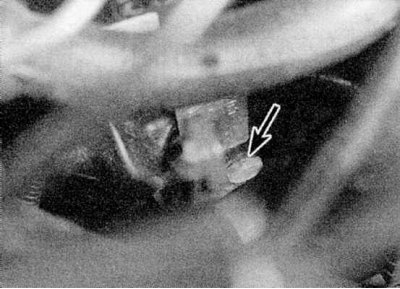
3. To align the timing marks, you need to turn the crankshaft. This can be done with a wrench on the crankshaft pulley bolt. To improve access to the pulley bolt, jack up the front right corner of the car, remove the wheel and remove the wheel arch liner (attached with plastic staples). To make the crankshaft turn more easily, remove the glow plugs (Chapter Engine electrical equipment) or fuel injectors (Chapter Power and exhaust systems).
3. To align the timing marks, you need to turn the crankshaft. This can be done with a wrench on…


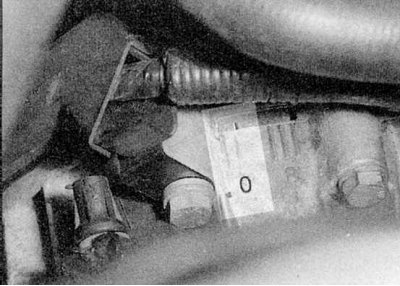
4. Looking through the opening in the clutch housing, turn the crankshaft so that the timing mark on the flywheel aligns with the TDC (0°) mark on the clutch housing (refer to the accompanying illustration).


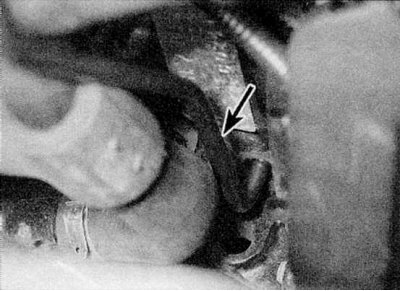
5. On F8Q models, remove the three mounting bolts and the upper plastic drive belt/right engine mount cover from the upper bracket, noting the location of the mounting bolts. On F9Q models, remove the mounting nuts and the sound deadening cover.

5. On F8Q models, remove the three mounting bolts and the upper plastic drive belt/right engine…


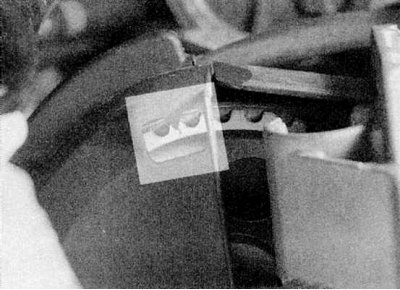
6. Make sure that the timing mark on the camshaft gear is aligned with the pointer on the outside of the drive belt cover (refer to the accompanying illustration). Now piston No.1 is set at TDC on the compression stroke.

7. You can check the position of the crankshaft as follows. If necessary, remove the air cleaner housing assembly (Chapter Power and exhaust systems).
7. You can check the position of the crankshaft as follows. If necessary, remove the air cleaner…


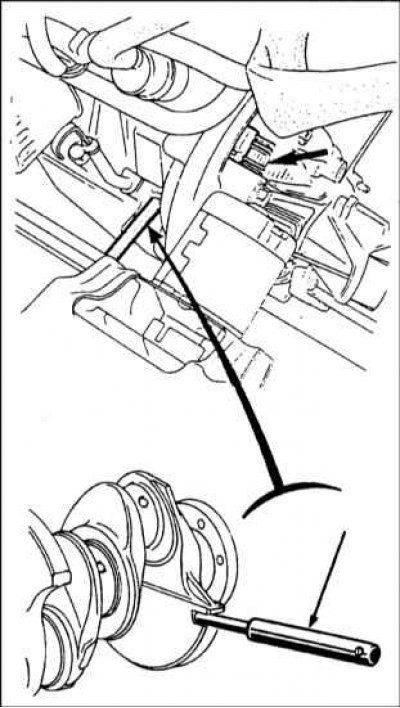
8a. The exact position of the crankshaft can be checked by inserting the locating pin - Renault Mot. 861 tool (early version) or Mot/1054 (the latest version).


8a. The exact position of the crankshaft can be checked by inserting the locating pin - Renault…


8b. To do this, unscrew the plug from the front left end of the cylinder block, next to the base of the oil level dipstick tube.

8b. To do this, unscrew the plug from the front left end of the cylinder block, next to the base of…


8b. Insert the dowel pin until it fits into the groove in the crankshaft. You may have to turn the crankshaft forward or backward slightly (refer to the accompanying illustration).

Note: Do not attempt to rotate the engine with the pin installed. If the engine must be left in this condition for an extended period of time, it is recommended that a warning note be left in the engine compartment.


9. Finally, remove the locating pin and install all removed components.
This article is available on: russian, bulgarian, belarusian, ukrainian, serbian, croatian, romanian, polish, slovak, hungarian
Article has been reviewed by editor: Fedoseev Denis
Share with friends:
Previous
Megane 1: Diesel engines 1.9 l
Next

Description of the compression and tightness test of component…
Diesel engine repair in the engine compartment
1.9 litre diesel engine specifications
Checking and adjusting valve clearances
Removal, inspection and installation of the toothed drive belt
Removal and installation of drive belt gears and tensioner mechanism
Replacing camshaft seals
Removal, inspection and installation of camshaft and tappets
Other articles on other Renault models

➽ Top dead center (TDC) for piston #1 — location Renault Clio 1 (1990-1998)
➽ Setting the piston of the first cylinder to the TDC position of… Renault Logan 1 (2004-2012, petrol)
➽ Setting the piston of the first cylinder to the TDC position of… Renault Sandero 1 (2007-2012, petrol)
➽ Cranking the engine to top dead center (TDC) Renault 19 (1988-1996)
➽ Camshaft Position Sensor Renault Duster 1 (2009-2017)
Link to this article in different formats
Reviews and comments of visitors
No comments yet


Add two numbers 28 + 50


Megan 2 (2002-2009, petrol) 
  • User manual
  • Introduction to manual
  • Controls and instruments
  • Salon equipment
  • Operation and driving
  • Maintenance and care
  • Power unit
  • Engine repair
  • Fuel system
  • Injection system
  • Intake and exhaust system
  • Starting and charging system
  • Cooling system
  • Decreased toxicity
  • Transmission
  • Clutch
  • Mechanical gearbox
  • Automatic gearbox
  • Wheel drive mechanism
  • Chassis, running gear
  • Suspension and wheels
  • Steering
  • Brake system
  • Body and interior
  • Exterior (external elements)
  • Interior (internal elements)
  • Doors, locks and windows
  • Heating and air conditioning
  • Electrical equipment
  • Equipment and devices
  • Headlights and lighting
  • Electrical circuits
Megane 1 (1995-2002) 
  • General information
  • User manual
  • Maintenance
  • Power unit
  • Petrol engines 1.4/1.6 l
  • Petrol engines 2.0 l
  • Diesel engines 1.9 l
  • Overhaul of engines
  • Cooling system
  • Fuel system (petrol)
  • Fuel system (diesel)
  • Decreased toxicity
  • Charge and launch systems
  • Ignition system (petrol)
  • Preheat system (diesel)
  • Transmission
  • Clutch
  • Mechanical gearbox
  • Automatic gearbox
  • Drive shafts
  • Chassis, running gear
  • Brake system
  • Car suspension
  • Steering
  • Body and interior
  • Exterior (external elements)
  • Interior (internal elements)
  • Doors, locks and windows
  • Electrical equipment
  • Equipment and devices
  • Electrical circuits
RenaultBook.ru © 2018–2026 | Mobile version | News and articles | Sitemap: EN BG BY UA RS HR RO PL SK HU | Administration | Site search | Bookmark
Duster 1 (2009-2017) | Fluence 1 (2009-2020, petrol) | Kangoo 1 (1997-2007) | Laguna 2 (2001-2007) | Logan 1 (2004-2012, petrol) | Logan 2 (2012-2020) | Megane 1 (1995-2002) | Megan 2 (2002-2009, petrol) | Sandero 1 (2007-2012, petrol) | Scenic 1 (1996-2003) | Symbol 1 (1999-2008, petrol) | Symbol 2 (2008-2013, petrol) | Renault 19 (1988-1996) | Espace I and II (1984-1996) | Espace III (1996-2002) | Clio 1 (1990-1998) |
We want your visit to be comfortable 😌 and use cookies 🍪 to do so.