



 |
 |
Some repairs require the engine to be installed in a specific position. There are 3 options for this:
1. Raise the Renault 19 as if changing the front wheels and secure it, engage 5th gear and turn the raised front wheels; their movement is transmitted to the engine.
2. Move the car forward a little with 5th gear engaged, making sure that there is a straight section of road in front of the car.
3. Remove the spark plugs (incandescent) — the engine will turn over more easily — and rotate the V-belt pulley of the crankshaft or generator using the appropriate key. This method can be used on Renault 19 with an automatic transmission.
4. If the generator V-belt pulley slips when turned with a wrench, press the V-belt so that it is taut and does not slip.
View the original source on this resource RenaultBook.ru
5. Never crank the engine by turning the camshaft sprocket, as this will stretch the toothed drive belt and may unnoticeably jump over a tooth on the camshaft sprocket.
Note: Recommendation: the engine can only be turned in the direction of rotation, i.e. clockwise. This applies to all Renault 19 engines.
Setting the piston of the 1st cylinder to TDC
To perform some engine and ignition repair work (gasoline engine), and also the high-pressure fuel pump (diesel), the piston of the 1st cylinder must be at the top dead center (TDC). This means that it must be at the top point of the working surface of the cylinder. In a four-stroke internal combustion engine, as well as in a diesel engine, the piston is at TDC twice during each of the 4 strokes. First, when the working mixture ignites, and second, after the exhaust gases are released and the injection of the working mixture or air begins (on a diesel engine). As a rule, in the TDC position, a spark is supplied to ignite the fuel, and on a diesel engine, fuel is injected into the swirl chamber.
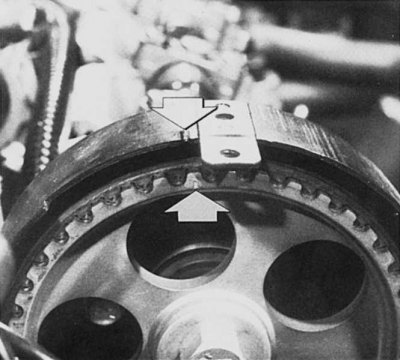
This is how the marks on the timing belt cover and on the camshaft sprocket should match (the picture shows a car with a gasoline engine), so that cylinders 1 and 4 are at TDC. In this case, the piston of the 1st cylinder is in the working stroke position.
Engine type "C"
1. Remove the distributor cap.
2. Crank the engine until the distributor rotor is on the contact of the 1st cylinder.
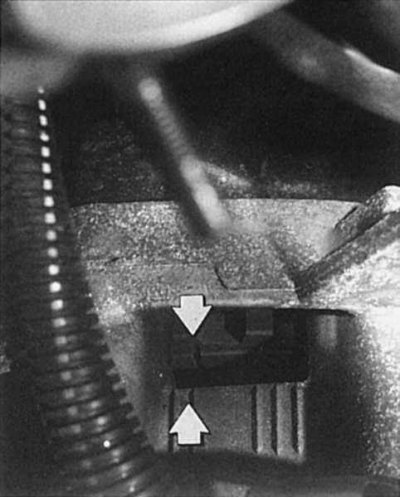
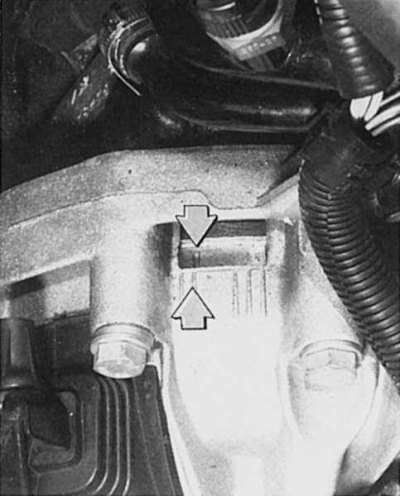
3. If necessary, turn the engine a little further until the 0° mark in the inspection window of the gearbox housing coincides with the mark on the flywheel.
Engine type "F"
1. Turn the engine until the flywheel mark aligns with the mark in the clutch housing hole.
2. Now pistons 1 and 4 are at TDC.
3. Check whether both valve tappets of the 1st cylinder are unloaded. In addition, the corresponding camshaft cams should be directed left and right upwards. To do this, you need to remove the cylinder block cover, how to do this is described in the section Checking and adjusting valve clearance this chapter.
4. If you did everything correctly, then the 1st cylinder is in the TDC position of the working stroke.
5. If not, turn the engine clockwise and check the camshaft position again.
Diesel
1. Engage 5th gear and push the vehicle until the mark on the timing belt cover aligns with the mark on the camshaft timing belt sprocket.
2. Now pistons 1 and 4 are at TDC, with piston 1 at TDC of the working stroke.
3. For control: the cams of the 1st cylinder should look symmetrically from the left and right upwards. To do this, the cylinder head cover must be removed.