



Contents: Pressure value 🠛 Too low pressure 🠛 Finding the cause of the malfunction 🠛 Compression Reduction Control Check 🠛
Measuring the compression in the engine cylinders allows you to determine the degree of tightness of the valves and piston rings. The engine power, easy engine start in cold weather, oil consumption and fuel consumption, as well as the formation of smoke by the diesel engine depend on this. The measurement is performed as follows:
1. Warm up the engine to operating temperature.
2. Turn off the ignition (see chapter Ignition system) and the high voltage wire, unscrew all the spark plugs.
3. On diesel, disconnect the preheating control wire and the engine switch.
4. Also remove the glow plug wires and unscrew the glow plugs.
5. Insert or screw the rubber cone of the compression tester into the spark plug or glow plug hole of cylinder 1 (located to the right in the direction of travel behind the sprocket of the toothed drive belt of the camshaft).
6. Set the parking brake. The manual transmission lever should be in neutral, the automatic transmission switch should be in the "parking" position.
7. On a vehicle with a gasoline engine, have an assistant turn on the starter with the gas pedal fully depressed.
8. On a diesel engine, ask an assistant to simply turn on the starter.
9. Crank the engine with the starter for about 5 seconds until the compression gauge readings stop increasing.
10. Record the measurement result. If using a compression tester with a memory device, proceed to measuring the compression of the next cylinder.
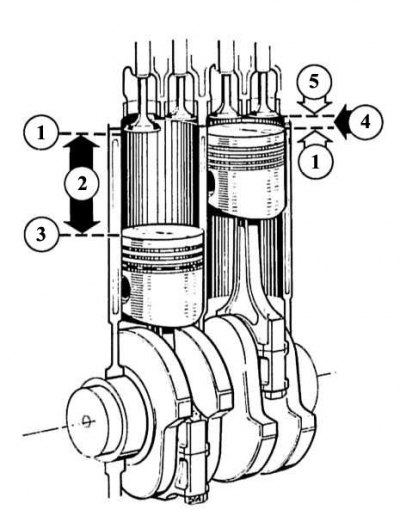
The working volume (2) is the space from the upper (1) to the lower (3) dead center. Between the upper dead center, which is limited on the right cylinder by the piston mirror, and the surface of the cylinder head (5) is the combustion chamber (4).
Pressure value
For accurate compression measurement, it is necessary to pre-adjust the valve clearances as described in the chapter "Adjusting the valve clearance". For normal engine operation, not only the compression ratio is important, but also its equal value in all cylinders. During measurement at the same starter speed, the following values are considered normal:
Engine | Short designation of engine type | Normal compression pressure | Wear limit | Maximum difference in values between cylinders |
1.4 l 1.7 l 1.8 l 16V Diesel | C3J F3N F3P F7P F8Q | 11-13 bar 12-14 bar 12-14 bar 13-16 bar 28-34 bar | 6 bar 8 bar 8 bar 10 bar 24 bar | 3 bar 3 bar 3 bar 3 bar 5 bar |
Too low pressure
Low compression does not necessarily indicate a malfunction. The reason for this may be a discrepancy between the measurement data of different control and measuring devices. It is much worse if the difference between 4 results obtained when measuring the pressure in the cylinders exceeds 3, and on a diesel engine 5 bar. This may be due to:
- wear of pistons and piston rings;
- piston ring sediment due to carbon deposits;
- oval shape of cylinders as a result of piston seizures;
- carbon deposits on valves;
- valve retraction;
- burnt valves due to too small clearance in the valve drive.
Note: Recommendation: In most cases, the cause of low compression is loose valves, which leads to a decrease in engine power. To eliminate the problem, either grind the valves or repair the cylinder head.
Finding the cause of the malfunction
To determine the cause of too low compression, use the following method. Into the spark plug hole (incandescent) pour in some thick oil and measure the pressure again.
- If the pressure is low, the reason is a faulty valve.
- If the pressure has become higher, then the cause of the malfunction is the piston rings and, probably, the cylinders. The poured oil for some time seals the gaps between the piston and the cylinder walls, which leads to an increase in compression.
Compression Reduction Control Check
Source is located on the website www.RenaultBook.ru
More accurate data can be obtained by conducting a control check, which is done in some auto repair shops. The device for measuring compression pressure consists of 2 sections, with one section maintaining constant pressure. The second section is connected by a hose through the spark plug holes (injection holes on diesel) with the combustion chamber, and through the jet with the first section and with the measuring scale. If the combustion chamber being tested loses pressure, this is displayed on the scale. A larger leak can be determined by listening:
- A whistling noise from the exhaust pipe indicates a faulty exhaust valve.
- The release of forced air from the air filter indicates a faulty intake valve.
- If the cylinder head gasket is faulty or the cylinder head is cracked, the forced air will escape from the nearest spark plug hole (incandescent) or from an open expansion tank with coolant.
- If the cylinder walls, piston or piston rings wear out, gases enter the crankcase and exit through the oil dipstick pipe or tube.