
Rear view of the C-engine (looking in the direction of travel)
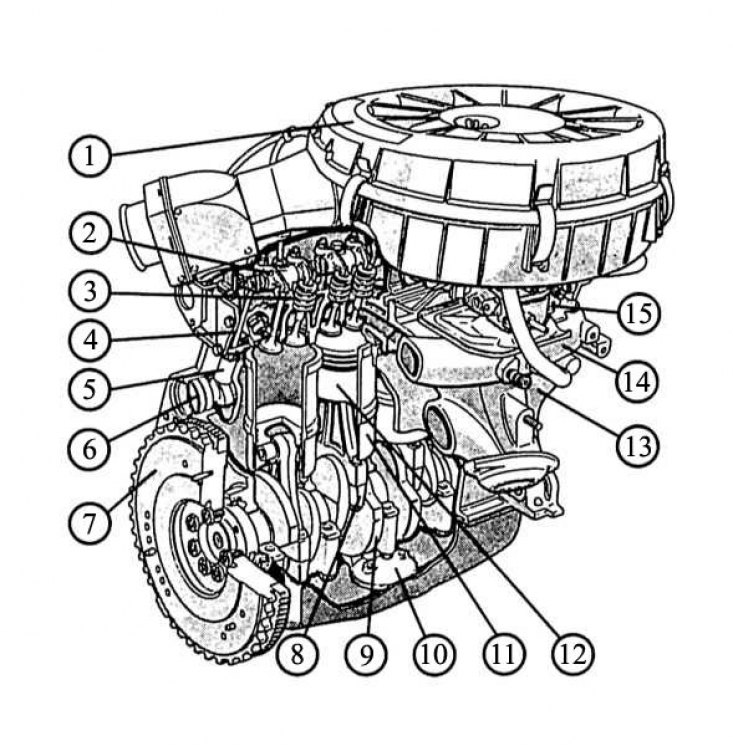
1 - air filter; 2 - rocker arm of the valve gas distribution mechanism; 3 - valve with a spring; 4 - pusher rod; 5 - valve pusher; 6 - camshaft; 7 - flywheel; 8 - connecting rod; 9 - main bearing; 10 - oil inlet pipe of the oil pump; 11 - cylinder sleeve; 12 - pistons; 13 - muffler exhaust manifold; 14 - intake manifold; 15 - carburetor (on the C-engine considered in the book, replaced by an injection system).
Cutaway view of the 1.8-liter F-engine
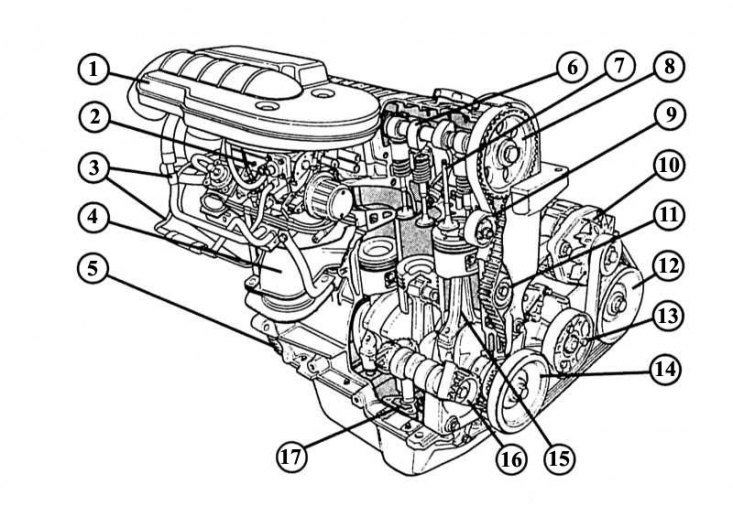
1 - branch pipes of the inlet gas pipeline; 2 - carburetor (on the F-engine considered in the book, it was replaced by an injection system); 3 - pipes for inlet and outlet of air from the engine; 4 - muffler exhaust manifold; 5 - flywheel; 6 - camshaft; 7 - inlet valve; 8 - camshaft timing belt pulley; 9 - tension roller of the toothed belt; 10 - generator; 11 - drive roller of the toothed belt; 12 - servo pump pulley; 13 - coolant pump pulley; 14 - crankshaft pulley; 15 - connecting rod; 16 - additional shaft of the oil pump.
Sectional view of a 16-valve engine
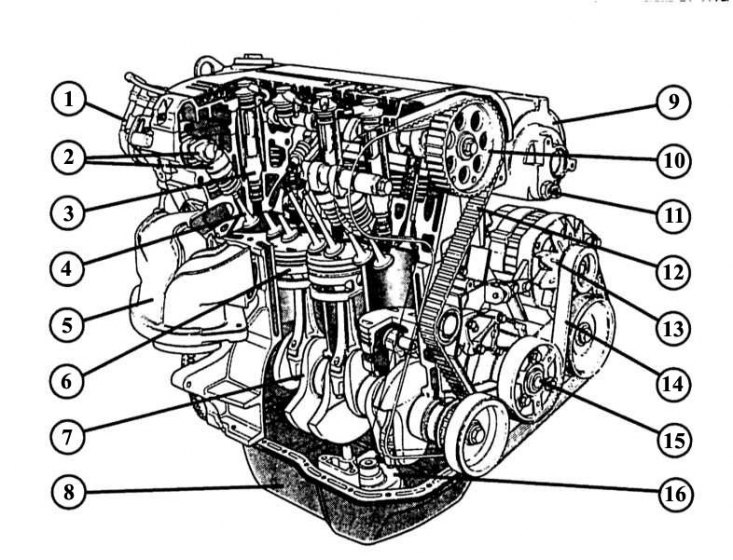
1 - ignition distributor; 2 - camshaft with hydraulic compensators; 3 - spark plugs; 4 - exhaust valve; 5 - exhaust manifold; 6 - piston; 7 - crankshaft; 8 - oil pan; 9 - intake manifold; 10 - intake camshaft pulley; 11 - intake air temperature sensor; 12 - toothed belt; 13 - generator; 14 - V-belt; 15 - coolant pump pulley; 16 - suction neck of the oil pump.
Sectional view of a diesel engine
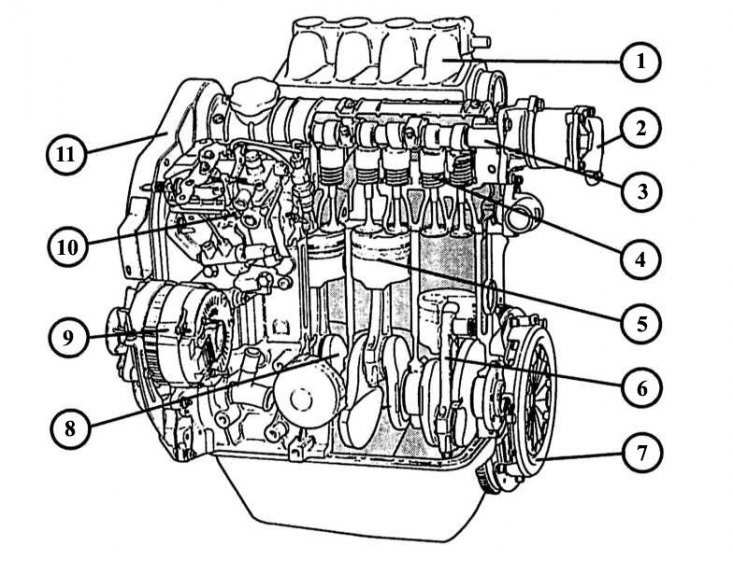
1 - intake manifold; 2 - vacuum pump of the brake booster; 3 - camshaft; 4 - valve with spring and poppet; 5 - pistons; 6 - connecting rod; 7 - flywheel with clutch; 8 - crankshaft; 9 - generator; 10 - high pressure fuel pump (injection pump); 11 - a casing of a gear driving belt.
Engine housing
The body of all the types of engines discussed in this book is made of cast iron. In its lower part is the crankshaft; above - cylinders (four in a row). The cylinders are surrounded by channels for the coolant. These channels are also present in the upper part of the engine.
Crankshaft
It converts the reciprocating motion of the cylinders into rotational. It is connected to the cylinders by means of connecting rods, each of which is attached to the corresponding «knee» shaft through replaceable liners. The alignment of the mass of the eccentric knees and connecting rods is carried out by counterweights.
Connecting rod
For combustion adjustment, the pistons have, depending on the type of engine, different recesses in the top of the piston. In the upper third of each piston there are piston rings, which are elastically fixed in grooves on the piston. They press against the cylinder wall. The two upper piston rings close the path of the gas mixture from the combustion chamber down to the crankcase, and the lower oil scraper ring prevents oil from the crankcase from entering the piston chamber.
Cylinders
On a 1.4 liter engine «WITH» sleeves for pistons are mounted in the bores of the engine cylinders. They are flushed with coolant. Therefore they are called «wet» cylinder liners. The worn liners can be replaced, although the pistons must also be replaced.
Both 1.7-/1.8-litre, 16-valve engines and diesel (F-engine) cylinders are part of the engine body. Sleeves are inserted into the cylinders, which are fitted to the piston diameter. When repairing the engine, the holes are bored a few tenths of a millimeter to eliminate signs of wear. Pistons for bored cylinders must be selected. This is easy to do, as there is a wide choice of their sizes.
Cylinder head gasket
It protects the oil and coolant channels from high pressure from the combustion chambers. One of the most important parts in diesel engines is the cylinder head gasket. Since the gasket separates the cylinder block and the cylinder head, it is possible, depending on its thickness, to vary the height of the combustion chamber and thus compensate for the difference in piston height.
Cylinder head
The cylinder head has a maze of coolant channels. The cylinder head is made of aluminum alloy on all Renault 19 engines. The light metal cylinder head has a high thermal conductivity and therefore provides, especially on a gasoline engine, better cooling of the working mixture. A colder mixture provides more compression. There is no detonation. Depending on the type of engine, the combustion chambers have a different shape. Of particular importance is the absence of protrusions and irregularities in the combustion chamber in order to ensure a high gas flow rate. This allows you to achieve the optimal ratio of air and fuel in the working mixture and achieve complete combustion of the fuel. The mixture flow on the 16-valve engine is arranged according to the principle of cross scavenging, with an inlet at the front and an outlet at the rear of the engine. With cross blowing, the burnt fuel is removed from the combustion chamber faster during the stroke of the power stroke, as it moves along the shortest path. As a result, the suction side cylinders are filled faster with the working mixture - which leads to an increase in engine power.
1.7-, 1.8-liter petrol and diesel engines are equipped with a counterflow cylinder head. With this type of block head, the inlet and outlet ports are on the same side. On Renault 19, this side of the block head faces the front wall of the body. In this regard, the intake of fresh air and the release of exhaust gas are difficult. This, however, has significant advantages for diesel supercharging operation, since the air moves along the shortest path.
Valves
The 1.4-liter C-engine has valves in a row and is actuated by push rods and rocker arms from a camshaft located slightly to the side. On modern F-engines, the camshaft, located at the top of the cylinder head, acts on the valves arranged in a row in the cylinder head directly by means of cup tappets. On a 16-valve engine, there are 2 exhaust and 2 intake valves per cylinder, respectively, which are pressed by twin cams, the glass pushers of which have hydraulic clearance adjustment, which eliminates the need for adjusting the clearance in the valve drive on these engines.
Valve drive
All nodes involved in the opening and closing of valves are called «valve drive». The function of the valves is to open and close the intake and exhaust ports in the cylinder head for the intake of the working mixture or the exhaust gases. At some point, both cylinder valves are closed. In a short period of time, the mixture is ignited by a spark on a car with a gasoline engine or fuel is injected through a nozzle on a diesel engine. With the coordinated operation of the intake and exhaust valves with the movement of the pistons, the engine develops full power.
1.4 liter C-engine
In a C-engine, the camshaft is located slightly to the side of the engine housing. It actuates the valves using push rods and valve levers. The camshaft is mounted in four places and is driven by a short roller chain with a mechanical tensioner. In the center of the camshaft is a gear wheel that drives the ignition distributor and oil pump. High pushers move along the guides of the cams. They operate pushrods, which, with the help of valve levers, actuate valves located in parallel in the cylinder head. The clearance in the valve actuator is set by tightening the rocker bolts.
F-engine: petrol and diesel
On these engines, the camshaft is located in the upper part of the housing and is attached in five places. It is driven by a timing belt from the crankshaft. At the same time, the toothed belt rotates the intermediate shaft of the oil pump. On a diesel engine, this belt also drives the high-pressure fuel pump. The camshaft acts on the valves with the help of glass pushers. The clearance in the valve drive is not adjustable, but is set by replacing the setting plate in the valve lifter cups.
16 valve engine
The 16-valve engine has two camshafts on top of the cylinder head. Each shaft is attached at five points. Both camshafts are driven by a toothed belt from the crankshaft. The toothed belt has a tensioner. At the same time, the toothed belt drives the intermediate shaft for the oil pump.
Each cylinder is equipped with 2 intake and 2 exhaust valves. Valves arranged in a V-shape are actuated by glass tappets with hydraulic clearance adjustment.
Note. Recommendation: with hydraulic (automatic) when adjusting the clearance in the valve drive, manual adjustment is not performed; the valve actuator on the 16-valve engine is not serviced.
Pushrod function with hydraulic gap adjustment
When the valve is closed, oil from the engine lubrication system flows through the annular groove into the poppet. After passing the check valve in the tappet, the oil enters the high pressure chamber and fills it. At the same time, the pressure spring pushes the cup pusher against the camshaft and locks the high pressure chamber cylinder with the end of the valve stem. As the camshaft rotates and its eccentric cam presses against the cam follower, the pressure in the high pressure chamber increases. The check valve closes the inlet and oil cannot escape. Due to the fact that the oil is not compressed, a fixed joint is formed between the pusher and the cylinder. After the valve is closed, a small gap in the valve actuator occurs due to loss of oil, which, however, will immediately be compensated again by the pressure chamber pressure spring. With the check valve open, oil is again supplied to the liberated volume of the chamber. Thus, the hydraulic pusher is ready for operation again.
Camshaft drive chain (C-engine)
Through the drive chain, the crankshaft drives the camshaft. This chain is «the weakest» link in the valve drive, as it is most subject to wear. With increasing mileage, the chain stretches, which is compensated to a certain extent by the chain tensioner. If a chirping sound is heard on a 1.4L C-engine at idle, the cause is the camshaft drive circuit.
Toothed drive belt
An important part of the valve drive on Renault 19 F-engines is a toothed drive belt. The designers of the Renault engine chose this conventional drive train because it has a longer life and is quieter.
Obvious advantage: the toothed drive belt is very flexible, so additional devices can be driven with it (water pump, oil pump, etc.).