English Русский
Български
Беларускі
Український
Српски
Hrvatski
Română
Polski
Slovenský
Magyar
Bookmark Contacts Articles Sitemap
Company vehicles Peugeot Company vehicles Opel Company vehicles Skoda Company vehicles Land Rover Company vehicles Mitsubishi Company vehicles Volkswagen Company vehicles Honda
RenaultBook.ru


Duster   Fluence   Kangoo   Laguna   Logan   Megane   Sandero   Scenic   Symbol   Clio   Other
Renault 19 (1988-1996) Espace I and II (1984-1996) Espace III (1996-2002)

Engine lubrication system (Renault 19)

  • Main
  • Renault
  • Renault 19 (1988-1996)
  • Power unit
  • Engine repair
  • Engine lubrication system
0
Contents: Oil pump 🠛 Oil temperature 🠛

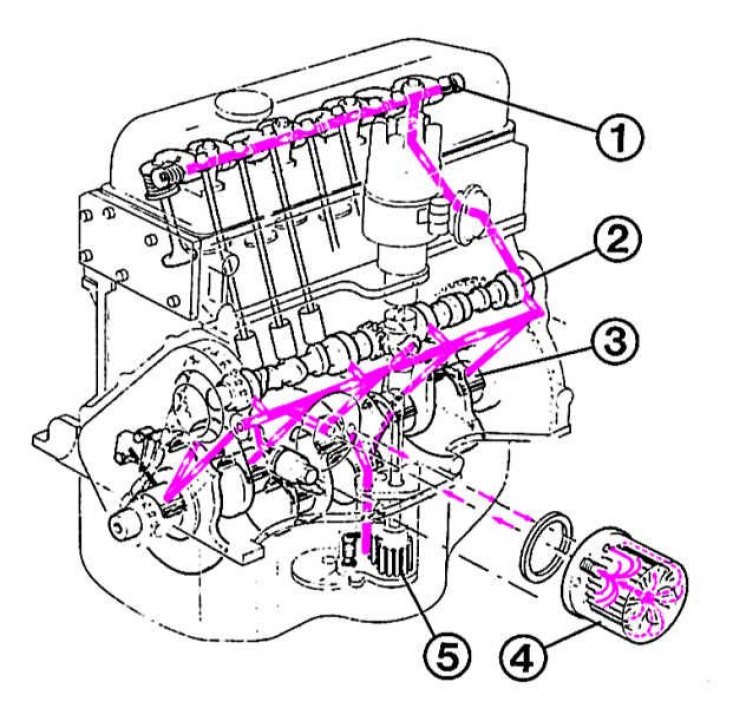
The lubrication system of the F-engine looks the same as that of the C-engine shown in this picture


1 - valve lever axis; 2 - camshaft; 3 - crankshaft; 4 - oil filter; 5 - oil pump with oil suction…

1 - valve lever axis; 2 - camshaft; 3 - crankshaft; 4 - oil filter; 5 - oil pump with oil suction pipe.


In an engine, oil is needed to lubricate the units, bearings and rubbing surfaces. Oil is supplied to these places under pressure. To do this, the oil pump sucks oil through a reinforced oil intake pipe and sends it to the oil filter. If the filter is dirty or has not been replaced in a timely manner, the safety valve starts working. When it opens, the filter is excluded from the oil flow pattern. Unfiltered oil greatly increases bearing wear. From the filter, the oil goes through the main oil line, where the oil pressure sensor is installed, and then through the channels in the engine body to the lubrication points of the crankshaft and camshaft. From the crankshaft, oil is supplied to individual connecting rod bearings. Then the lubricant goes through the oil channels to the oil pan and from there is again taken by the oil pump.


Oil pump


When the throttle valve is fully open, up to 30 liters of oil per minute pass through the engine lubrication system. The oil pump drive is designed differently depending on the engine type:
  • on the C-engine (1.4L) the oil pump is driven by a drive shaft that operates directly from the camshaft.
  • on F-engine (1.7-/1.8 l, 16-valve and diesel) the oil pump is driven by the intermediate shaft toothed drive belt. On both the C-engine and the F-engine, the oil pump with oil suction pipe is located in the oil pan.
  • The Renault 19 is equipped with a gear-type oil pump, in which two identical gears engage when rotating, pumping oil from the oil pan to the lubrication points.

Oil temperature


Oil temperature is essential for efficient engine operation. However, an oil temperature sensor was only installed as standard on the 16-valve Renault 19. The temperature sensor readings can be used to monitor changes in the engine's thermal conditions. Oil temperature is usually measured in the oil filter flange or in the oil pan. The oil temperature is lowest in these areas. In piston rings, for example, the oil temperature can reach 300°C. Temperatures that are too low are more dangerous than temperatures that are too high. At temperatures below 60°C, the oil loses some of its properties, which leads to increased engine wear. Therefore, you should not immediately start a cold engine at more than 3,500 rpm, at least until the oil reaches 60°C. If you do not have an oil temperature sensor, you can use the coolant temperature gauge. Remember that it takes twice as long for the oil to reach operating temperature as for the coolant. Thus, the oil will reach a temperature of about 60°C only after the coolant has completely warmed up.


Oil pressure


At t ~80°C, multi-component oil of viscosity CEET 10 W-30 will have the following characteristics:

Engine
Short designation
1.4 l
C3J
1.7-/1.8 l / 16-valve diesel
F3P/F7P/F8Q
Oil pressure at 750 rpm, bar
At 1000 rpm, bar
At 3000 rpm, bar
At 4000 rpm, bar
0,7
—
—
3,5
—
2,0
3,5
—

The text is available on this website (www.Renaultbook.ru)

Since only the 16-valve Renault 19 is equipped with a tachometer, you can check the pressure values given in the table on other modifications only after installing an oil pressure gauge. If the oil pressure drops below the minimum specified in the table, the oil pressure warning light comes on. If the pressure is too high, due to cold and very viscous oil, the safety valve opens the bypass (oil bypass channel), as a result of which the oil, after passing through the oil pump, returns to the oil intake pipe.

If you want to measure the oil pressure in your engine, unscrew the oil pressure sensor and install a pressure gauge in its place.

Note: Recommendation: After fast driving, the oil pressure at idle may briefly drop below the values specified in the table. This happens because the oil becomes too hot and at the same time very liquid. At the same time, the oil pressure indicator light may start flashing. When you press the gas pedal, the oil pressure increases and the indicator light goes out.
This article is available on: russian, bulgarian, belarusian, ukrainian, serbian, croatian, romanian, polish, slovak, hungarian
Article has been reviewed by editor: Trofimova Anastasia
Share with friends:
Previous
19: Engine repair
Next

Individual engine components
The design and technical characteristics of engines
Engine ventilation system
Inspect the engine for leaks
Running in a new engine
Engine life
Nominal and maximum speed
Other articles on other Renault models

➽ Engine lubrication system oil filter Renault Logan 1 (2004-2012, petrol)
➽ Engine lubrication system — general information Renault Scenic 1 (1996-2003)
➽ General information about the engine lubrication system Renault Symbol 1 (1999-2008, petrol)
➽ Electronic engine start immobilizer system Renault Duster 1 (2009-2017)
➽ Technical characteristics of engines for diagnostic procedures… Renault Fluence 1 (2009-2020, petrol)
Link to this article in different formats
Reviews and comments of visitors
No comments yet


Add two numbers 13 + 45


Renault 19 (1988-1996) 
  • General information
  • Maintenance
  • Power unit
  • Engine repair
  • Exhaust system
  • Cooling system
  • Supply system
  • Single-point injection
  • Multi-point injection
  • Diesel injection system
  • Transmission
  • Clutch
  • Car gearbox
  • Chassis, running gear
  • Car suspension
  • Steering
  • Brake system
  • Wheels and tires
  • Body and interior
  • Exterior (external elements)
  • Interior (internal elements)
  • Heating and ventilation
  • Electrical equipment
  • Equipment and devices
  • Headlights and lighting
  • Ignition system
  • Power devices
  • Electrical circuits
Espace I and II (1984-1996) 
  • General information
  • Introduction to the guide
  • Troubleshooting
  • Power unit
  • Engine repair
  • Cooling system
  • Carburetor fuel system
  • Injection fuel system
  • Diesel fuel system
  • Ignition system
  • Transmission
  • Clutch
  • Car gearbox
  • Drive shafts
  • Chassis, running gear
  • Brake system
  • Steering
  • Front suspension
  • Rear suspension
  • Body and interior
  • Exterior (external elements)
  • Interior (internal elements)
  • Doors, locks and windows
  • Electrical equipment
  • Equipment and devices
  • Electrical circuits
Espace III (1996-2002) 
  • General information
  • Introduction to the manual
  • User manual
  • Power unit
  • Petrol engines F3R
  • Petrol engines Z7X
  • Diesel engines G8T
  • Diesel engines G9T
  • Transmission
  • Clutch
  • Mechanical gearbox
  • Automatic gearbox
  • Drive shafts
  • Chassis, running gear
  • Steering
  • Front suspension
  • Rear suspension
  • Brake system
  • Body and interior
  • Exterior (external elements)
  • Interior (internal elements)
  • Doors, locks and windows
  • Heating and ventilation
  • Electrical equipment
  • Equipment and instruments
  • Power devices
  • Electrical circuits
RenaultBook.ru © 2018–2026 | Mobile version | News and articles | Sitemap: EN BG BY UA RS HR RO PL SK HU | Administration | Site search | Bookmark
Duster 1 (2009-2017) | Fluence 1 (2009-2020, petrol) | Kangoo 1 (1997-2007) | Laguna 2 (2001-2007) | Logan 1 (2004-2012, petrol) | Logan 2 (2012-2020) | Megane 1 (1995-2002) | Megan 2 (2002-2009, petrol) | Sandero 1 (2007-2012, petrol) | Scenic 1 (1996-2003) | Symbol 1 (1999-2008, petrol) | Symbol 2 (2008-2013, petrol) | Renault 19 (1988-1996) | Espace I and II (1984-1996) | Espace III (1996-2002) | Clio 1 (1990-1998) |
We want your visit to be comfortable 😌 and use cookies 🍪 to do so.