



Contents: Disassembling the camshaft 🠛 Hydraulic compensators for 16-valve…🠛 Disassembling the cylinder head 🠛 Checking the cylinder head 🠛 Installing the cylinder head 🠛 Cylinder head tightening torques 🠛
Elements of the valve timing mechanism on a 1.8-liter engine
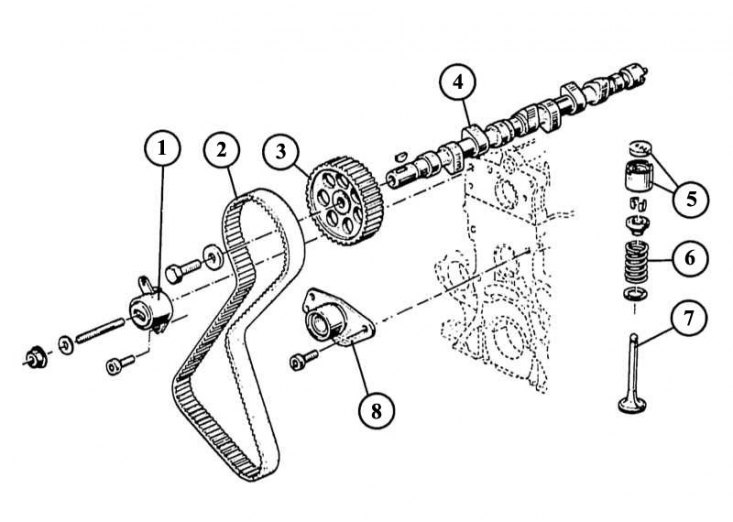
1 - Timing belt tension roller; 2 - toothed drive belt; 3 - Timing belt pulley of the camshaft drive; 4 - camshaft; 5 - cup pusher with adjusting washer; 6 - valve spring with small parts (for example, valve stem gasket); 7 - valve; 8 - toothed belt guide roller.
Elements of the diesel engine valve timing mechanism
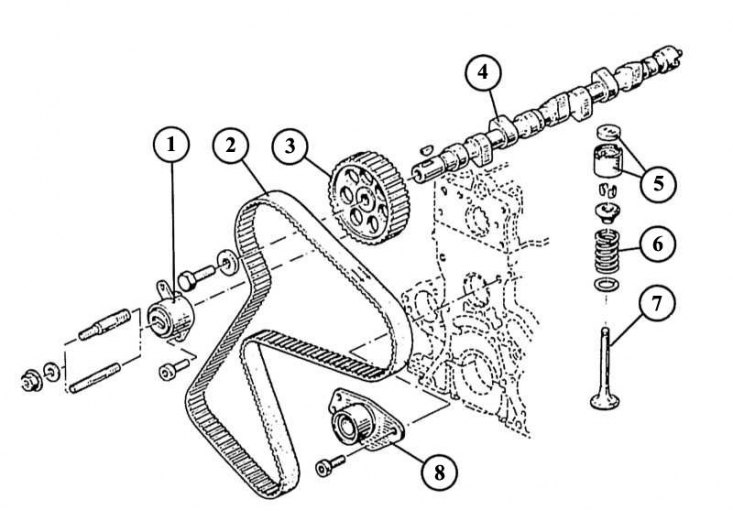
1 - Timing belt tension roller; 2 - toothed drive belt; 3 - camshaft timing belt sprocket; 4 - camshaft; 5 - cup pusher with adjusting washer; 6 - valve spring with components; 7 - valve; 8 - guide roller of the toothed drive belt.
Valve timing mechanism of 16V engine
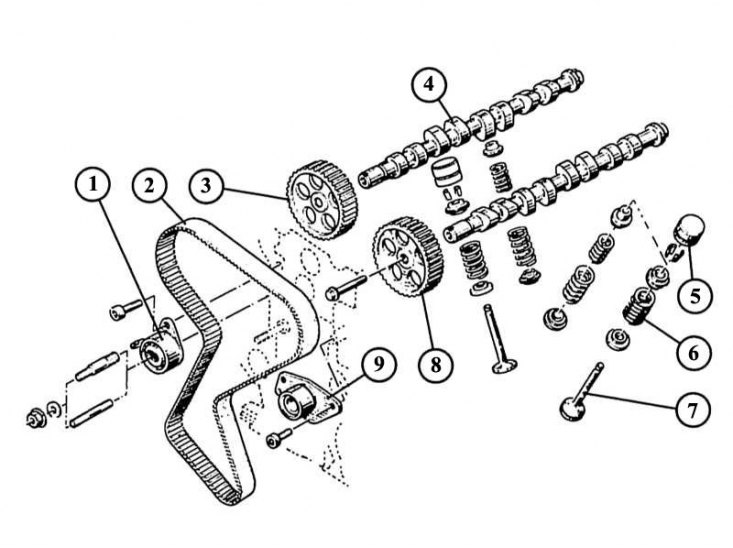
1 - Timing belt tension roller; 2 - toothed drive belt; 3 - sprocket of the toothed belt of the exhaust camshaft; 4 - exhaust camshaft; 6 - Double valve spring with components; 7 - valve; 8 - intake camshaft timing belt sprocket; 9 - toothed belt guide roller.
To perform repair and maintenance work on the cylinder head, you must have at least one assistant. For the work described below, you must have a torque wrench (torque wrench).
Disassembling the camshaft
Engines type "F" except 16-valve
If the camshaft is removed on the cylinder head that is not removed, then the work performed also includes removing the timing belt. In addition, the injection moment of the high-pressure fuel pump must be adjusted again for a diesel engine. The work is carried out in exactly the same way on a 16-valve engine, but with a greater volume and degree of complexity compared to an F-engine, so it is best to repair a 16-valve engine in a car repair shop.
1. Secure the camshaft timing belt pulley using a #10 socket wrench or screwdriver inserted into one of the pulley holes.
2. Unscrew the central bolt securing the camshaft pulley.
3. Using light blows from a plastic hammer, separate the timing belt pulley from the conical seat of the camshaft.
4. Remove the camshaft spring washer.
5. Remove the ignition distributor (for gasoline engines) or, respectively, the brake booster vacuum pump (for diesel).
6. Number the camshaft bearing caps using a punch or chalk (for subsequent assembly).
7. Remove bearing caps 1, 3 and 5.
8. Loosen the nuts of bearing caps 2 and 4 alternately in a crosswise pattern.
9. Remove the camshaft from the cylinder head.
10. When you remove the valve lifters, mark them together with the associated adjusting washers (it is also necessary to record the dimensions of the adjusting washers). This is very important for subsequent assembly!
11. Before assembly, lubricate the working surfaces.
12. Install the camshaft so that the cams of cylinder No.1 face upward symmetrically.
13. Install the bearing caps according to the sequence noted during disassembly. Tighten the 6 mm bolts to 10 Nm and the 8 mm bolts to 20 Nm.
14. Install the camshaft timing belt sprocket - remember to install the woodruff key and tighten the centre bolt to 50 Nm.
15. Further work is carried out in the reverse order of the disassembly process.
16. Check the valve clearance and adjust it if necessary.
Note. Recommendation: apply a sealant (e.g. Curil) to the darker areas of bearing caps 1 and 5.
Make sure that the working surfaces of the camshaft bearings and bearing caps are not damaged.
Hydraulic compensators for 16-valve engine
Valve knocking
Valve knocking in a 16-valve engine indicates a malfunction of one or more hydraulic compensators. Valve knocking may also occur with properly functioning hydraulic compensators if:
- after starting the engine, oil does not immediately flow into the hydraulic compensator;
- the engine has been running at high speeds for a long time at high ambient temperatures, and the engine oil has become liquid;
- the car has not been used for a long time. After the engine warms up, the knocking should stop.
Determining the malfunction of hydraulic compensators
- start the engine and let it run until the electric fan of the engine cooling system turns on;
- increase the speed to 2000 rpm;
- if the valve knocking does not stop, turn off the engine and remove the cylinder head cover;
- install 1st cylinder (as when adjusting the valve clearance) to the TDC position. The camshaft cams should point up to the left and right;
- press the hydraulic compensator being tested with a wooden rod. If it is pressed through more than 0.1 mm, it must be replaced.
Disassembling the cylinder head
1. All engines: disconnect the ground wire from the battery terminal.
2. Remove the air filter.
3. Drain the coolant into a clean container, see chapter Cooling system.
4. Drain the oil from the engine.
5. Disconnect the electrical wires from the terminals and mark them for subsequent reassembly.
6. Disconnect the front exhaust pipe from the muffler exhaust manifold and from the main muffler.
7. Gasoline engines: Disconnect the fuel hoses from the injection system and plug them. Be careful! The fuel system is under pressure.
8. Remove the brake vacuum hose from the intake manifold. Replace the hose clamp when reassembling.
9. Diesel: disconnect the fuel recirculation hoses going to the high pressure fuel pump from the injectors.
10. Disconnect the fuel lines from the high pressure fuel pump and injectors and place them on a clean piece of cloth.
11. Plug the holes of the high-pressure fuel pump and injectors with small plugs made of soft material.
12. Remove the brake booster vacuum pump.
13. Remove the filter with the heating device. Disconnect the heated air supply hoses with the bracket from the engine.
14. Disconnect the engine ground wire.
15. Unscrew the lower bolts of the generator casing.
16. Turbocharged diesel: Disconnect the pipes going to the radiator and charge air cooler.
17. Remove the turbocharger air duct brackets from the engine.
18. Remove the air supply and outlet brackets from the exhaust manifold, muffler and turbocharger.
19. Remove the air ducts from the charge air cooler.
20. If a spacer is installed between the shock absorber struts, it must be removed.
21. Diesel and turbocharged diesel: place the engine on a support. For this purpose, workshops specialising in Renault use a spacer (Part # 1159-02), which is installed in front of the right drive shaft between the side member and the projection of the engine housing casting. If this device is not available, place the engine on a suitable support.
22. Also, to support the engine, a sheet of iron is installed, which has 2 holes, through which it is fastened next to the water pump between the engine body and the right side member. In auto repair shops, the Mot. 1159 tool is used for this purpose.
23. Type "F" engines: remove the cylinder head cover.
- remove the timing belt as described.
- remove the rear timing belt cover.
- unscrew the thermostat mount on the cylinder head.
- remove the thermostat, see chapter Cooling system.
- "F" type petrol engine with multi-point injection: remove the intake manifold assembly from the intake manifold. To do this, unscrew the 5 nuts and carefully remove the distribution pipe. Be careful not to damage the gasket.
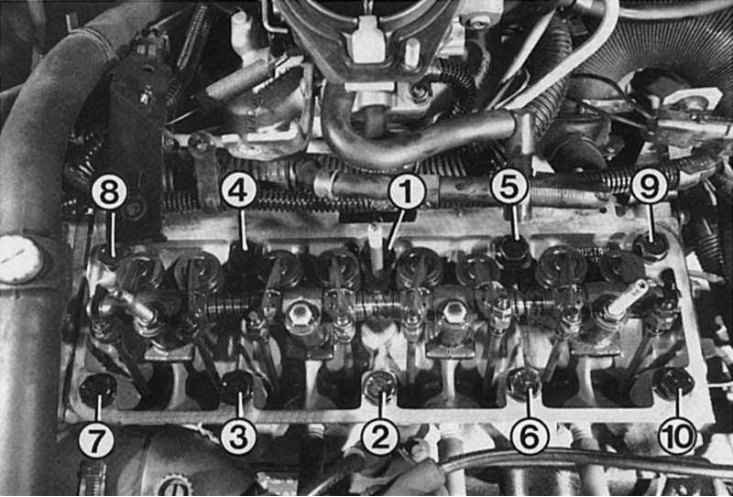
Cylinder head of the engine type "C". To avoid distortion of the cylinder head made of light metal, it is necessary to strictly follow the tightening sequence of the bolts securing the cylinder head during installation. The required tightening force is achieved in several stages (see table).
24. Pull the suction manifold forward out of the work area, making sure that the supply hoses do not become disconnected.
25. Remove the throttle linkage (throttle cable).
26. Remove the radiator, see chapter Cooling system.
27. Diesel and turbocharged diesel: Disconnect the glow plug wires.
28. Unscrew the balanced suspension fasteners from the self-aligning bearing and engine housing. At the same time, mark the position of the threaded connections to facilitate subsequent assembly.
29. Turbodiesel: Disconnect the threaded connections of the oil supply to the turbocharger.
30. Remove the coolant supply hoses to the turbocharger.
31. Engine type "C": disconnect the coolant hoses from the water pump and mark them for reassembly.
[Original publication on the website renaultbook]
32. Remove the three-phase alternator, see. Generator.
33. Remove the high tension wires from the spark plugs.
34. Remove the ignition distributor, see chapter Ignition system.
35. Remove the air hoses from the intake manifold.
36. Remove the throttle linkage.
37. Remove the cylinder head cover (3 nuts).
38. Remove the rocker shaft. To do this, remove the bearing mount (2 screws with washers and 2 spacer bolts).
39. Remove the valve levers and fold them in the order of removal so as not to mix up their order during assembly.
40. Unscrew the 10 cylinder head mounting bolts in the sequence opposite to their tightening, except for bolt No.2 (is located next to the ignition distributor) from the cylinder head.
41. Move the cylinder head by rotating it horizontally around bolt No.2.
42. If the cylinder head is stuck, loosen it by hitting it hard with a wooden hammer.
43. After this, unscrew bolt No.2 and carefully remove the cylinder head together with the intake and exhaust manifolds.
44. To protect cylinder liners from scuffing, auto repair shops use a cylinder liners retainer (Mot. 521-01).
45. 16-valve engine: remove the exhaust manifold muffler heat shield from the front wall. Unscrew the 2 exhaust manifold muffler bolts.
46. Remove the cylinder head mounting bolts (TORX-Stecknu in E12 and, accordingly, E 55) in 2 stages in the reverse order of tightening. In this case, first loosen the fastening bolts halfway and only then unscrew them completely.
47. Engine type "F": remove the cylinder head.
48. If the cylinder head is stuck, insert a wedge made of hard wood and tap it lightly to remove the cylinder head.
49. All engines: After removal, install the cylinder head in such a way as to avoid damage to the exposed valves.
50. Remove the old cylinder head gasket.
51. The contact surfaces of the engine housing and the cylinder head must be absolutely clean. Do not damage the soft surface of the cylinder head and its gasket.
52. After cleaning the surface, remove burrs from the edges of the combustion chambers. You can use sandpaper for this. Do not damage the edges of the combustion chamber with a hard tool. The cleaned surface should not have any damage.
Note: Recommendation: When removing the cylinder head, do not damage the sealing areas of the cylinder liners.
On a type "C" engine, the tappet rods on the adjusting bolt side and on the valve tappet side must have a uniform surface. If the mating areas are damaged, the tappet rods must be replaced.
Checking the cylinder head
1. Check the cylinder head for cracks, worn valves or spark plug threads.
2. Cracks no more than 0.5 mm thick or stripped initial threads of spark plugs do not affect the service life.
3. Check the cylinder head for distortion if the engine has overheated, for which:
4. Place a rigid metal ruler on the contact surface of the cylinder head with the engine body.
5. When checking with a feeler gauge, the deflection should not exceed 0.05 mm. Otherwise, the cylinder head must be replaced, since end grinding is unacceptable.
Note: Recommendation: when cleaning the cylinder head, ensure that no sealing gasket residue gets into the rocker shaft lubrication channels. This also applies to the channels in the engine housing. Never remove sealing gasket residue with a knife or scraper, as scratches may damage the surface of the cylinder head. Renault workshops use a cleaning agent for this purpose "Decap-joint". When using this product, the softened remains of the gasket are removed with a wooden spatula.
Installing the cylinder head
1. The threads of the cylinder head mounting bolts and the threads in the holes for them in the engine body must not be damaged.
2. If the threads are damaged, screw in new cylinder head mounting bolts.
3. To prevent loosening, there must be no oil or water in the engine housing bolt holes under any circumstances.
4. If the crankshaft has turned after disassembling the cylinder head, turn it so that none of the pistons are at TDC, otherwise the open valve may collide with the piston when installing the cylinder head.
5. Use centering sleeves.
6. Install a new cylinder head gasket without applying sealant so that the lubrication channels are not blocked.
7. Install the cylinder head, after checking that the centering sleeves are correctly positioned in the engine housing, and screw in the oiled bolts by hand.
8. Tighten the cylinder head bolts in the order shown in the illustration to the specified torque.
9. Engine type "C": Install the push rods, lubricated at both ends, into the guide bushings. Replace worn push rods if necessary.
10. Install the rocker arm shaft, making sure the valve adjusting bolts fit into the guide bushings.
11. Tighten the rocker arm axle support bolts to a torque of 15–20 Nm.
12. 16-valve engine: If there are no centering sleeves, screw two old cylinder head mounting bolts into the holes of bolts No.8 and 10 (pre-saw off the heads of these bolts and cut a slot for a screwdriver). After installing the cylinder head, screw in the remaining 8 bolts. After that, replace the centering bolts with two new ones.
13. Engine type "F": Install the rear timing belt cover.
14. Install the toothed drive belt and adjust its tension.
15. All engines: Adjust the valve clearance.
16. The remaining work is carried out in exactly the same way as during dismantling, only in reverse order.
Note: Recommendation: Cylinder head bolts are used only once.
Diesel engines use three types of sealing gaskets of varying thickness, depending on how far the pistons extend. To distinguish between the different types of gaskets, they have a marking in the upper left corner consisting of one, two or three dots. Make sure that the new cylinder head gasket has the same marking as the old one.
If the cylinder head gasket has an adhesive layer, then after removing it, it is necessary to install a new gasket.
Cylinder head tightening torques
Engine | 1.4 litre engine (C3J) | 1.7 liter engine (F3N) 1.8 liter engine (F3P) diesel (F8Q) | 16-valve engine (F7P) |
| 1. Step | Mounting bolts | Mounting bolts | Mounting bolts |
2. Step | — | no. 1-10 tighten to 70 Nm after at least 3 minutes pauses, bolts: | no. 1-10 tighten to 50 Nm |
3. Step | — | #1-10 loosen completely | after at least a 3-minute pause, the bolts: |
4. Step | — | no. 1-10 tighten to 25 Nm | #1-10 loosen completely |
5. Step | — | no. 1-10 turn further by 123 2° | no. 1-10 tighten to 20 Nm |
Tightening of the cylinder head mounting bolts, measured in angular degrees, must be done with a protractor key. A key without a protractor must be equipped with a homemade cardboard scale on which the angular degrees must be applied.