



Contents: Removal the distributor cap 🠛 Checking the ignition distributor…🠛 Removal the ignition distributor 🠛 Checking the speed sensor 🠛 Checking the pressure sensor 🠛
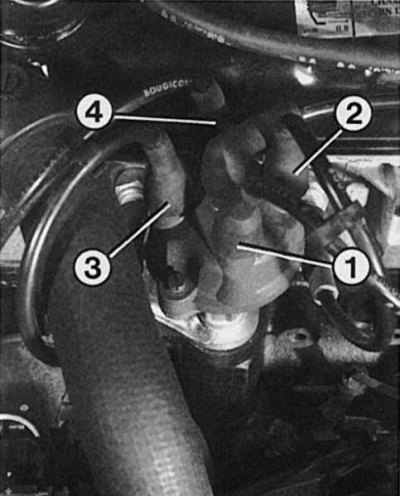
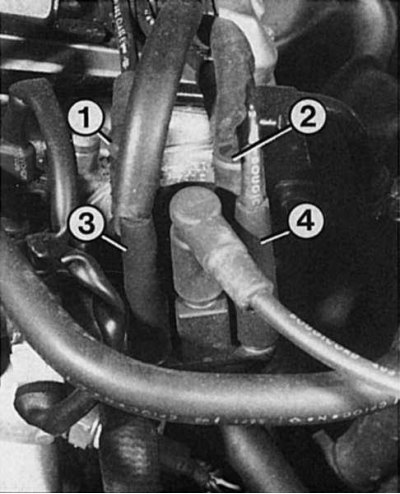
The figure shows the order in which the high-voltage wires are connected to the distributor cap: on the left is a type "C" engine; on the right is the ignition distributor of a 16-valve engine. All Renailt 19 engines have the same firing order. You can mark the wires and sockets on the distributor cap with the cylinder numbers - then you will avoid confusion when connecting them. Newer cars already have the cylinder numbers on the high-tension wires.
 |
 |
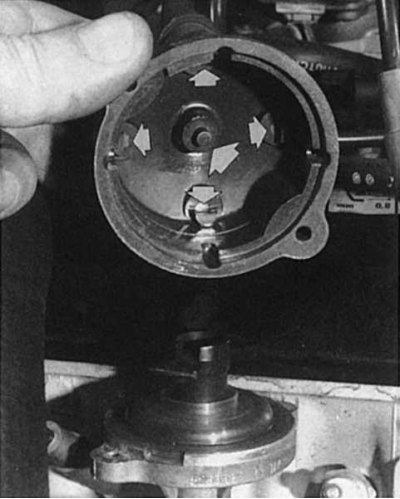
When servicing the distributor cap, limit yourself to determining wear on the contacts indicated by small arrows; state and mobility of the sliding graphite contact (arrow in the center) and scratches on the lid.
 |
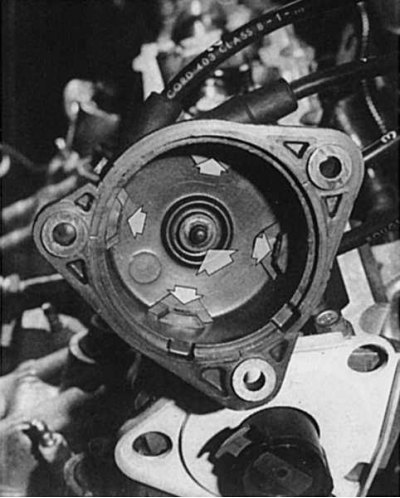 |
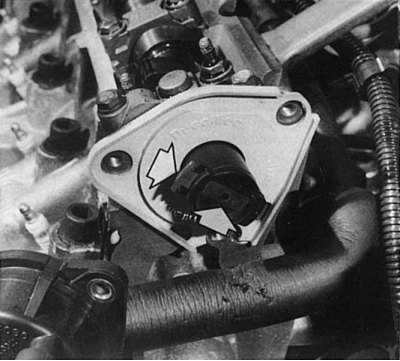
Arrows indicate the places on the ignition distributor rotor that should be checked if traces of carbon deposits are found. When purchasing a spare ignition distributor rotor, please note that if you had a glued rotor, you should buy the same one, and vice versa, do not confuse the ignition distributor rotor that is put on with a thrust ring with the glued rotor. When installing the dust cap, please note that it is correctly positioned in the distributor housing.
In the IEZ ignition system of Renault 19, the ignition distributor serves only to distribute the discharges produced by the ignition coil to the cylinders. At the same time, the rotor rotating in the ignition distributor cap supplies high-voltage electric current in accordance with the ignition order of the engine to the spark plugs.
Removal the distributor cap
1. Remove both TORX (T20) screws from the distributor cap.
2. Remove the distributor cap, leaving the high-voltage wires attached.
3. Remove the distributor rotor.
4. Remove the dust covers located inside.
5. When installing, install the dust cover so that its retaining protrusion fits into the recess in the edge of the distributor housing.
Article reprinted from the website [www.RENAULTBOOK.ru]
6. The ignition distributor rotor has a welded bulge that should fit into the recess in the ignition distributor shaft.
7. There is a lug on the distributor cap to prevent rotation, which must be properly inserted into the groove before the screws are tightened.
Checking the ignition distributor rotor and ignition distributor
1. Remove the distributor cap. It must be clean inside and out so that dirt or moisture does not interfere with the flow of current in the ignition system.
2. Wipe off any scale on the contacts.
3. Are the contact points oxidized? (copper corrosion)?
4. Clean and check that the distributor rotor does not move too far from the contacts.
5. The marks on the distributor cap, as if drawn with a pencil, are traces of carbon deposits from the leakage current, which broke through dirt or moisture and then burned this place.
6. As a temporary remedy, you can clean these areas with a screwdriver or knife and cover them with universal glue, nail polish, or, as a last resort, lipstick.
7. The carbon contact in the center of the lid should be slippery and shiny, easy to press and return to its original position without jamming.
8. The contact tongue and the bulge of the central contact of the ignition distributor rotor must not be burnt.
9. Finally, check once again that the rotor safety protrusion is installed correctly so that it can be placed on the distributor shaft.
Note. Recommendation: there are ignition distributors in which the distributor rotor is glued to the distributor shaft. This rotor should never be knocked off the shaft, but you should try to swing it with pliers and remove it without damage. The ignition distributor rotor should be glued after cleaning the gluing area with heat-resistant glue (up to 120°C).
Removal the ignition distributor
1. Disconnect the ground cable from the battery.
2. Mark the position of the ignition distributor relative to the engine body by making a scratch with a screwdriver.
3. Unscrew the mounting bolts (TORX T 40) from the cylinder head and remove the ignition distributor.
4. During installation, the ignition distributor must be installed in the same position as before disassembly.
Checking the speed sensor
1. If you think the speed sensor is the cause of the malfunction, you must first measure the distance between it and the flywheel.
2. To do this, insert a feeler gauge between the flywheel and the sensor. The gap should be 1.0-0.5 mm.
3. To further check, disconnect the speed sensor pin connector from the ignition module.
4. Measure the resistance in both pin contacts. It should be 200-50 Ohms.
Checking the pressure sensor
As already mentioned, the control unit receives data on the pressure in the intake manifold as electrical signals from the pressure sensor.
1. To check, remove the pressure sensor hose and close it.
2. Ask an assistant to start the engine and let it run at medium speed (about 2000 rpm.).
3. When the rotation speed is uniform, reconnect the hose.
4. Since air is sucked in from the intake pipe through the hose, the ignition timing should change and, accordingly, the engine speed should increase without pressing the gas pedal.
5. If the engine does not increase speed, then either the hose is leaky or the pressure sensor is faulty.