
English Русский
Български
Беларускі
Український
Српски
Hrvatski
Română
Polski
Slovenský
Magyar
Bookmark Contacts Articles Sitemap
Company vehicles Peugeot Company vehicles Opel Company vehicles Skoda Company vehicles Land Rover Company vehicles Mitsubishi Company vehicles Volkswagen Company vehicles Honda
RenaultBook.ru


Duster   Fluence   Kangoo   Laguna   Logan   Megane   Sandero   Scenic   Symbol   Clio   Other
Renault 19 (1988-1996) Espace I and II (1984-1996) Espace III (1996-2002)

Checking the ignition coil (Renault 19)

  • Main
  • Renault
  • Renault 19 (1988-1996)
  • Electrical equipment
  • Ignition system
  • Checking the ignition coil
0
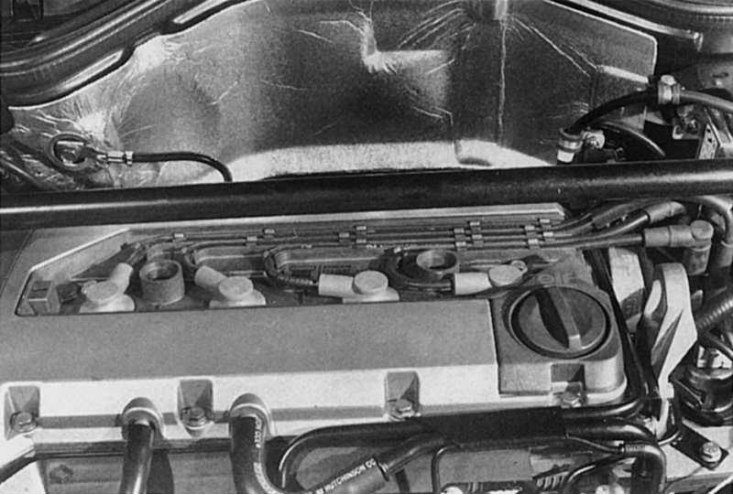
The spark plug wires on the 16-valve Renault 19 are well secured and completely protected from vibration. This reduces the likelihood of a malfunction due to spark plug wires. If oil or water gets on the wires or tips (especially salty), then this may cause breakdowns in the wire.

To prevent confusion when connecting wires, later modifications of Renault 19 have numbers applied, so that the possibility of incorrectly connecting high-tension wires to the ignition coil or spark plug wires is almost excluded.
Measuring the voltage between the «+» terminal and ground; it should be at least 9.5 V.

  • Measuring the voltage between the "+" terminal and ground; it should be at least 9.5 V.
  • Measuring resistance: With the ignition off, remove all wires from the ignition coil.
  • Using an ohmmeter with a measurement range of 0-1 Ohm and 1-10 k Ohm, measure the resistance between the ignition coil terminals "-" and "+" (primary winding). The resistance value should be 0.6-0.2 Ohm.
  • The measurement result on the secondary winding should be 2-12 k.
  • These measurements cannot be used to determine a short circuit in the ignition coil.
  • If there is not enough secondary voltage in the ignition system, although the ignition module and control unit are in good working order, then the ignition coil must be replaced.

Removal the ignition coil


Although the ignition coil is combined with the ignition module into a single unit, it can be replaced separately in the event of a malfunction.


Information is located on the website: renaultbook.ru

1. Disconnect the ground cable from the battery.

2. Remove the connectors from the ignition coil.

3. Disconnect the ignition coil high-tension central wire. To do this, unhook both safety hooks.

4. Remove both TORX screws and remove the ignition coil from the ignition module.
This article is available on: russian, bulgarian, belarusian, ukrainian, serbian, croatian, romanian, polish, slovak, hungarian
Article has been reviewed by editor: Trofimova Anastasia
Share with friends:
Previous
19: Ignition system
Next

Ignition coil
Troubleshooting the ignition system
Ignition interlock
Safety precautions when working with ignition lEZ
Ignition system device
Ignition distributor
High voltage wires
Firing order
Checking spark plugs
Spark plug characteristics
Other articles on other Renault models

➽ Checking the ignition system Renault Logan 1 (2004-2012, petrol)
➽ Replacing spark plugs and checking the ignition system Renault Megane 1 (1995-2002)
➽ Checking the ignition switch (lock) Renault Sandero 1 (2007-2012, petrol)
➽ Ignition coil — removal and installation Renault Clio 1 (1990-1998)
➽ Ignition key positions Renault Duster 1 (2009-2017)
Link to this article in different formats
Reviews and comments of visitors
No comments yet


Add two numbers 32 + 50


Renault 19 (1988-1996) 
  • General information
  • Maintenance
  • Power unit
  • Engine repair
  • Exhaust system
  • Cooling system
  • Supply system
  • Single-point injection
  • Multi-point injection
  • Diesel injection system
  • Transmission
  • Clutch
  • Car gearbox
  • Chassis, running gear
  • Car suspension
  • Steering
  • Brake system
  • Wheels and tires
  • Body and interior
  • Exterior (external elements)
  • Interior (internal elements)
  • Heating and ventilation
  • Electrical equipment
  • Equipment and devices
  • Headlights and lighting
  • Ignition system
  • Power devices
  • Electrical circuits
Espace I and II (1984-1996) 
  • General information
  • Introduction to the guide
  • Troubleshooting
  • Power unit
  • Engine repair
  • Cooling system
  • Carburetor fuel system
  • Injection fuel system
  • Diesel fuel system
  • Ignition system
  • Transmission
  • Clutch
  • Car gearbox
  • Drive shafts
  • Chassis, running gear
  • Brake system
  • Steering
  • Front suspension
  • Rear suspension
  • Body and interior
  • Exterior (external elements)
  • Interior (internal elements)
  • Doors, locks and windows
  • Electrical equipment
  • Equipment and devices
  • Electrical circuits
Espace III (1996-2002) 
  • General information
  • Introduction to the manual
  • User manual
  • Power unit
  • Petrol engines F3R
  • Petrol engines Z7X
  • Diesel engines G8T
  • Diesel engines G9T
  • Transmission
  • Clutch
  • Mechanical gearbox
  • Automatic gearbox
  • Drive shafts
  • Chassis, running gear
  • Steering
  • Front suspension
  • Rear suspension
  • Brake system
  • Body and interior
  • Exterior (external elements)
  • Interior (internal elements)
  • Doors, locks and windows
  • Heating and ventilation
  • Electrical equipment
  • Equipment and instruments
  • Power devices
  • Electrical circuits
RenaultBook.ru © 2018–2026 | Mobile version | News and articles | Sitemap: EN BG BY UA RS HR RO PL SK HU | Administration | Site search | Bookmark
Duster 1 (2009-2017) | Fluence 1 (2009-2020, petrol) | Kangoo 1 (1997-2007) | Laguna 2 (2001-2007) | Logan 1 (2004-2012, petrol) | Logan 2 (2012-2020) | Megane 1 (1995-2002) | Megan 2 (2002-2009, petrol) | Sandero 1 (2007-2012, petrol) | Scenic 1 (1996-2003) | Symbol 1 (1999-2008, petrol) | Symbol 2 (2008-2013, petrol) | Renault 19 (1988-1996) | Espace I and II (1984-1996) | Espace III (1996-2002) | Clio 1 (1990-1998) |
We want your visit to be comfortable 😌 and use cookies 🍪 to do so.