
English Русский
Български
Беларускі
Український
Српски
Hrvatski
Română
Polski
Slovenský
Magyar
Bookmark Contacts Articles Sitemap
Company vehicles Peugeot Company vehicles Opel Company vehicles Skoda Company vehicles Land Rover Company vehicles Mitsubishi Company vehicles Volkswagen Company vehicles Honda
RenaultBook.ru


Duster   Fluence   Kangoo   Laguna   Logan   Megane   Sandero   Scenic   Symbol   Clio   Other
Renault 19 (1988-1996) Espace I and II (1984-1996) Espace III (1996-2002)

Troubleshooting the Preheater (Renault 19)

  • Main
  • Renault
  • Renault 19 (1988-1996)
  • Electrical equipment
  • Ignition system
  • Troubleshooting the Preheater
0
Contents: System troubleshooting 🠛 Checking for electricity 🠛 Checking glow plugs 🠛 Checking the preheating device…🠛
If one of the glow plugs is defective, it is noticeable mainly on a cold engine. While the fuel in the other cylinders ignites immediately, the cylinder with the defective plug starts much later. The engine initially does not run on all cylinders and emits blue clouds of exhaust gases.

It is possible, however, that one or even several defective glow plugs will go unnoticed during warm weather. However, after the first cool nights, everything will be revealed: the engine starts with great difficulty or does not start at all.

System troubleshooting


1. First check if there is voltage in the red positive wire of the preheater control unit.

2. If there is voltage, check if electrical current is reaching the glow plugs.

3. If power is supplied to the spark plugs properly, then it is necessary to check whether the glow plugs are working properly.

Checking for electricity


1. Connect a test lamp between the ground and the connector of the wire supplying current to the glow plugs.

2. Turn the ignition key to the "heat" position. The test lamp should light. This means that the glow plugs are supplied with electric current in order.

3. If the test lamp does not light, the preheater control unit, ignition switch or power supply wire is faulty.

Checking glow plugs


A faulty glow plug can be identified as follows:

1. Disconnect the wires from cylinders 1 and 2.


2. Disconnect the wires from the glow plugs.

3. Connect the test lamp wire to the positive terminal of the battery.

4. Using the test tip of the lamp, touch each glow plug mounting thread in turn. Where the lamp does not light, the glow plug is bad.

5. The method described above can only detect a completely faulty glow plug, but you will not be able to detect a glow plug that heats up weakly or does not heat up at all. Therefore, checking glow plugs by visual inspection remains the most reliable type of control:

6. Remove the injectors as described in the section Diesel injection system.

7. Leave the glow plug wire connected.

8. Turn the ignition key to the preheat position.

9. Look through the hole in the cylinder head to see which spark plug has heated poorly or not heated at all.

10. Replace faulty glow plugs, and if you want to be on the safe side, replace the entire set of glow plugs.

Checking the preheating device control device
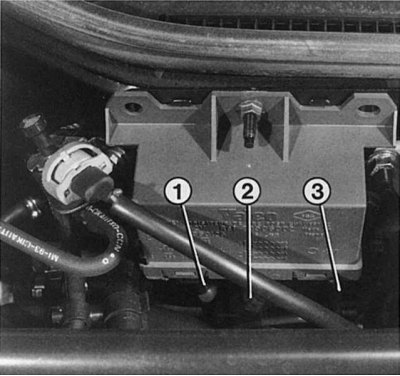


If you suspect that the preheater control unit is the reason why the engine does not start, you…


If you suspect that the preheater control unit is the reason why the engine does not start, you should first check whether its connectors are connected correctly and whether there is any oxide on them. Often they are the cause of the malfunction due to loss of voltage. The figure shows:


1 - Plug connection for switched positive, full load microswitch, thermal switch, starter (+), preheating indicator lamp, cold start solenoid valve and ground;

(View the original source on this resource: renaultbook)

2 - power supply for glow plugs No.1 and 2, as well as 3 and 4; direct connection of the battery (+).

1. Disconnect the wire from the glow plugs.

2. Connect a test lamp between the end of the unscrewed wire and ground.

3. Turn the ignition key to the preheating position and watch the test lamp: it should light until the preheating indicator lamp goes out.

4. Briefly turn on the starter. When the starter turns, the test lamp should light, otherwise, the wire to the preheater control device may be broken.

5. If the test lamp does not light, the control unit is faulty. It is also possible that one of the supply wires, the shut-off valve, or the entire ignition switch is faulty.
This article is available on: russian, bulgarian, belarusian, ukrainian, serbian, croatian, romanian, polish, slovak, hungarian
Article has been reviewed by editor: Trofimova Anastasia
Share with friends:
Previous
19: Ignition system
 

Glow Plugs — Removal and Installation
Preheating device
Troubleshooting the ignition system
Recommended spark plugs
Spark plug characteristics
 
Other articles on other Renault models

➽ Troubleshooting your car Renault Duster 1 (2009-2017)
➽ Troubleshooting Renault Kangoo 1 (1997-2007)
➽ Troubleshooting Algorithm Renault Laguna 2 (2001-2007)
➽ General description of troubleshooting in electrical systems Renault Megane 1 (1995-2002)
➽ Troubleshooting electrical equipment Renault Scenic 1 (1996-2003)
Link to this article in different formats
Reviews and comments of visitors
No comments yet


Add two numbers 41 + 33


Renault 19 (1988-1996) 
  • General information
  • Maintenance
  • Power unit
  • Engine repair
  • Exhaust system
  • Cooling system
  • Supply system
  • Single-point injection
  • Multi-point injection
  • Diesel injection system
  • Transmission
  • Clutch
  • Car gearbox
  • Chassis, running gear
  • Car suspension
  • Steering
  • Brake system
  • Wheels and tires
  • Body and interior
  • Exterior (external elements)
  • Interior (internal elements)
  • Heating and ventilation
  • Electrical equipment
  • Equipment and devices
  • Headlights and lighting
  • Ignition system
  • Power devices
  • Electrical circuits
Espace I and II (1984-1996) 
  • General information
  • Introduction to the guide
  • Troubleshooting
  • Power unit
  • Engine repair
  • Cooling system
  • Carburetor fuel system
  • Injection fuel system
  • Diesel fuel system
  • Ignition system
  • Transmission
  • Clutch
  • Car gearbox
  • Drive shafts
  • Chassis, running gear
  • Brake system
  • Steering
  • Front suspension
  • Rear suspension
  • Body and interior
  • Exterior (external elements)
  • Interior (internal elements)
  • Doors, locks and windows
  • Electrical equipment
  • Equipment and devices
  • Electrical circuits
Espace III (1996-2002) 
  • General information
  • Introduction to the manual
  • User manual
  • Power unit
  • Petrol engines F3R
  • Petrol engines Z7X
  • Diesel engines G8T
  • Diesel engines G9T
  • Transmission
  • Clutch
  • Mechanical gearbox
  • Automatic gearbox
  • Drive shafts
  • Chassis, running gear
  • Steering
  • Front suspension
  • Rear suspension
  • Brake system
  • Body and interior
  • Exterior (external elements)
  • Interior (internal elements)
  • Doors, locks and windows
  • Heating and ventilation
  • Electrical equipment
  • Equipment and instruments
  • Power devices
  • Electrical circuits
RenaultBook.ru © 2018–2026 | Mobile version | News and articles | Sitemap: EN BG BY UA RS HR RO PL SK HU | Administration | Site search | Bookmark
Duster 1 (2009-2017) | Fluence 1 (2009-2020, petrol) | Kangoo 1 (1997-2007) | Laguna 2 (2001-2007) | Logan 1 (2004-2012, petrol) | Logan 2 (2012-2020) | Megane 1 (1995-2002) | Megan 2 (2002-2009, petrol) | Sandero 1 (2007-2012, petrol) | Scenic 1 (1996-2003) | Symbol 1 (1999-2008, petrol) | Symbol 2 (2008-2013, petrol) | Renault 19 (1988-1996) | Espace I and II (1984-1996) | Espace III (1996-2002) | Clio 1 (1990-1998) |
We want your visit to be comfortable 😌 and use cookies 🍪 to do so.