


Note: The cylinder head is removed together with the intake and exhaust manifolds.
Note: Have a new timing belt, cylinder head and valve cover gaskets, and (possibly) a set of new cylinder head bolts on hand.
Removal
1. Disconnect the ground cable from the battery (refer to Chapter Engine electrical equipment).
Warning: If the car radio in your car is coded, make sure you know the code before disconnecting the battery.
2. Drain the fluid from the cooling system and from the cylinder block on the E7J engine as described in Chapter Maintenance (on the E7J engine it is important to drain the block because if the wet cylinder liners are disturbed, coolant will drain into the sump).
3. Drain the engine oil as described in Chapter Maintenance.
4. Remove the toothed drive belt, refer to Section Removal, inspection and installation of the toothed drive belt from this Chapter.
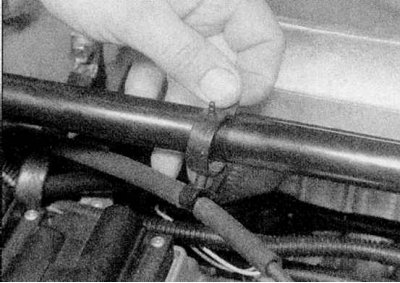
5a. Remove the air cleaner assembly as described in Chapter Power supply and exhaust systems. On the K7M engine, remove the reinforcing rod between the front suspension domes.
5b. Disconnect the air duct from the throttle body (refer to the illustrations).
6. Disconnect the accelerator pedal cable from the throttle body (refer to Chapter Power supply and exhaust systems).
7. On the E7J engine, unscrew the gas pedal cable holder from the valve cover.
8. On the K7M engine, remove the ignition coils from the valve cover as described in Chapter Engine electrical equipment; disconnect the high-tension wires from the spark plugs and unscrew the wire retainer from the valve cover.
9. Disconnect the crankcase ventilation hoses from the valve cover.
10. Loosen the bolts and remove the valve cover and gasket.
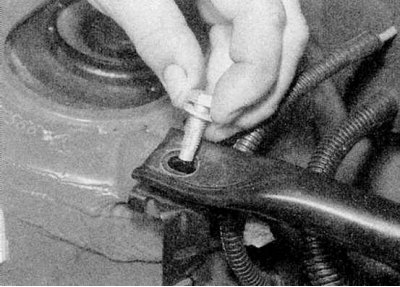
11. Unscrew the ground cable from the right side of the bulkhead (refer to the accompanying illustration).
12. Loosen the clamps and disconnect the fuel feed and return hoses from the throttle body (e7J engine) or fuel line (k7M engine).
13. Disconnect the fuel vapor recirculation solenoid valve hose.
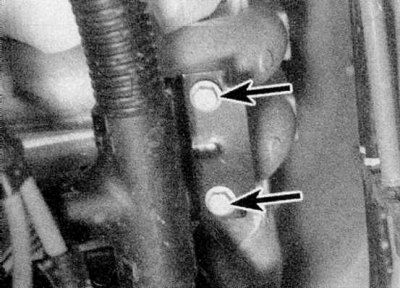
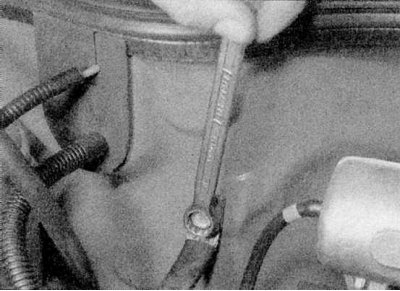
14. Disconnect the wiring and hoses from the MAP sensor at the bulkhead. Also unscrew the wiring harness from the intake manifold, and disconnect all wiring from the cylinder head (refer to the accompanying illustration).
15. Loosen the clamp and disconnect the brake booster hose from the intake manifold.
16. Loosen and remove the upper oil dipstick tube mounting bolt.
17. Remove the spark plugs as described in Chapter Maintenance.
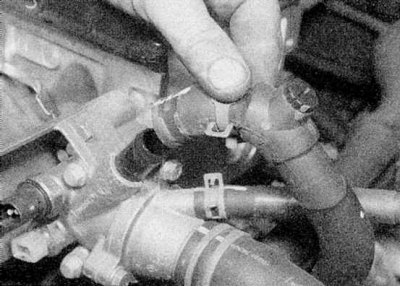
18a. Release the clamp and disconnect the upper radiator hose from the thermostat housing. Also disconnect the heater hoses and the expansion tank hose.
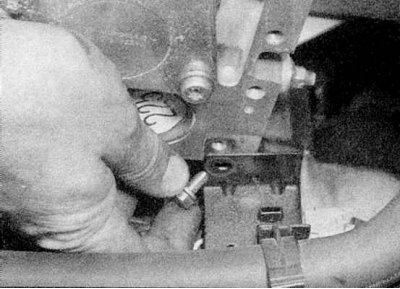
18b. Unscrew the heater hose holder on the left side of the cylinder head (refer to the illustrations).
19. Loosen and remove the generator upper mounting/adjustment bolt from the bracket on the rear of the cylinder head.
20. Unscrew the nuts and remove the heat shield from the exhaust manifold. Remove the intake pipe as described in Chapter Power supply and exhaust systems.
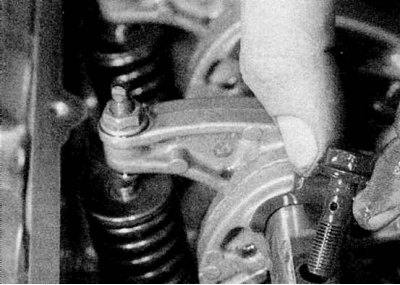
21a. Unscrew and remove the rocker arm shaft and mounting plate.
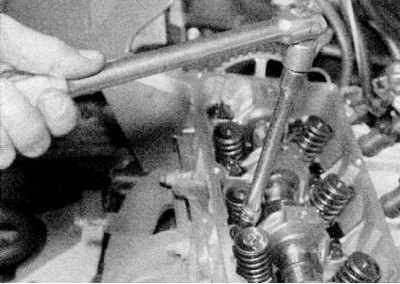
21b. Then gradually loosen the cylinder head mounting bolts.
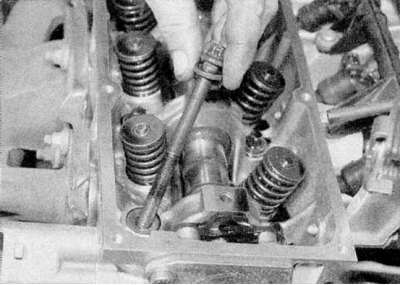
21c. Remove all bolts except the one in the front right corner, which only needs to be loosened three to four turns.
22. Now it is necessary to break the connection between the cylinder head, gasket and cylinder block. On the E7J engine, it is important not to lift or disturb the "wet" cylinder liners.
To avoid this, pull the left end of the cylinder head forward, rotating it around the retained bolt, then move the head back to its original position. If this procedure is not performed on an E7J engine, there is a chance that the cylinder liners will move and the seals will be damaged, causing leaks after the head is installed.
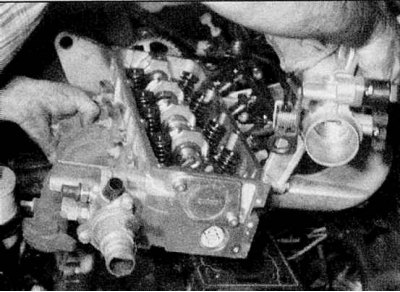
23a. Remove the remaining bolt and lift the head off the cylinder block.
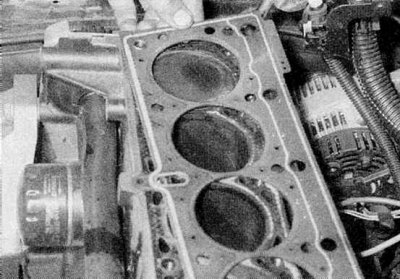
23b. Then remove the gasket. Note the mounting on the front right corner of the block (refer to the illustrations).
24. Remove the intake manifold and exhaust manifold as described in Chapter Power supply and exhaust systems.
(Source is located on the website: «renaultbook»)
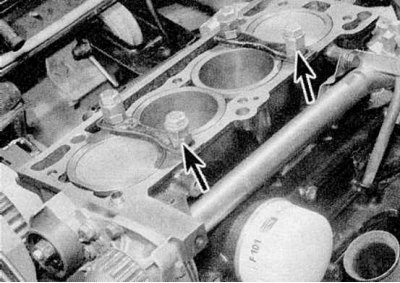
25. Please note that on the E7J engine the crankshaft should not be rotated with the head removed, as the liners may be displaced. If there is a need to rotate the crankshaft (for example when cleaning the piston bottom), secure the sleeves with bolts and washers or mounting clamps (refer to the accompanying illustration).
Inspection
1. The mating surfaces of the cylinder head and block must be completely clean. Use a scraper to remove all traces of gasket and carbon deposits, and clean the tops of the pistons. Work especially carefully with the aluminum cylinder head, as the soft metal can be easily damaged. Also, make sure that no dirt gets into the oil and water passages - this is especially important for the lubrication circuit, as carbon deposits can block the oil supply to the camshaft and crankshaft bearings and rocker arms. Use masking tape and paper to isolate the water, oil passages and bolt holes in the cylinder block. Clean the piston crowns in the same way.
2. Check the block and head for nicks, deep scratches and other damage. If there are small scratches, they can be carefully removed with a file. More serious damage can be eliminated by resharpening, but this work should be entrusted to a specialist.
3. Using a straightedge, check the cylinder head for warpage. On the E7J engine, also check the cylinder liner protrusion. These parameters are closely related to the burnout of the cylinder head gasket.
4. Clean all bolt holes in the block. Make sure there is no oil left in them, otherwise there is a risk that the block may crack under hydraulic pressure when tightening the bolts.
5. Inspect the bolt threads and the threads in the cylinder block for damage. If necessary, use a tap of the appropriate size to renew the threads in the block and use a die to clean the threads on the bolts. It is recommended to replace the bolts after each removal.
Installation
1. Secure the intake manifold and exhaust manifold to the cylinder head as described in Chapter Power supply and exhaust systems.
2. Make sure piston #1 is at TDC, then wipe the head and block surfaces. On the E7J engine, remove the cylinder liner clamps.
3. Make sure the locating pin is in place in the front right corner of the unit.
4. Place the new gasket on the block by sliding it onto the pin - the gasket can only be installed in one position (refer to the accompanying illustration).
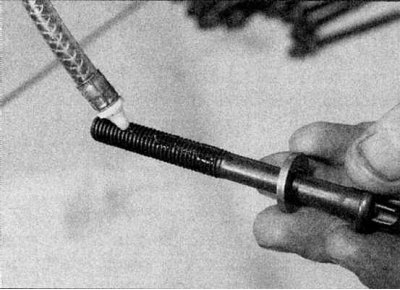
5a. Lower the head onto the block. Lubricate the threads and areas under the bolt heads, install washers.
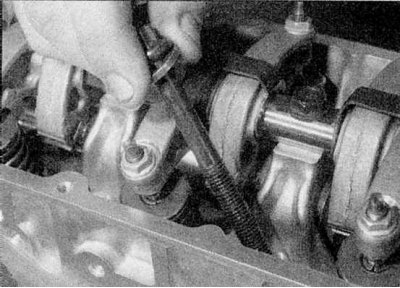
5b. Then insert the bolts. Note that the shorter bolts are installed on the intake side - and are screwed in by hand only for now (refer to the illustrations).
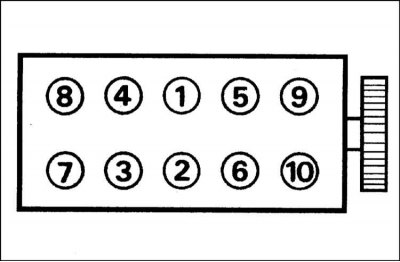
6a. Tighten the cylinder head bolts in the sequence shown in Specifications by effort (refer to the illustrations).
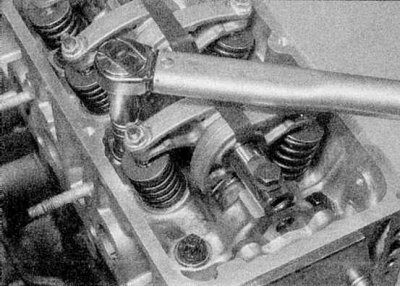
6b. When tightening bolts, make paint marks on the bolt heads and cylinder head to ensure the correct angle, or purchase a special tightening tool.
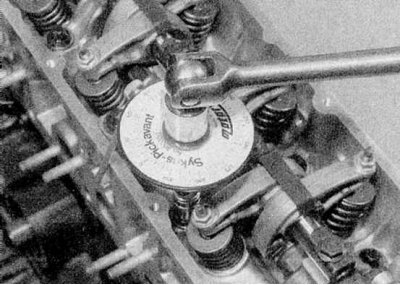
6c. If the bolts are tightened exactly as specified, there is no need to re-tighten them after the engine is first started.
7. Install the rocker shaft and mounting plate, refer to Section Removal, inspection and installation of the camshaft. If the cylinder head has been rebuilt, it is recommended to check the valve clearances at this stage to eliminate any possibility of the valves touching the pistons after installing the toothed drive belt. Turn the crankshaft so that no piston is in the TDC position.
8. Install the exhaust pipe as described in Chapter Power supply and exhaust systems, then install the heat shield on the exhaust manifold and tighten the nuts.
9. Insert the generator upper mounting/adjustment bolt into the rear of the cylinder head, then adjust the drive belt tension as described in Chapter Maintenance, and tighten the bolt.
10. Connect the expansion tank hose, heater hoses and upper radiator hose to the thermostat housing, making sure the clamps are in place.
11. Install and tighten the upper oil dipstick tube mounting bolt.
12. Connect the brake booster hose to the inlet manifold.
13. Install the spark plugs as described in Chapter Maintenance.
14. Connect the wiring and hoses to the absolute pressure sensor.
15. Connect the fuel vapor circulation control solenoid valve hose.
16. Connect the fuel supply and return hoses to the throttle body (e7J engine) or to the fuel line (k7M engine).
17. Secure the ground cable to the bulkhead.
18. Adjust the valve clearances if you have not already done so (refer to Section Checking and adjusting valve clearances from this Chapter).
19. Install the valve cover with a new gasket and tighten the bolts evenly to the specifications shown Specifications effort.
20. Connect the crankcase ventilation hose to the valve cover.
21. On the K7M engine, install the high-voltage ignition coils on the valve cover and connect the high-voltage wires to the spark plugs. Secure the high-voltage wire holder to the valve cover.
22. On the E7J engine, install the accelerator pedal cable bracket to the valve cover.
23. Connect the gas pedal cable and adjust it as described in Chapter Power supply and exhaust systems.
24. Install the air cleaner assembly as described in Chapter Power supply and exhaust systems. On the K7M engine, connect the air duct to the throttle body.
25. Install a new timing belt, refer to Section Removal, inspection and installation of the toothed drive belt from this Chapter.
26. Fill the engine with fresh oil as described in Chapter Maintenance.
27. Install and tighten the drain plug in the cylinder block on the E7J engine.
28. Fill and bleed the cooling system as described in Chapter Maintenance.
29. Connect the ground cable to the battery.