
Note. When installing, use a new head gasket and new cylinder head bolts, and a new valve cover gasket may also be required - see text.
Removing
1. The following procedure describes the removal and installation of the cylinder head along with the intake manifold and exhaust manifold and high pressure fuel pump.
2. Disconnect the earth cable from the battery (contact the head Engine electrical equipment). On models with an F9Q engine, unscrew the fixing nuts and remove the engine soundproof cover.
Attention! If the car radio in your car is coded, make sure you know the code before disconnecting the battery.
3. Drain the liquid from the cooling system, including the cylinder block.
4. To improve access, unscrew the reinforcing rod (where available) between the domes of the front suspension struts.
5. Remove the auxiliary drive belt. On models with F9Q engines and air conditioning, remove the accessory belt tensioner mounting plate, then remove the fuel pump/alternator mounting bolt.
6. Turn away a cable of weight from a back part of the engine.
7. On models with an F8Q engine, disconnect the throttle cable from the high pressure fuel pump, and move the cable away from the engine, noting how it runs (contact the head Power and exhaust systems if it is needed).
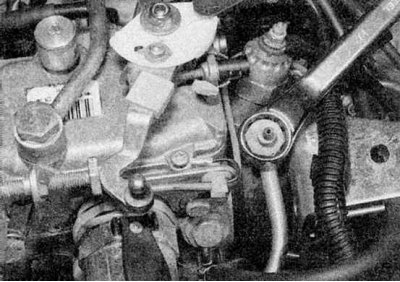
8. Screw type connection "banjo" and disconnect the fuel supply line from the fuel pump (refer to accompanying illustration). Remove sealing washers. Seal the open end of the tubing and the hole in the pump to allow dirt to enter.
9. Remove the mounting bracket and disconnect the main fuel return hose at the high pressure fuel pump. Pass the hose through the rear mounting lug on the cylinder head and move the hose away from the engine. Seal the open ends of the tube and hose to prevent dirt from entering.
10. Disconnect and remove the air duct connecting the air filter to the intake manifold or turbocharger (note that it will also be necessary to disconnect the breather hoses that are connected to the air duct).
11. On engines with a turbocharger, disconnect and remove the air duct connecting the air cooler (intercooler) with turbocharger.
12. Remove the toothed drive belt as described in Section Removal, inspection and installation of a toothed drive belt, and tension mechanism as described in Section Removal from the installation of gear wheels of the drive belt and tension mechanism. To support the engine / transmission, Renault vehicles use a special holder mounted under the right front side of the cylinder block and subframe and an additional bracket attached below the water pump.
13. Unscrew the hose holder from the front of the fuel pump bracket and move the hoses and holder away from the pump.
14. Disconnect the breather hoses from the oil separator, and on engines with a turbocharger, also disconnect the hose from the boost pressure corrector on the fuel pump. Also disconnect the ends of these hoses from the manifold.
15. Remove one hose holder from the front mounting lug and one from the vacuum pump and remove the hose assembly from the engine.
16. On engines without a turbocharger, disconnect the coolant hose from the thermostat housing.
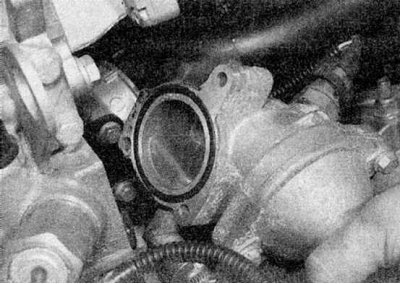
17. On engines with a turbocharger, unscrew the thermostat housing from the cylinder head, and move it to the side without disconnecting the hoses and sensor wiring (refer to accompanying illustration).
18. Disconnect the cooling system hose from the left rear corner of the cylinder head, and move it away from the head.
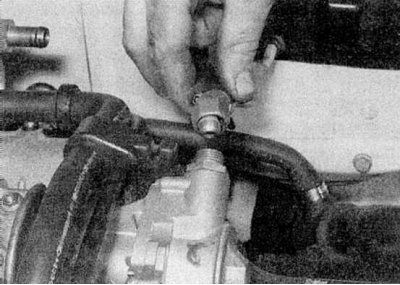
19. Disconnect the hose from the vacuum pump (refer to accompanying illustration).
20. Disconnect all electrical wiring from the fuel pump. Mark all connections to avoid confusion during installation.
21. Disconnect the electrical feed wires from the glow plugs.
22. On non-turbocharged engines, disconnect the electrical connector from the gauge gauge/water temperature warning light assembly located in the thermostat housing below the vacuum pump.
23. Disconnect all tubes and hoses from a collector and a turbocompressor, being guided by the corresponding Sections of the Head Power and exhaust systems. Mark all tubes and hoses so as not to confuse during installation.
24. Where applicable, unscrew the hose holders from the manifolds and around the head, and move the hoses to the side.
25. On engines with a turbocharger, remove the two bolts securing the turbocharger inlet elbow to the bracket on the transmission. Remove the nut and bolt securing the mounting bracket to the turbocharger and inlet elbow, and remove the elbow.
26. Remove the bolts securing the inner top timing belt cover to the cylinder block.
27. Remove the timing belt idler pulley bolt that goes through the inner cover.
28. Remove the front part of the exhaust system as described in Chapter Power and exhaust systems.
29. On engines with a turbocharger, unscrew the union nut securing the turbocharger oil feed pipe to the cylinder block and remove the pipe.
30. On turbocharged engines, remove the bolts securing the turbocharger bracket to the turbocharger and engine and remove the bracket.
31. If not already done, remove the dowel pin from the cylinder block and rotate the crankshaft a quarter of a turn counterclockwise to place all four pistons in the middle of the cylinders.
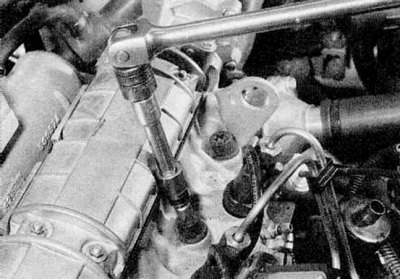
32. Working in the reverse order of the illustration, gradually loosen the cylinder head bolts a half turn at a time until they can be removed by hand (refer to accompanying illustration). Discard the bolts.
33. The cylinder head, together with the parts attached to it, is very heavy, so it is recommended to use a winch when removing it from the cylinder block.
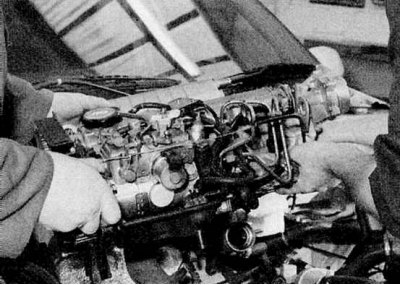
34. Raise your head (complete with manifolds, fuel pump and inner toothed belt top cover) up from the cylinder block (refer to accompanying illustration). If the dowel pins are loose, remove them and fold them together with the head.
35. If required, manifolds, turbocharger (where applicable) and the fuel pump can be removed from the head, guided by the relevant Sections of the Head Power and exhaust systems.
Inspection
1. The mating surfaces of the head and cylinder block must be perfectly clean. Use a scraper to remove all traces of gaskets and deposits, and clean the tops of the pistons. Be especially careful with an aluminum cylinder head as the soft metal can be easily damaged. Also, be careful not to get dirt into the oil and water passages - this is especially important for the lubrication chain, as deposits can block the oil supply to the camshaft and crankshaft bearings or rocker arms. Using adhesive tape and paper, isolate the water, oil channels and bolt holes in the cylinder block. Clean the piston crowns in the same way.
2. Check the block and head for nicks, deep scratches, or other damage. If there are small scratches, they can be carefully removed with a file. More serious damage can be repaired by regrinding, but this work should be entrusted to a specialist.
3. Using a ruler placed on edge, check the curvature of the cylinder head. On the E7J engine, also check the protrusion of the cylinder liners.
4. Clean all bolt holes in the block. Make sure that no oil remains in them, otherwise there is a possibility that when tightening the bolts, the block may crack under the action of hydraulic pressure.
5. Examine a carving of bolts and a carving in the block of cylinders on presence of damages. If necessary, renew the threads in the block with a tap of the appropriate size and clean the threads on the bolts with a screw-cutting die. It is recommended to replace the bolts after each removal.
Gasket selection
1. Rotate the crankshaft until pistons #1 and #4 are just below TDC (below the surface of the cylinder block). Place the dial micrometer on the cylinder block, set it to zero on the surface of the block. Move the gauge probe to the center of #1 piston, then slowly rotate the crankshaft back and forth to bring the piston past TDC, marking the highest micrometer reading. Write down the result.
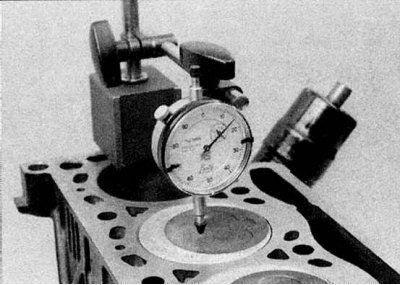
2. Repeat this procedure on piston #4, then turn the crankshaft half a turn (180°) and repeat the procedure on pistons #2 and #3 (refer to accompanying illustration). All measurements must be taken on the longitudinal axis of the crankshaft (to eliminate errors due to piston bias).
3. If a micrometer is not available, the piston protrusion can be measured using a ruler and feeler gauges or a vernier caliper. However, these methods are less accurate and therefore cannot be recommended.
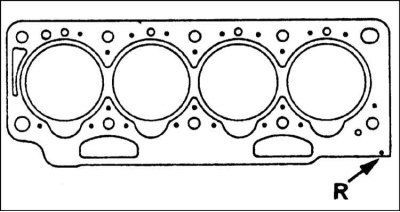
4a. Use the highest measured piston protrusion to determine the appropriate gasket.
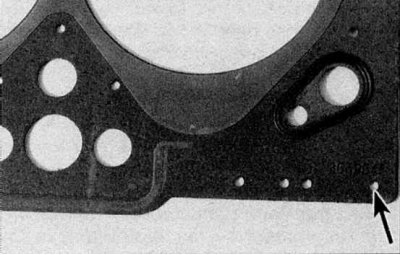
4b. The thickness marking holes are located in the front corner of the gasket, on the flywheel side (refer to illustrations).
Note. The holes for designating the thickness of the gasket are located at a distance of 25 mm from its edge. Ignore other openings outside this area.
Bolts of fastening of a head of the block of cylinders
The manufacturer recommends that the cylinder head bolts be replaced each time they are removed.
Installation
1. Install manifolds, turbocharger (where applicable) and a high-pressure fuel pump to the cylinder head, guided by the relevant Sections of the Chapter Power and exhaust systems.
2. Remove the dowel pin from the cylinder block and rotate the crankshaft clockwise until the No. 1 and No. 4 pistons are past bottom dead center and begin to rise, then place them in the middle of the cylinders (this is to prevent the piston from hitting the valves. Do not turn the crankshaft any more until you install the toothed drive belt.
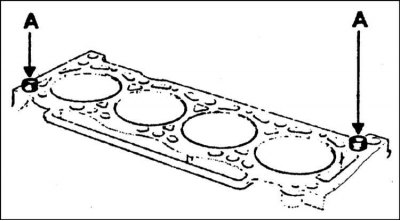
3. Make sure the dowel pins are in place in the cylinder block, then position the gasket in the correct orientation (refer to accompanying illustration).
4. Lower the head onto the cylinder block. The timing belt inner upper cover must properly mate with the lower inner cover on the cylinder block. Disconnect the hoist and winch. On F8Q engines, make sure that the swirl chambers do not fall out of their sockets in the cylinder head.
5. Lightly grease the new cylinder head bolts. Wait for excess oil to drain, then insert bolts with washers and hand tighten.
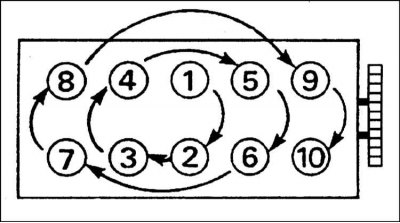
6. In the sequence shown, tighten the cylinder head bolts as shown in Specifications effort (refer to accompanying illustration). Please note that on F8Q engines without a turbocharger or on F9Q engines, it is not necessary to re-tighten the bolts. And on F8Q engines with a turbocharger, at the end of the assembly, after the first start of the engine, it is necessary to additionally tighten the bolts, after warming up the engine to normal operating temperature and waiting until it cools down completely.
7. On engines with a turbocharger, install the turbocharger bracket and tighten the mounting bolts.
8. On engines with a turbocharger, install the turbocharger oil feed pipe/hose and tighten the coupler on the cylinder block.
9. Establish a forward part of final system as it is described in the Head Power and exhaust systems.
10. Establish a bolt of fastening of an intermediate pulley of a gear drive belt to the block of cylinders, then establish the mechanism of a tension of a gear drive belt as it is described in Section Removal from the installation of gear wheels of the drive belt and tension mechanism.
11. Install a new toothed drive belt as described in Section Removal, inspection and installation of a toothed drive belt.
12. On turbocharged engines, inspect the O-ring in the turbocharger inlet elbow and replace if necessary. Install the elbow and bracket.
13. Install hose mounts to manifolds as noted prior to removal.
14. Connect all tubes and hoses to manifolds and turbocharger as noted prior to removal.
15. On non-turbocharged engines, connect the wiring harness to the gauge gauge/water temperature warning light assembly.
16. Connect the supply wires to the glow plugs.
17. Connect all electrical wiring to the high pressure fuel pump.
18. Connect the engine ground cable to the rear mounting lug.
19. Connect a hose of system of cooling to a head of the block of cylinders and a hose to the vacuum pump of brake system.
20. Connect the air ducts to the air filter, intake manifold, turbocharger and air cooler (intercooler), where available. Make sure all hoses are properly connected.
21. On turbocharged engines, inspect the O-ring between the thermostat housing and cylinder head and replace if necessary. Install the thermostat housing to the cylinder head.
22. On engines without a turbocharger, connect the coolant hose to the thermostat housing.
23. Connect the crankcase breather hoses, and on engines with a turbocharger, also connect the boost pressure correction hose. Install the brackets to the motor mounting lug and the vacuum pump.
24. Install the hose bracket to the high pressure fuel pump bracket.
25. Thread the main fuel return hose through the engine mounting lug and connect it to the tubing on the high pressure fuel pump.
26. Connect the fuel supply hose to the fuel pump.
27. Connect a cable of a pedal of gas as it is described in the Head Power and exhaust systems.
28. Where applicable, install the reinforcing rod on the front suspension strut domes.
29. Make sure the drain plug in the cylinder block (where available) secure, then fill and bleed the cooling system.
30. Install the auxiliary drive belt tensioner and bracket, then the drive belt.
31. Connect the mass cable to the battery.
32. Bleed the fuel system as described in Chapter Power and exhaust systems.
33. On engines with a turbocharger, before starting the engine, follow the procedure described in Chapter Power and exhaust systems (filling the turbocharger lubrication circuit). On models with F9Q engine, install the engine soundproof cover.
34. On F8Q engines with a turbocharger, tighten the cylinder head bolts to final torque (talk to Specifications), by preheating the engine to normal operating temperature and waiting until it has completely cooled down. It may be necessary to remove the upper bracket of the right engine mount (refer to section Replacing engine/transmission mounts), to access one of the bolts.