



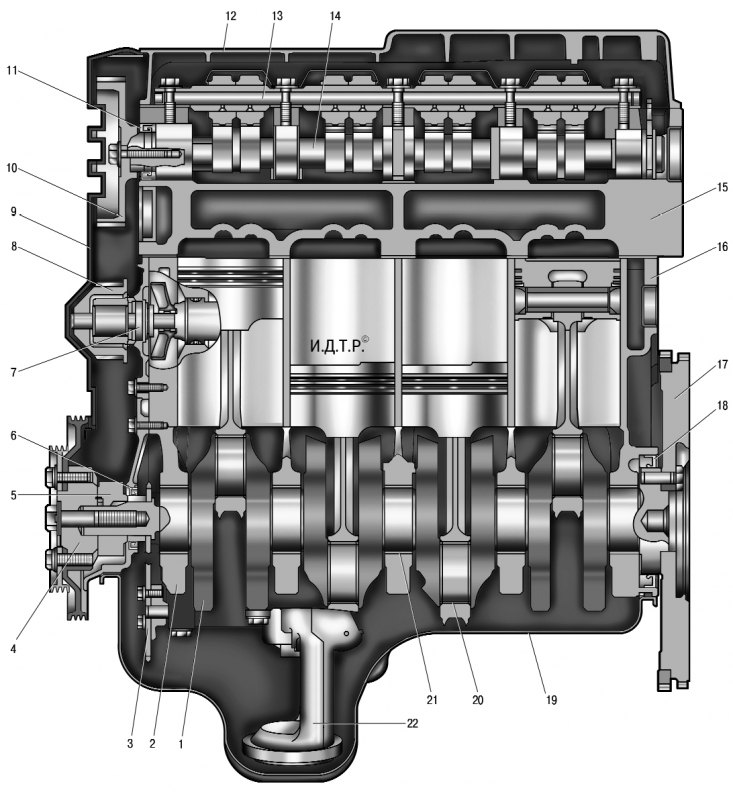
5.1. Engine (longitudinal section): 1 – crankshaft; 2 – crankshaft main bearing cap; 3 – oil pump sprocket; 4 – auxiliary drive pulley; 5 – toothed pulley of the crankshaft; 6 – front crankshaft oil seal; 7 – water pump; 8 – toothed pulley of water pump; 9 – valve timing belt cover; 10 – camshaft toothed pulley; 11 – camshaft oil seal; 12 – cylinder head cover; 13 – valve drive rocker arm axis; 14 – camshaft; 15 – cylinder head; 16 – cylinder block; 17 – flywheel; 18 – rear crankshaft oil seal; 19 – oil pan; 20 – connecting rod bearing shell; 21 – main bearing shell; 22 – oil pump inlet pipe
Both engines with in-line vertical arrangement of cylinders and liquid cooling have almost completely identical design, but differ in working volume. Moreover, the working volume of the K7M 710 engine is increased in comparison with the K7J 710 engine by increasing the piston stroke, which is achieved by increasing the radius of the crankshaft crank with an unchanged cylinder diameter. This entailed an increase in the height of the cylinder block, which is different for these engines. In addition, due to the increased diameter of the clutch, aggregated with the K7M 710 engine, the diameter of the flywheel is also increased, which entailed a change in the shape of the clutch housing of the gearbox. Therefore, the location of the threaded holes for fastening the gearbox in the cylinder blocks of these engines is also different. The design of the engines is shown in Figures 5.1 and 5.2.
Engines with an overhead camshaft with one five-bearing camshaft have two valves per cylinder. The camshafts of both engines are driven by reinforced toothed belts. The engine valves are driven from the camshaft by rocker arms, which rest on one arm on the camshaft cams and have bolts on the other arm for adjusting the clearances in the valve mechanism with locknuts, acting on the ends of the valve stems.
Cylinder heads 15 (see figure 5.1) both engines are made of aluminum alloy with a transverse cylinder scavenging scheme (the inlet and outlet ports are located on opposite sides of the head). The heads are fitted with pressed seats and guide bushings 15 (see figure 5.2) valves. The inlet 7 and outlet 16 valves have one spring 14, fixed through the plate 13 by two crackers.
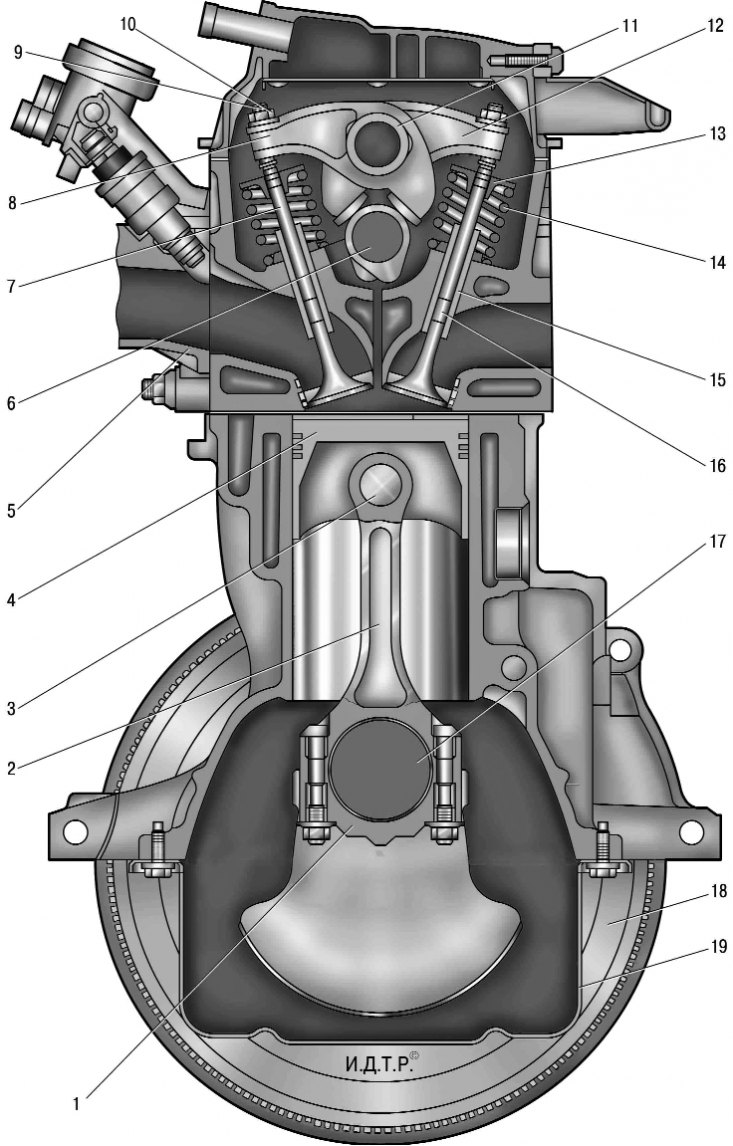
5.2. Engine (cross section): 1 – connecting rod cover; 2 – connecting rod; 3 – piston pin; 4 – piston; 5 – inlet pipe; 6 – camshaft; 7 – inlet valve; 8 – intake valve rocker; 9 – adjusting bolt; 10 – adjusting bolt lock nut; 11 – valve drive rocker arm axis; 12 – exhaust valve rocker; 13 – valve spring plate; 14 – valve spring; 15 – valve guide bushing; 16 – exhaust valve; 17 – crankshaft; 18 – flywheel; 19 – oil pan
On the upper plane of the block head, the axis 11 of the rocker arms 8 and 12 of the inlet and outlet valves, respectively, is attached with bolts. Bolts 9, secured with locknuts 10, are installed in the holes in the shoulders of the rocker arms to adjust the clearances in the valve drive mechanism, resting on the ends of the valve stems.
Camshaft 14 (see figure 5.1) installed in a bearing bed made in the head body and secured against axial movement by a thrust flange.
The plane of the joint between the head and the cylinder block is sealed with a gasket, which is a plate molded from thin sheet metal.
Cylinder Blocks 16 (see figure 5.1) both engines are a single casting that forms the cylinders, cooling jacket, upper part of the crankcase and five crankshaft supports, made in the form of crankcase partitions. The blocks are made of special high-strength cast iron with cylinders bored directly in the block body. The covers of the 2 main bearings are machined together with the blocks and are not interchangeable. The cylinder blocks have special bosses, flanges and holes for fastening parts, units and assemblies, as well as channels for the main oil line.
Crankshaft 1 rotates in main bearings having thin-walled steel liners 20 and 21 with an antifriction layer. The axial movement of the crankshaft is limited by two half rings installed in the grooves of the bed of the middle main bearing.
Flywheel 17, cast from cast iron, is mounted on the rear end of the crankshaft and secured with six bolts. A toothed rim for starting the engine with a starter is pressed onto the flywheel. In addition to it, a toothed crown is made on the flywheel, ensuring the operation of the top dead center sensor of the engine management system.
Pistons (figure 5.3) are made of aluminum alloy. On the cylindrical surface of the piston head there are ring grooves for the oil scraper and two compression rings.
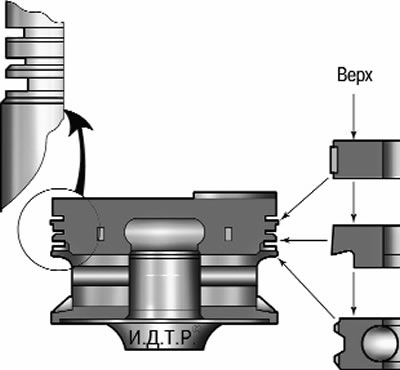
5.3. Piston and piston rings
Source is located on the website www.RENAULTBOOK.ru
Piston pins 3 (see figure 5.2) they are installed in the piston bosses with a gap and pressed with tension into the upper heads of the connecting rods, which are connected by their lower heads to the connecting rod journals of the crankshaft through thin-walled liners, similar in design to the main ones.
Connecting rods 2 steel, forged, with I-section rod.
The lubrication system is combined (for more details see. "Engine lubrication system").
The closed-type crankcase ventilation system does not communicate directly with the atmosphere, therefore, simultaneously with the suction of gases in the crankcase, a vacuum is formed in all engine operating modes, which increases the reliability of various engine seals and reduces the emission of toxic substances into the atmosphere.
The system consists of two branches, large and small.
When the engine is idling and operating at low loads, when the vacuum in the intake manifold is high, crankcase gases are sucked in by the intake manifold through the small branch of the system.
At full load conditions, when the throttle valve is open at a large angle, the vacuum in the intake pipe decreases, and in the air supply hose it increases, and crankcase gases through the large branch hose connected to the fitting on the cylinder head cover mainly enter the air supply hose, and then through the throttle assembly into the intake pipe and engine cylinders.
The engine cooling system is hermetically sealed, with an expansion tank, consists of a cooling jacket made in casting and surrounding the cylinders in the block, combustion chambers and gas channels in the cylinder head. Forced circulation of the coolant is provided by a centrifugal water pump 7 (see figure 5.1) with a crankshaft drive by a toothed timing belt. To maintain the normal operating temperature of the coolant, a thermostat is installed in the cooling system, which closes the large circle of the system when the engine is not warmed up and the coolant temperature is low.
The fuel system of both engines consists of an electric fuel pump installed in the fuel tank, a throttle assembly, a fine fuel filter installed on the fuel tank, a fuel pressure regulator installed in the fuel pump module, injectors and fuel lines, and also includes an air filter.
The ignition system of both engines is microprocessor-based and consists of an ignition module, high-voltage wires and spark plugs. The ignition module is controlled by the electronic unit of the engine management system. The ignition system does not require maintenance or adjustment during operation.
Power unit (engine with gearbox, clutch and final drive) mounted on three supports with elastic rubber elements - two upper side (right and left), bearing the main mass of the power unit, and the rear, compensating for the torque from the transmission and the loads that arise when the car starts moving, accelerates and brakes.
Note. This section describes engine repair work that is accessible to a novice mechanic, such as replacing seals, powertrain suspension supports, checking compression, adjusting and grinding valves, etc. A major overhaul of the engine with its complete disassembly requires special equipment and tools, as well as the appropriate technical training of the performer. Therefore, if such repairs are necessary, contact the branded service station.