



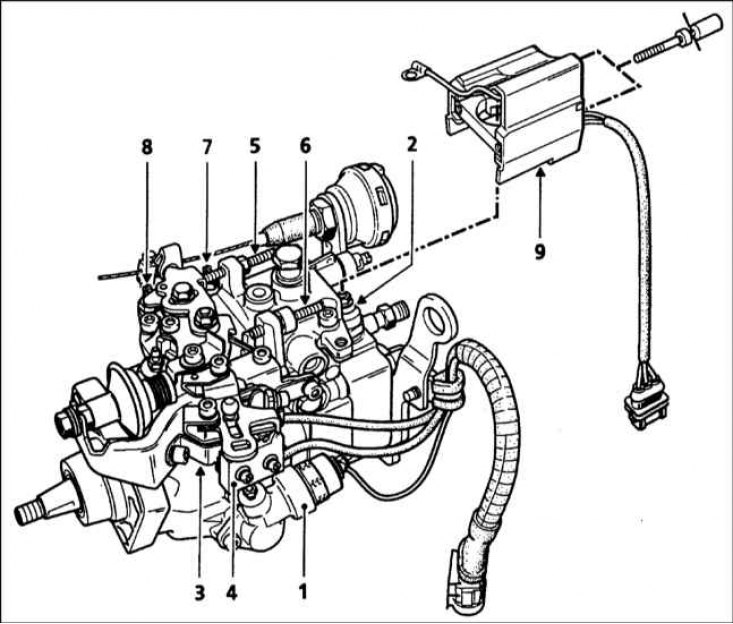
1 - Load sensing solenoid valve (ALFB); 2 - Fuel cut-off valve winding; 3 - Pre-glow/EGR valve microswitch; 4 - Air conditioner micro switch; 5 - Deceleration speed adjustment screw; 6 - Maximum speed adjustment screw; 7 - Idle speed adjustment screw; 8 - Fast idle speed adjustment screw; 9 - Electronic block of the coded valve
Lucas High Pressure Fuel Pump Components
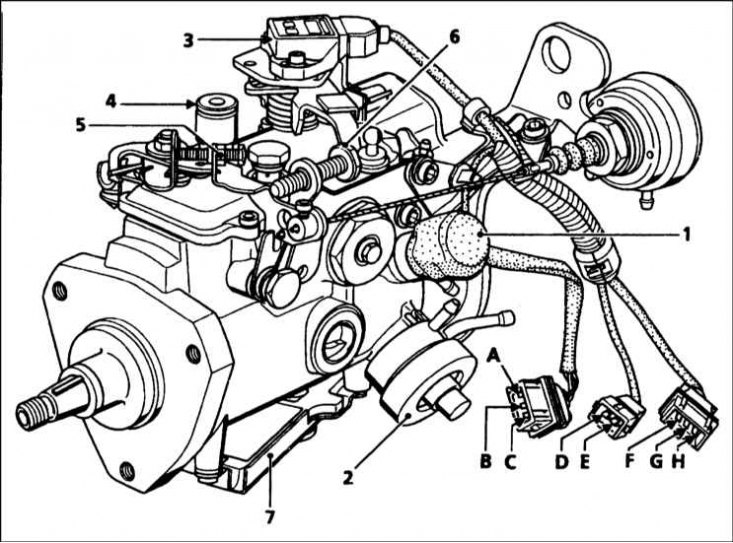
1 - Injection advance corrector; 2 - Boost pressure corrector; 3 - Throttle lever potentiometer; 4 - Injection timing control hole plug; 5 - Idle speed adjustment screw; 6 - Deceleration speed adjustment screw; 7 - Electronic block of the coded valve; A - Mass; B - + After ignition on; C - Coded line; D - Injection advance corrector control; E - + after ignition on; F - Mass; G - Throttle control lever signal; H - 5V power supply to the throttle lever potentiometer
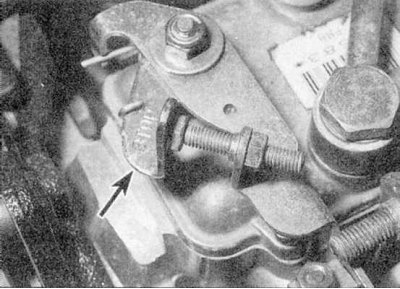
Lever (arrow) for manual fuel shut-off - LUCAS high pressure fuel pump
Models with F8Q engine
The fuel system consists of a fuel tank, a fuel filter with a water separator, a high-pressure fuel pump, injectors and related components. As the fuel passes through the filter, it is heated by a special element installed in the filter housing. The F8Q 784 and 786 engines are equipped with a turbocharger. The exhaust system is a conventional type, but some models may be equipped with an exhaust gas recirculation system and/or an uncontrolled catalytic converter, which reduce the amount of harmful impurities in the exhaust gas.
Fuel is pumped from the fuel tank by a high-pressure fuel pump.
Before reaching the pump, the fuel passes through a fuel filter where it is cleaned of foreign objects and water. Excess fuel lubricates the rotating components of the pump and then returns to the tank (refer to the illustrations).
The high-pressure fuel pump is driven by a toothed belt and rotates at half the speed of the crankshaft.
The F8Q 620 engine is equipped with a Bosch fuel pump. The high pressure required to inject fuel into the compressed air in the combustion chamber is achieved by a cam plate acting on a separate piston. The fuel passes through a central rotor with a single outlet port, which alternately aligns with the outlet ports of the injectors.
Fuel dosing is controlled by a centrifugal regulator that responds to the position of the gas pedal and engine speed. The regulator is connected to a metering valve that increases or decreases the amount of fuel injected with each pump stroke.
The main injection moment is set by the manufacturers when installing the pump. When the engine is running, the injection moment is automatically adjusted to the crankshaft speed by means of a special mechanism that rotates the cam plate or ring.
The solenoid valve on the pump is used for short-term correction of the injection timing during cold starting.
The electromagnetic valve is controlled by the pre-heating system control unit or the altitude sensor. When the coolant temperature is less than 29°C, the supply voltage is supplied to the valve coil when the engine is started. If the coolant temperature sensor is defective, the further operation of the valve will depend on the air temperature, which is measured by a temperature sensor installed on the control unit. If both sensors are defective, the electromagnetic valve is automatically switched on for 200 seconds each time the engine is started. It is also supplied with current through a relay, which is controlled by the altitude sensor, when the ambient pressure reaches 900±20 mbar.
The F8Q 784, 786 and 788 engines are equipped with a Lucas DPC fuel pump.
This pump consists of an injection advance corrector controlled by an electronic unit. Fuel in the pump passes into the hydraulic head through a measuring valve connected to the gas pedal cable and the boost pressure corrector. The hydraulic head consists of two pistons directed in opposite directions, held together by rollers moving in a ring. The injection moment is determined by a signal coming from the needle lift sensor of the 1st injector.
A separate device is also designed to increase fuel supply as boost pressure increases.
Four fuel injectors inject fuel into swirl chambers mounted in the cylinder head. The injectors are calibrated to open and close only at specific pressures, ensuring efficient ignition of the fuel-air mixture. The injector needle is lubricated with fuel, which accumulates in a spring chamber and is directed to the return hose of the fuel pump through a discharge pipe.
Cold starting is aided by a heater or glow plugs installed in each swirl chamber (Chapter Engine electrical equipment).
The fast idle system is controlled by a thermal actuator or a vacuum actuator, depending on the model.
On models with fast idle thermal drive (f8Q engines), a temperature sensor in the cooling system controls the fast idle lever on the fuel pump via a cable, increasing the idle speed until the engine is warm.
On models with vacuum drive (f8Q engines 784, 786 and 788), the fast idle cable is controlled by a vacuum actuator via an electromagnetic unit. The electromagnetic unit is controlled by the pre-heating control unit and on models with air conditioning there is additional control from the compressor clutch relay.
The shut-off valve stops the fuel supply to the fuel pump rotor when the ignition is off.
Subject to the conscientious fulfillment of the specified in Specifications maintenance, the fuel injection system will last a long time. The fuel pump can outlive the engine. The main potential cause of damage to the fuel pump and injectors is dirt or water in the fuel.
Servicing of the fuel pump and injectors is limited for the car enthusiast and any work not described in this Chapter must be carried out by a Renault service station or a specialist in fuel injection systems.
Note: Due to lack of technical data at the time of writing this Manual, the following Sections are only partially applicable to F8Q 788 engines. Therefore, for more information, please contact your Renault service centre.
Models with F9Q engine
The design and operation of the injection system used on the F9Q engine is basically the same as that of the F8Q engine described above. The main difference between the two systems is in the injection system control. On the F9Q engine, fuel metering and injection timing are controlled by an electronic injection control unit (ECU). This system is similar in principle to the engine management system used on gasoline models and uses similar sensors to provide the electronic control module with the data required for various engine operating conditions. The sensors monitor coolant temperature, air temperature, fuel flow, engine speed, vehicle speed, atmospheric pressure, fuel temperature and gas pedal position. Based on this data, the ECU controls the fuel pump, calculating the amount of fuel injected and the injection timing, the pre-heating system, the exhaust gas recirculation system, the engine immobilizer of the anti-theft system and the engine stop.
Subject to the conscientious fulfillment of the specified in Specifications maintenance, the fuel injection system will last a long time. The fuel pump can outlive the engine. The main potential cause of damage to the fuel pump and injectors is dirt or water in the fuel.
Servicing of the fuel pump and injectors is limited for the car enthusiast and any work not described in this Chapter must be carried out by a Renault service station or a specialist in fuel injection systems.
If a fault occurs in the injection system, first check that all electrical wiring in the system is securely connected and not oxidized. Also check that the air filter element is clean, the compression in the engine cylinders is normal and the engine breather hoses are not clogged or damaged.
If the fault persists after these checks, contact a Renault service station that has the ability to check the system using the Renault XR25 diagnostic tester. The tester will quickly and easily identify the fault, eliminating the need to check all the system components separately, which is time-consuming and can lead to damage to the ECU.
Warning! When working with fuel system components, especially fuel injectors, certain precautions must be taken. See warnings at the beginning of the Sections.