



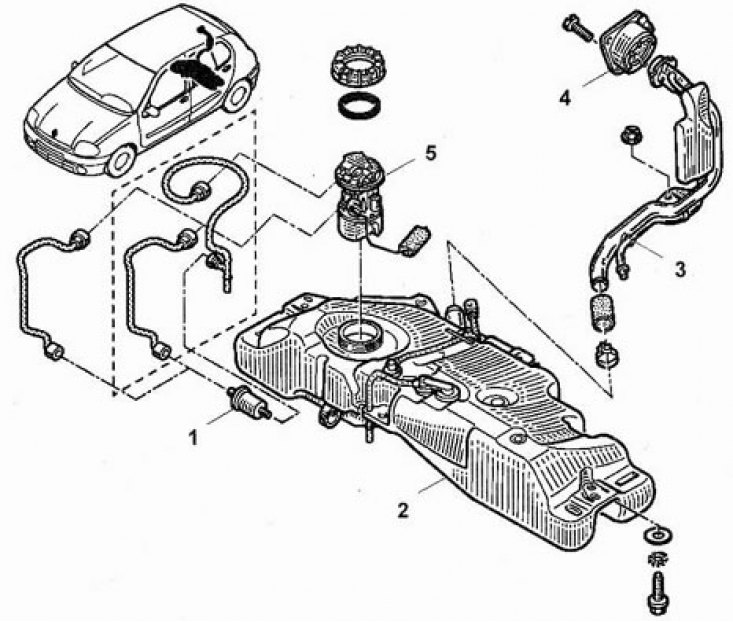
Fuel system. 1 - Fuel filter, 2 - Fuel tank, 3 - Fuel filler pipe, 4 - Fuel filler neck cover, 5 - Fuel pump assembly.
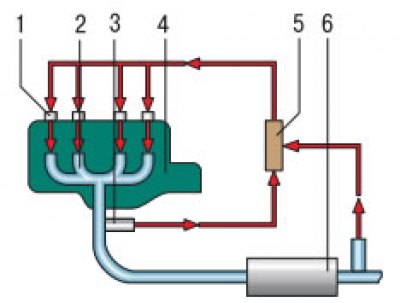
Diagram of the air-fuel mixture control circuit: 1 - nozzle; 2 - exhaust manifold; 3 - control sensor of oxygen concentration in exhaust gases (lambda probe); 4 - engine; 5 - electronic engine control unit; 6 - catalytic converter of exhaust gases
The fuel system includes a fuel tank located at the rear of the vehicle, an electric fuel pump built into the tank (immersed in fuel), fuel filter and pipeline system. The system also includes an electronic control unit (ECU), various sensors, components and electrical wiring of the fuel injection system.
The fuel pump delivers fuel under pressure to the fuel rail, which serves as a reservoir for the injectors installed on each cylinder that inject fuel into the intake tracts.
The engine is equipped with a Siemens-Sirius fuel injection system. This is a distributed injection that delivers fuel in accordance with the order of the cylinders at the start of the intake stroke.
To obtain information about which of the cylinders is currently in the intake stroke, the ECU uses a single TDC and engine speed sensor, which determines:
- TDC of pistons of the first and fourth cylinders;
- TDC of pistons of the second and third cylinders.
The system includes two exhaust gas oxygen concentration sensors, one of which is installed before the catalytic converter, and the second - after it. Signals from the sensors inform the ECU about deviations from the normal combustion process of the mixture in the cylinders and are used to correct this process in order to optimize engine operation.
The coolant temperature sensor informs the ECU about the thermal state of the engine.
Air enters the system through the intake silencer, which is attached to the air filter. The engine air temperature sensor informs the ECU of the temperature of the air passing through the throttle valve.
The crankshaft position sensor informs the ECU about the engine speed and the position of the pistons in the cylinders.
The knock sensor informs the ECU about a deviation in the fuel combustion process, accompanied by detonation in the cylinders. The change in engine load is transmitted to the ECU by a pressure sensor installed in the intake manifold.
The ECU controls the engine idle speed via the idle speed controller (stepper motor), which is mounted on the throttle body. The regulator controls the opening of the bypass air channel, bypassing the throttle valve. If the throttle valve is closed (the fuel pedal is released), The ECU commands the regulator to control the air flow into the engine, thus regulating the idle speed.
The potentiometer mounted on the accelerator pedal informs the ECU about the position of the throttle valve at each specific moment of engine operation.
To correct the idle speed when additional load is applied (air conditioning, power steering pump) the sensor is designed to allow the ECU to increase the idle speed, thereby preventing the engine from stopping.
To improve the engine's environmental friendliness and increase its efficiency, a waste collection system is used (adsorption) fuel vapors with their subsequent combustion in the engine cylinders. The recirculation valve of this system is also controlled by the ECU.
When receiving information about an abnormal situation from the sensors, the ECU switches to the backup engine control mode. In this case, the ECU ignores abnormal signals and, using the remaining signals, issues commands to continue engine operation, although with a decrease in fuel efficiency and dynamics. In this case, a warning signal lights up on the instrument panel and a corresponding fault code is entered into the ECU memory.
The system has a built-in inertial fuel shut-off sensor that is triggered by an impact in the event of a traffic accident. The sensor stops the fuel pump, preventing gasoline from leaking if the fuel lines are damaged.
The ignition system works together with the fuel injection system according to the commands of the ECU.
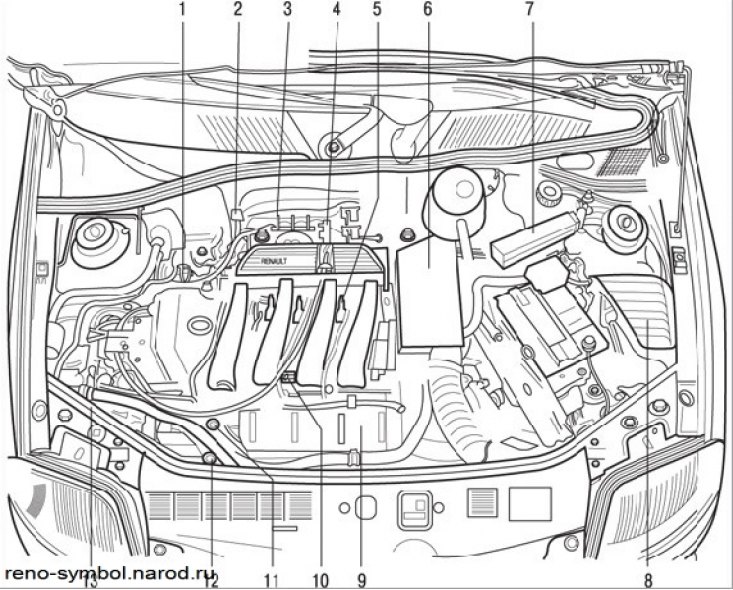
Figure 3.93. Location of fuel injection system components in the engine compartment: 1 – pressure sensor; 2 – stepper motor of idle speed controller; 3 – throttle position sensor; 4 – upper oxygen concentration sensor; 5 – coils and spark plugs; 6 – coolant temperature sensor and top dead center sensor; 7 – Injection system control unit; 8 – power relay; 9 – knock sensor; 10 – air temperature sensor; 11 – fuel distribution rail and fuel pressure regulator; 12 – Power steering pressure relay; 13 – adsorber with electromagnetic valve
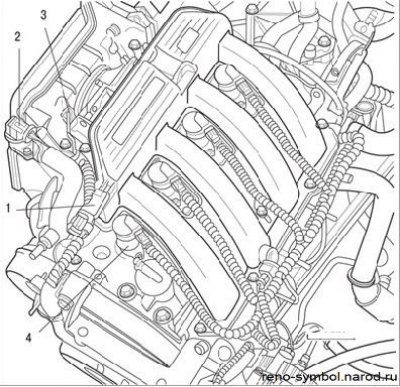
Figure 3.94. Location of injection system elements on the engine: 1 – pressure sensor; 2 – stepper motor of idle speed controller; 3 – throttle position sensor; 4 – ignition coil
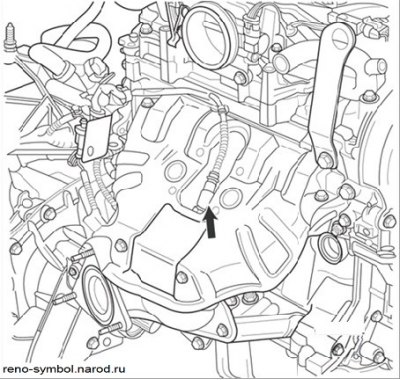
Figure 3.95. Upper oxygen concentration sensor
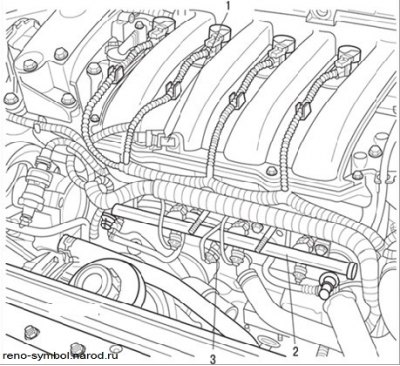
Figure 3.96. Location of the incoming air temperature sensor (1), fuel rail (2), and knock sensor (3) on the engine
The location of the fuel injection system elements is shown in Figures 3.93, 3.94, 3.95, 3.96.
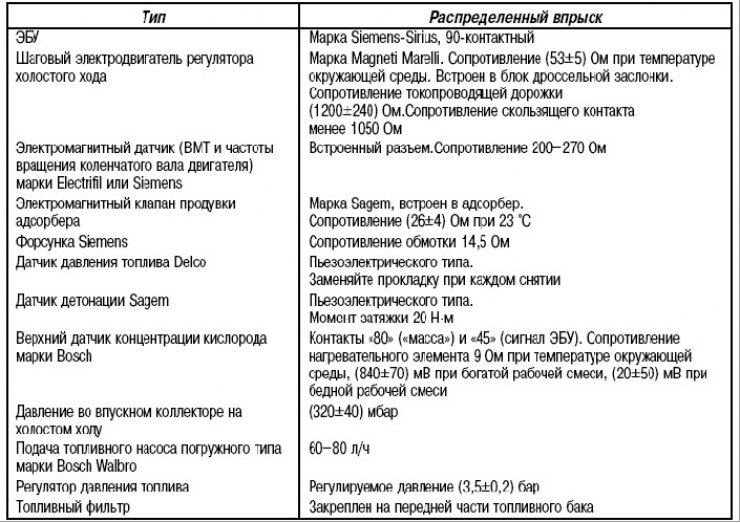
The technical characteristics of the injection system are given in Table 3.7.
Table 3.7. Technical characteristics of the injection system
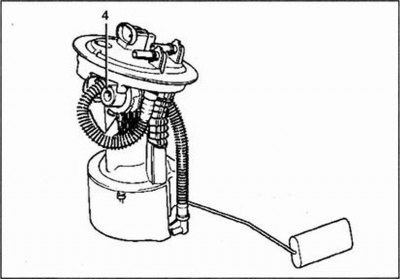
Fuel pressure regulator
The fuel pressure regulator (4) is installed in the tank in the fuel pump/fuel level sensor unit.
Checking fuel pressure
Special tool:
- Pressure gauge with hose and seals - Mot. 1311-01
- Adapter - Mot. 1311-08
Examination
1. Remove the fuel rail guard.
2. Loosen the bolt (1) securing the fuel supply hose.
3. Install the adapter (tee) Mot. 1311-08 in place of the hose.
4. Connect the pressure gauge Mot. 1311-01 and the fuel supply hose (1) to the adapter.
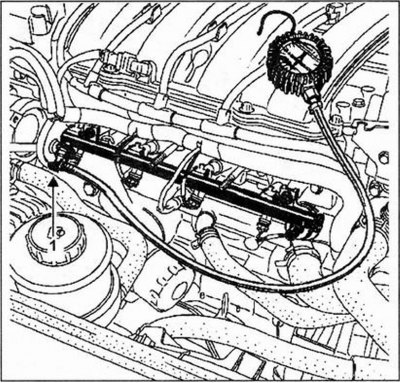
5. Start the engine.
6. After the fuel pressure has stabilized, read the pressure gauge readings.
Fuel pressure:
- For a circuit with return - 3.5±0.06 bar
- For a circuit without return - 3.5 bar
Fuel cut-off in collision
To reduce the risk of fire in a collision, a fuel supply shut-off system is installed on the vehicle. Fuel supply is restored after repairs by mechanically cocking the inertial switch (1). The switch is installed in the fuel pump circuit between terminal 1 of the fuel pump relay and the "plus" of the power source.
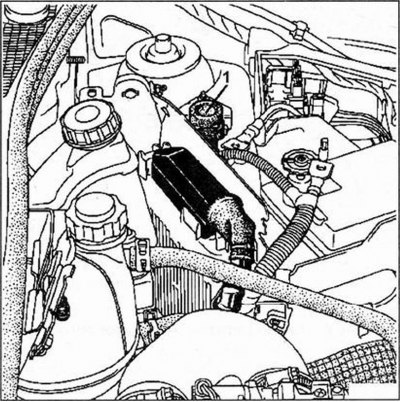
In the event of a collision, the inertial mass of the switch (steel ball) due to its movement, it breaks the fuel pump power supply circuit. The power supply is disconnected at the fuel pump and injectors. To restore the power supply circuit after repair, you need to press the inertia switch button. After this, be sure to reset the fault code (fuel pump power failure) from the control unit memory.