



Contents: Replacing the electronic control…🠛 Features of testing the electronic…🠛 Electronic control unit of the…🠛 Diagnostics of the injection system…🠛 Signal form 🠛
Note: The following describes the Siemens "Sirius 32" injection system for the K7J 700 engine; a similar system with some design differences is used for the K4J engine.
General information
Table. Main components of the Siemens "Sirius 32" injection system for the K7J 700 engine.
| Name | Brand/Type | Characteristics |
| Control unit | SIEMENS "SIRIUS" | 90 pin connector |
| Injection system type | - | Multi-point injection |
| Stepper electric motor | PHILIPS | Resistance: > 53 ohms at 25°C |
| Throttle potentiometer | PIERBURG | It is part of the throttle valve unit Conductive path resistance: 1200±240 Ohm Resistance of moving contact: < 1050 Ohm |
| Magnetic sensor (TDC and engine crankshaft speed) | ELECTRIFIL or SIEMENS | Resistance: 200 - 270 Ohm |
| Evaporative emission solenoid valve | SAGEM | Built into the adsorber Resistance: 26±4 Ohm at 23°C |
| Nozzle | SIEMENS | Resistance: 14.5 Ohm at 20°C Flow rate at leakage: 0.7 cm³ per minute (maximum) |
| Pressure sensor | DELCO ELECTRONICS | Resistance: -100 kOhm |
| Knock sensor | SAGEM | Piezoelectric type (tightening torque 20 Nm) |
| Oxygen sensor | NTK | Pins 80 (Ground) and 45 (Signal) Heater resistance: 6±1 ohm at 23°C Rich fuel mixture: > 750±70 mV Lean fuel mixture: < 150±50 mV |
| Refrigerant pressure sensor | TEXAS INSTRUMENTS | The air conditioning control unit is integrated into the injection system control unit |
| Ignition coil | SAGEM | Monoblock type coil with four outputs |
| Candles | EYQUEM | RFC50LZ2E, Tightening torque: 25 - 30 Nm |
| Manifold pressure at idle | - | 330±40 mbar |
| Submersible fuel pump | - | 3±0.06 bar at 80 l/h for circuit with return 3.5 bar: 160 l/h for circuit without return |
Replacing the electronic control unit of the injection system
Electronic control units are supplied without codes, but ready for programming. When replacing the unit, it is necessary to enter the car code into it, and then make sure that the immobilizer system is working. To do this, simply turn on the ignition for a few seconds, and then turn it off. The immobilizer system is turned on when the key is removed.
Features of testing the electronic control unit of the injection system
Attention! Remove the key from the ignition. After 10 seconds, the immobilizer system indicator should start flashing. Cars of this model are equipped with a special type of control unit, which must be coded to ensure its operability. Therefore, it is recommended not to test electronic control units of the injection system taken from a warehouse or from another car, in order to avoid problems with coding and decoding. which can lead to failure of these control units.
Equipment for testing
It is recommended to use a universal digital multimeter for testing. It should have a high input resistance (not less than 10 kOhm/V) and measurement ranges: voltage 0-20 V, resistance 0-200 Ohm and 0-20 kOhm. In some cases, it is necessary to use an oscilloscope.
Verification procedure
- Make sure the ignition is off.
- Connect the test leads with contacts that match the terminal sizes to the measuring instrument.
- To make the connector easier to access, remove the control unit.
- To access the connector terminals from the wire side, remove the connector cover or protective cover.
- Check the reliability of the control unit connector connection. - Determine the pin numbering using the connector diagram.
- The measuring instrument probes must be connected to the terminals on the wire side only. One probe is connected to the connector terminal, and the other to ground or another terminal of the control unit.
Caution. Avoid short-circuiting the terminals to ground. This may cause damage to the control unit, wiring or sensors. Pay attention to the test conditions (for example: "ignition ON", "cranking" or "speed 3000 rpm"). Measure the signals at the specified terminals and compare with the magnitude or shape of the nominal signal specified in the table.
Electronic control unit of the injection system
Assignment of input/output contacts of the electronic control unit of the injection system.
 |
1 - switch (cylinders 2 and 3)
3 - power circuit mass 4 - fuel vapor recovery system electromagnetic valve 8 - relay 1 of the electric fan unit of the coolant temperature control system 9 - Engine overheating indicator 10 - air conditioning compressor 12 - idle speed controller (contact B) 13 - coolant temperature sensor 15 - pressure sensor mass 16 - manifold pressure sensor 18 - refrigerant pressure sensor 19 - knock sensor screen 20 - knock sensor 24 - Crankshaft speed sensor 26 - diagnostics 28 - power circuit mass 29 - "+" after ignition switch 30 - "+" to ignition switch 32 - Switch (cylinders 1 and 4) 33 - power circuit mass 38 - relay 2 of the electric fan unit of the coolant temperature control system 39 - drive relay 41 Idle speed controller (contact A) 42 - idle speed controller (contact C) 43 - throttle potentiometer 45 - oxygen sensor 46 - air conditioner 49 - air temperature sensor 53 - vehicle speed sensor 54 - Crankshaft speed sensor 56 - diagnostics 58 - immobilizer 59 - injector 1 60 - nozzle 3 63 - Oxygen sensor heating 66 - "+" after ignition switch 68 - fuel pump relay 70 - information about the engine crankshaft speed 72 - idle speed controller (contact D) 73 - coolant temperature sensor mass 74 - throttle potentiometer power supply 75 - throttle potentiometer mass 77 - air temperature sensor mass 78 - pressure sensor power supply 79 - knock sensor mass 80 - oxygen sensor mass 82 - refrigerant pressure sensor mass 83 - power supply for refrigerant pressure sensor 85 - Power steering pressure sensor 89 - injector 4 90 - nozzle 2 - input signal, - output signal |
Diagnostics of the injection system SIEMENS "SIRIUS 32" (using the K4J engine as an example)
Electronic control unit connector pins
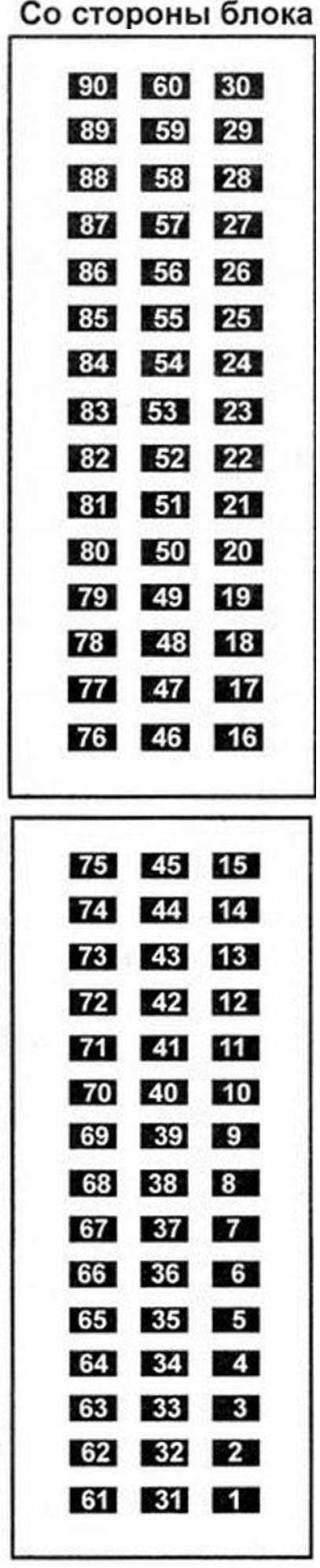 |
1 - control of ignition coil 2-3,
3 - power circuit mass, 4 - absorber cleaning control, 8 - control of relay 1 of the electric fan unit of the coolant temperature control system, 9 - coolant temperature lamp, 10 - air conditioning compressor control, 12 - idle speed controller control (contact B), 13 - coolant temperature sensor input, 15 - pressure sensor mass, 16 - manifold pressure sensor signal input, 18 - refrigerant pressure sensor signal, 19 - knock sensor screen, 20 - knock sensor signal input, 24 - crankshaft speed sensor signal input, 26 - diagnostics, 28 - power circuit mass, 29 - "+" after ignition switch, 30 - "+" to the ignition switch, 32 - ignition coil control 1-4, 33 - power circuit mass, 38 - control of relay 2 of the electric fan unit of the coolant temperature control system, 39 - drive relay control, 41 - idle speed controller control (contact), 42 - idle speed controller control (contact C), 43 - throttle potentiometer signal, 45 - oxygen sensor signal input, 46 - air conditioner signal, 49 - air temperature sensor input, 53 - vehicle speed input, 54 - crankshaft speed sensor signal input, 56 - diagnostics, 58 - anti-theft engine start blocking system, 59 - control of injector 1, 60 - control of injector 3, 63 - oxygen sensor heating control 66 - "+" after ignition switch, 68 - fuel pump relay control, 70 - information about engine speed TDC, 72 - idle speed controller control (contact D), 73 - coolant temperature sensor mass, 74 - throttle potentiometer power supply, 75 - throttle potentiometer mass, 77 - air temperature sensor mass, 78 - pressure sensor power supply, 79 - mass of the knock sensor, 80 - oxygen sensor mass, 82 - refrigerant pressure sensor mass, 83 - power supply of the refrigerant pressure sensor, 85 - information about the power steering pressure relay (depends on the model), 89 - control of injector 4, 90 - injector control 2 |
Equipment for testing
It is recommended to use a universal digital multimeter for testing. It should have a high input resistance (not less than 10 kOhm/V) and measurement ranges: voltage 0-20 V, resistance 0-200 Ohm and 0-20 kOhm. In some cases, it is necessary to use an oscilloscope.
Verification procedure
- Make sure the ignition is off.
- Connect the test leads with contacts that match the terminal sizes to the measuring instrument.
- To make the connector easier to access, remove the control unit.
- To access the connector terminals from the wire side, remove the connector cover or protective cover.
- Check the reliability of the control unit connector connection.
- Use the connector diagram to determine the pin numbers.
- The measuring instrument probes must be connected to the terminals on the wire side only. One probe is connected to the connector terminal, and the other to ground or another terminal of the control unit.
Caution! Avoid short-circuiting the terminals to ground. This may result in failure of the control unit, wiring or sensors.
- Please note the test conditions (for example: "ignition ON", "cranking" or "speed 3000 rpm").
- Measure the signals at the indicated terminals and compare with the nominal signal magnitude or shape given in the table.
| Components/Chains | Block output | Signal | Conditions for conducting the inspection | Nominal value | Oscilloscope settings* | Signal form |
| Air Conditioning Compressor Clutch Relay - Some Models | 10 |  | Ignition ON. | 11-14 V | ||
| 10 | | Engine running air conditioning OFF. | 11-14 V | |||
| 10 | | Engine running, air conditioning ON. | 0.1 V | |||
| Electronic control unit of air conditioner some models | 10 | | Ignition ON. | 11-14 V | ||
| 10 | | Engine running air conditioning OFF. | 11-14 V | |||
| 10 | | Engine running, air conditioning ON. | 0.1 V | |||
| 23 | ¦ | |||||
| 46 | | Engine running, air conditioning ON. | 0 B | |||
| Air Conditioning Refrigerant Pressure Sensor - Some Models | 18 | | Ignition ON. | 0.6 V | ||
| 82 |  | Ignition ON. | 0 B | |||
| 83 |  | Ignition ON. | 5 V | |||
| Air Conditioner - Windshield Defroster Signal - Some Models | 88 | ¦ | ||||
| Battery | 30 | | Ignition OFF. | 11-14 V | ||
| Crankshaft position sensor | 24 | | Ignition ON. | 1.9 V | ||
| 24 | | Idling | 0.9 V? | 1 V/1 ms | 1 | |
| 54 | | Ignition ON. | 1.9 V | |||
| 54 | | Idling | 0.9 V? | 1 V/1 ms | 1 | |
| Diagnostic connector | 26 | Ignition ON. | 0 B | |||
| 56 | Ignition ON. | 0 B | ||||
| Weight | 3 | | Ignition ON. | 0 B | ||
| 28 | | Ignition ON. | 0 B | |||
| 33 | | Ignition ON. | 0 B |
| Components/Chains | Block output | Signal | Conditions for conducting the inspection | Nominal value | Oscilloscope settings* | Signal form |
| Engine Management System Relay | 39 |  | Ignition OFF. | 0 B | ||
| 39 | | Ignition ON. | 0.1 V | |||
| 66 | | Ignition ON. | 11-14 V | |||
| Cooling Fan Motor Relay | 8 | | Ignition ON. | 11-14 V | ||
| 8 | | Engine running condenser fan motor OFF. | 11-14 V | |||
| 8 | | Engine running condenser fan motor ON. | 0 B | |||
| 38 | | Ignition ON. | 11-14 V | |||
| 38 | | Engine running cooling fan motor OFF. | 11-14 V | |||
| 38 | | Engine running cooling system fan motor ON. | 0.1 V | |||
| High Coolant Temperature Indicator | 9 | | Ignition ON - indicator does not light | 11-14 V | ||
| 9 | | The engine is running, the indicator is not on | 11-14 V | |||
| 9 | | The engine is running, the indicator is on | 0 B | |||
| Coolant temperature sensor | 13 | | Ignition ON, coolant temperature 10°C approx | 3.5 V | ||
| 13 | | Ignition ON, coolant temperature 90°C approx | 0.5 V | |||
| 73 | | Ignition ON. | 0 B | |||
| Fuel vapor accumulator solenoid valve | 4 | | Idling | 1% | ||
| 4 | | Ignition ON. | 11-14 V | |||
| Fuel pump relay | 68 | | Ignition OFF. | 0 B | ||
| 68 | | Ignition ON. | briefly 0.9 V, then 11-14 V | |||
| 68 | | The engine is running | 0.9 V | |||
| Heated Oxygen Sensor - Front | 45 | | Ignition ON. | 0.4 V | ||
| 45 | | Idling | 0.1-0.9 V | |||
| 45 | | Idling | 0.2 V/1 s | 2 | ||
| 63 | | Ignition ON. | 11-14 V | |||
| 63 | | Idling | 5V/2ms | 9 | ||
| 80 | | Ignition ON. | 0 B | |||
| Heated Oxygen Sensor - Rear | 44 | | Ignition ON. | 0.4 V | ||
| 44 | | Idling | 0.6 V | |||
| 65 | | Ignition ON. | 11-14 V | |||
| 65 | | Idling | 5V/2ms | 9 | ||
| 76 | | Ignition ON. | 0 B |
| Components/Chains | Block output | Signal | Conditions for conducting the inspection | Nominal value | Oscilloscope settings* | Signal form |
| Idle Air Bypass Control Valve | 41(72) | | Idling | 4V/20ms | 4 | |
| 12(42) | | Idling | 4V/20ms | 4 | ||
| 12 | | Ignition ON. | 11-14 V | |||
| 42(12) | | Idling | 4V/20ms | 4 | ||
| 72 (41) | | Idling | 4V/20ms | 4 | ||
| 41 | | Ignition ON. | 11-14 V | |||
| 42 | | Ignition ON. | 0.3 V | |||
| 72 | | Ignition ON. | 0.27 V | |||
| Ignition coil cylinder 1 & 4 | 32 | | Ignition ON. | briefly 11-14 V then 0 V | ||
| 32 | | The engine is running | 4V/3ms | 5 | ||
| Ignition coil cylinder 2 & 3 | 1 | | Ignition ON. | briefly 11-14 V, then 0 V | ||
| 1 | | The engine is running | 4V/3ms | 5 | ||
| Ignition switch | 29 | | Ignition ON. | 11-14 V | ||
| Electronic immobilizer control unit - some models | 58 | Ignition ON. | 2V/50ms | 8 | ||
| Nozzle 1 | 59 | | Ignition ON. | 11-14 V | ||
| 59 | | Idling | 3.1 ms | 10 V/2 ms | 6 | |
| Nozzle 2 | 90 | | Ignition ON. | 11-14 V | ||
| 90 | | Idling | 3.1 ms | 10 V/2 ms | 6 | |
| Nozzle 3 | 60 | | Ignition ON. | 11-14 V | ||
| 60 | | Idling | 3.1 ms | 10 V/2 ms | 6 | |
| Nozzle 4 | 89 | | Ignition ON. | 11-14 V | ||
| 89 | | Idling | 3.1 ms | 10 V/2 ms | 6 | |
| Instrument cluster control unit crankshaft speed signal | 70 | | Idling | 25 Hz approximately | ||
| 70 | | 3000 rpm | 100 Hz approximately | |||
| Instrument cluster control unit - fuel consumption signal - some models | 11 | | Idling | 4 V/0.2 s | 3 | |
| Instrument cluster control unit - vehicle speed signal some models | 53 | | ¦ | |||
| Intake Air Temperature Sensor | 49 | | Ignition ON, air temperature 10°C approx | 2.4 V | ||
| 77 | | Ignition ON. | 0 B | |||
| Knock sensor | 20 | | Idle - short-term acceleration | 0.1 V/0.5 ms | 7 | |
| 79 | | Ignition ON. | 0B | |||
| Knock sensor shielded wire | 19 | | Ignition ON. | 0B | ||
| Manifold Absolute Pressure Sensor | 15 | | Ignition ON. | 0 B | ||
| 16 | | Ignition ON. | 4.8 V | |||
| 16 | | Idling | 1.6 V | |||
| 16 | | Idle - short-term acceleration | 4.8 V | |||
| 78 | | Ignition ON. | 5 V |
| Components/Chains | Block output | Signal | Conditions for conducting the inspection | Nominal value | Oscilloscope settings¹ | Signal form |
| Malfunction Indicator Light (MIL) - Some Models | 34 | Ignition ON - indicator lights up | 0 B | |||
| 34 | The engine is running, the indicator is not on | 1-14 V | ||||
| Multifunctional control unit some models | 58 | Ignition ON. | 2V/50ms | 8 | ||
| Multifunctional control unit some models | 88 | ¦ | ||||
| 58 | ¦ | |||||
| Power Steering Pressure Switch - Some Models | 85 | | The engine is running, the steering wheel is motionless | 11-14 V | ||
| 85 | | The engine is running, the steering wheel is turning | 0 B | |||
| Throttle position sensor | 43 | | Ignition ON, throttle closed | 0.5 V | ||
| 43 | | Ignition ON, throttle fully open | 4.5 V | |||
| 74 | | Ignition ON. | 5 V | |||
| 75 | | Ignition ON. | 0 B | |||
| Electronic control unit of automatic transmission | 27 | ¦ | ||||
| 57 | ¦ |
* - Approximate settings - value of divisions voltage/time.
[Text of the original source on this website RENAULTBOOK.ru]
 - No specific signal value or random digital signal.
- Input signal - battery voltage or signal from a sensor.
- Output signal - the signal or voltage supplied to the component.
- Constant mass (sensor) - internal connection via control unit.
- Disconnectable ground - controlled by a transistor in the control unit.
- No specific signal value or random digital signal.
- Input signal - battery voltage or signal from a sensor.
- Output signal - the signal or voltage supplied to the component.
- Constant mass (sensor) - internal connection via control unit.
- Disconnectable ground - controlled by a transistor in the control unit.
Signal form
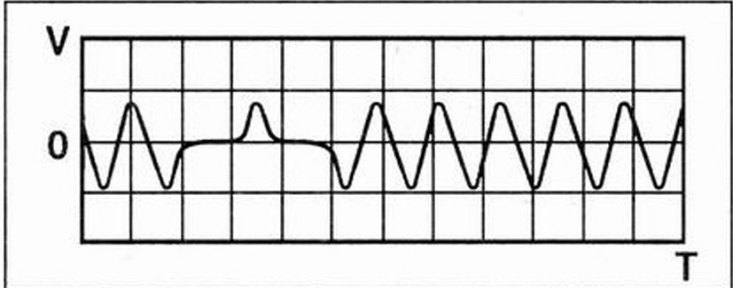
1 - Analog, AC, frequency modulated.
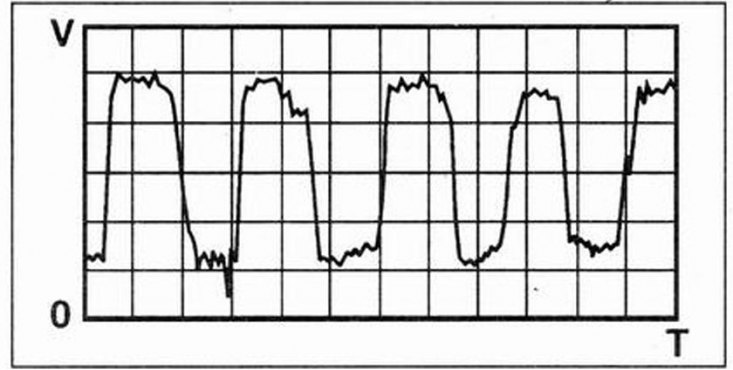
2 - Analog, DC.
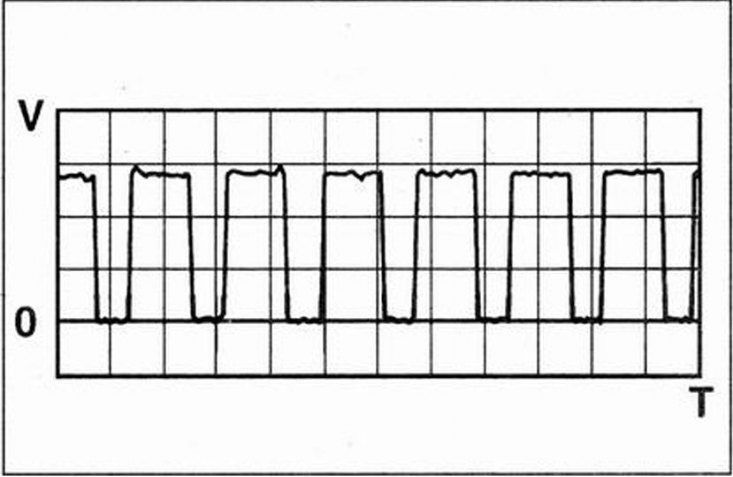
3 - Digital, DC, pulse-modulated or digital, DC, frequency-modulated.
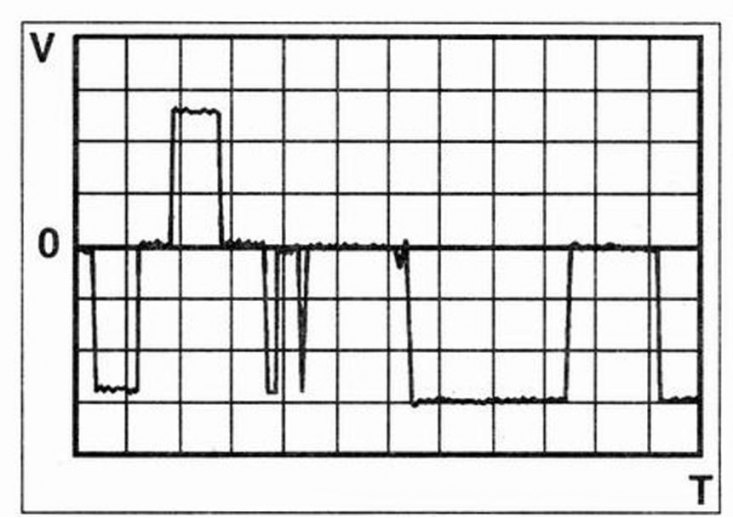
4 - Digital, DC, pulse-modulated or digital, DC, frequency-modulated.
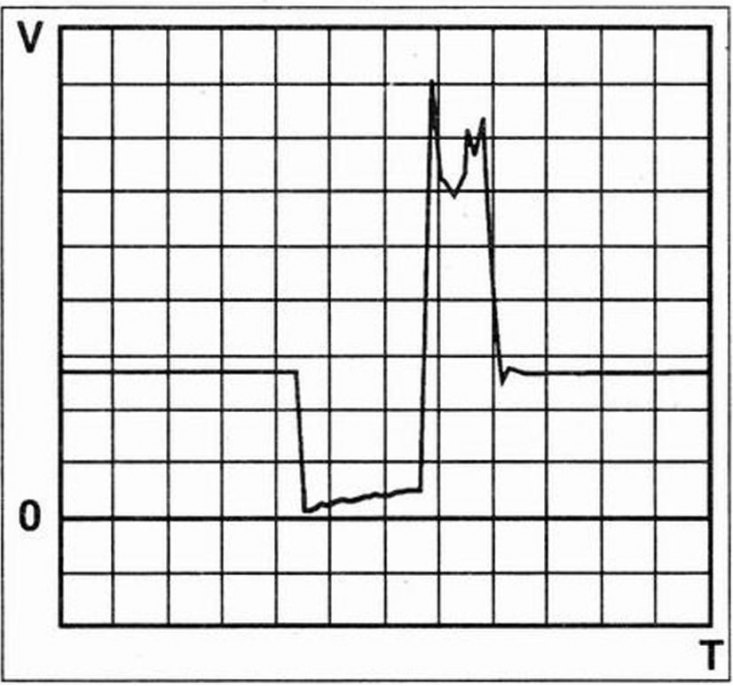
5 - Digital, DC, frequency modulated.
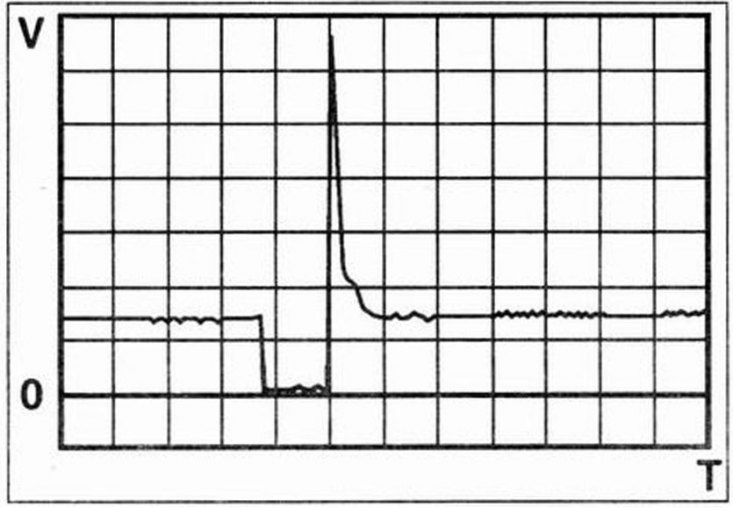
6 - Digital, DC, pulse modulated.
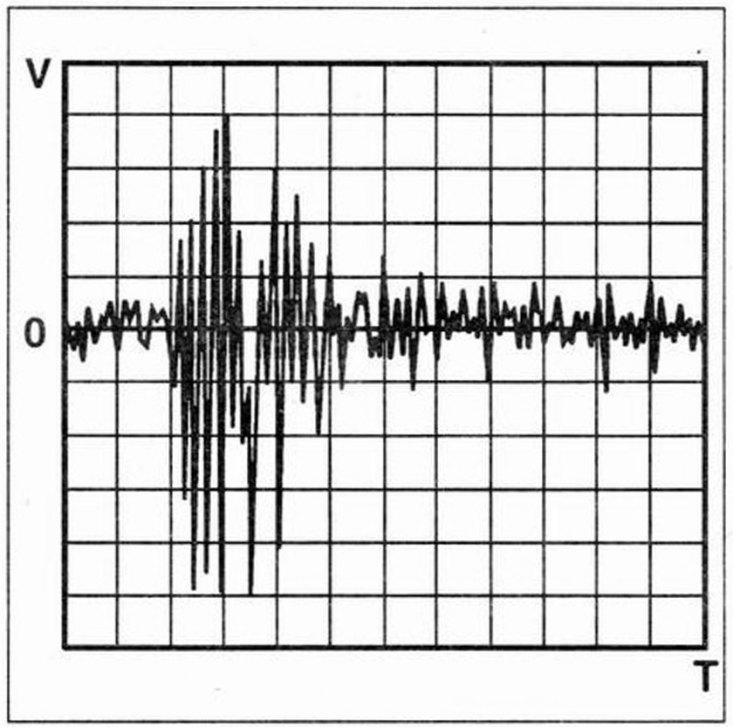
7 - Analog, AC.
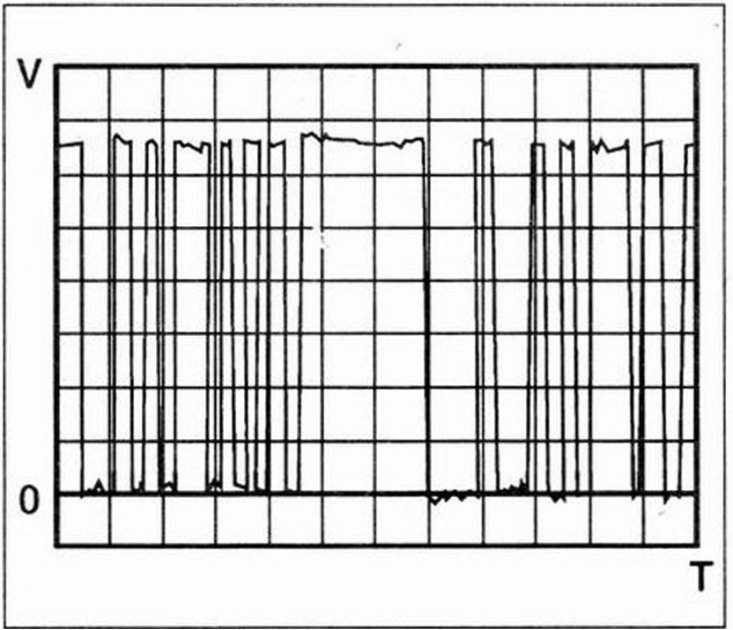
8 - Digital, DC.
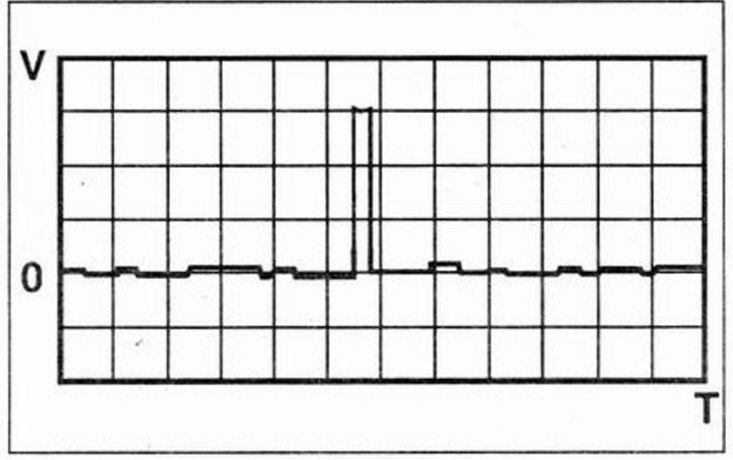
9 - Digital, DC.