
English Русский
Български
Беларускі
Український
Српски
Hrvatski
Română
Polski
Slovenský
Magyar
Bookmark Contacts Articles Sitemap
Company vehicles Peugeot Company vehicles Opel Company vehicles Skoda Company vehicles Land Rover Company vehicles Mitsubishi Company vehicles Volkswagen Company vehicles Honda
RenaultBook.ru


Duster   Fluence   Kangoo   Laguna   Logan   Megane   Sandero   Scenic   Symbol   Clio   Other
Symbol 1 (1999-2008, petrol) Symbol 2 (2008-2013, petrol)

Removal and installation the fuel pump (Renault Symbol 2)

  • Main
  • Symbol
  • Symbol 2 (2008-2013, petrol)
  • Power unit
  • Fuel system
  • Removal and installation the fuel pump
0
Contents: Removal 🠛 Installation 🠛

Removal


  • relieve pressure in the fuel system;
  • remove the wire from the negative terminal of the battery;
  • lift the back seat;
  • remove the metal cover on the rear floor to gain access to the pump cover;
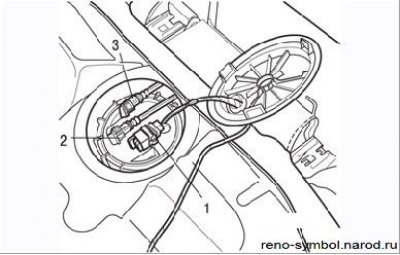
Figure 3.97. Fuel pump cover: 1-pin connector; 2 – fuel supply pipeline; 3 – drain pipe

Figure 3.97. Fuel pump cover: 1-pin connector; 2 – fuel supply pipeline; 3 – drain pipe

  • disconnect the electrical connector (Figure 3.97);
  • disconnect the quick release fitting of the fuel supply line (green color);
  • disconnect the quick release fitting of the drain pipe (red color). Plug the holes to prevent dirt from entering;
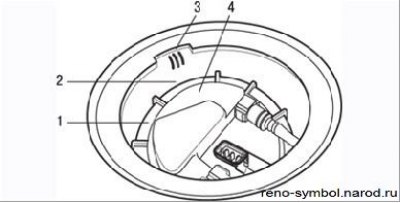
Figure 3.98. Fuel pump cover marking: 1 – round nut for fastening the fuel pump; 2 – mark on the…

Figure 3.98. Fuel pump cover marking: 1 – round nut for fastening the fuel pump; 2 – mark on the round nut; 3 – three marks on the fuel tank; 4 – mark on the fuel pump cover


  • fix the marking to align the elements of the unit (Figure 3.98). Place a wide-blade screwdriver against the protrusion of the round nut and tap it lightly with a hammer to loosen the nut, then unscrew it by hand;
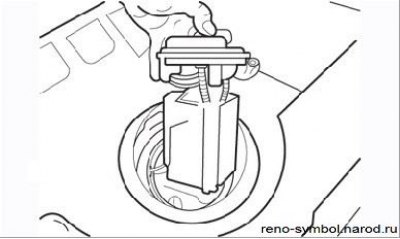
Figure 3.99. Removing the fuel pump from the fuel tank

Figure 3.99. Removing the fuel pump from the fuel tank

  • carefully remove the fuel pump and level sensor assembly from the tank (Figure 3.99);
  • inspect the sealing gasket. If it is free from defects, it can be reused.

Note: If several hours must pass between removal and installation of this unit, tighten the nut on the tank to avoid deformation.


Installation


  • clean the fuel pickup screen if necessary;
  • install the sealing gasket on the top of the fuel tank;
  • carefully place the pump into the tank;
  • align the marks as shown in Figure 3.99 and install the round nut. Tighten it securely and make sure the marks are aligned;
  • snap the pipe fittings;
  • connect the contact connector;
  • install the hatch plug;
  • perform the remaining operations in the reverse order of removal.
This article is available on: russian, bulgarian, belarusian, ukrainian, serbian, croatian, romanian, polish, slovak, hungarian
Article has been reviewed by editor: Kupriyanov Sergey
Share with friends:
Previous
Symbol 2: Fuel system
Next

Relieving pressure in the engine injection system
Fuel injection system Siemens «Sirius 32»
Description of the fuel system design
Removal, installation and adjusting the throttle cable
Removal and installation the throttle body
Removal and installation the fuel rail
Removal and installation the idle speed control valve
Fuel supply switch in case of collision
Other articles on other Renault models

➽ Manual fuel priming pump (K9K engine) Renault Duster 1 (2009-2017)
➽ Checking the electric fuel pump (all engines) Renault Fluence 1 (2009-2020, petrol)
➽ Fuel pump assembly with fuel level sensor Renault Kangoo 1 (1997-2007)
➽ Checking fuel pump performance (all engines) Renault Laguna 2 (2001-2007)
➽ Scheme 2. Fuel pump and fuel level sensor Renault Logan 1 (2004-2012, petrol)
Link to this article in different formats
Reviews and comments of visitors
No comments yet


Add two numbers 12 + 43


Symbol 2 (2008-2013, petrol) 
  • General information
  • User manual
  • Maintenance
  • Power unit
  • Engine repair
  • Cooling system
  • Fuel system
  • Exhaust system
  • Ignition system
  • Transmission
  • Clutch
  • Mechanical gearbox
  • Automatic gearbox
  • Drive shafts
  • Chassis, running gear
  • Front suspension
  • Rear suspension
  • Steering
  • Brake system
  • Body and interior
  • Exterior (external elements)
  • Interior (internal elements)
  • Doors, locks and windows
  • Heating and ventilation
  • Electrical equipment
  • Equipment and devices
  • Headlights and lighting
  • Power devices
  • Electrical circuits
Symbol 1 (1999-2008, petrol) 
  • General information
  • User manual
  • Car care
  • Maintenance
  • Power unit
  • Engine repair
  • Cooling and lubrication system
  • Supply system
  • Exhaust system
  • Ignition system
  • Transmission
  • Clutch
  • Mechanical gearbox
  • Automatic gearbox
  • Drive shafts
  • Chassis, running gear
  • Car suspension
  • Steering
  • Brake system
  • Body and interior
  • Exterior (external elements)
  • Interior (internal elements)
  • Doors, locks and windows
  • Restoration and repair
  • Electrical equipment
  • Equipment and devices
  • Headlights and lighting
  • Power devices
  • Heating and ventilation
  • Electrical circuits
RenaultBook.ru © 2018–2026 | Mobile version | News and articles | Sitemap: EN BG BY UA RS HR RO PL SK HU | Administration | Site search | Bookmark
Duster 1 (2009-2017) | Fluence 1 (2009-2020, petrol) | Kangoo 1 (1997-2007) | Laguna 2 (2001-2007) | Logan 1 (2004-2012, petrol) | Logan 2 (2012-2020) | Megane 1 (1995-2002) | Megan 2 (2002-2009, petrol) | Sandero 1 (2007-2012, petrol) | Scenic 1 (1996-2003) | Symbol 1 (1999-2008, petrol) | Symbol 2 (2008-2013, petrol) | Renault 19 (1988-1996) | Espace I and II (1984-1996) | Espace III (1996-2002) | Clio 1 (1990-1998) |
We want your visit to be comfortable 😌 and use cookies 🍪 to do so.