
English Русский
Български
Беларускі
Український
Српски
Hrvatski
Română
Polski
Slovenský
Magyar
Bookmark Contacts Articles Sitemap
Company vehicles Peugeot Company vehicles Opel Company vehicles Skoda Company vehicles Land Rover Company vehicles Mitsubishi Company vehicles Volkswagen Company vehicles Honda
RenaultBook.ru


Duster   Fluence   Kangoo   Laguna   Logan   Megane   Sandero   Scenic   Symbol   Clio   Other
Kangoo 1 (1997-2007)

Fuel vapor recovery system (Renault Kangoo 1)

  • Main
  • Kangoo
  • Kangoo 1 (1997-2007)
  • Power unit
  • Petrol engine D7F
  • Fuel vapor recovery system
0
Contents: Conditions for emptying the absorber 🠛 Solenoid valve 🠛 Fuel vapor absorber 🠛
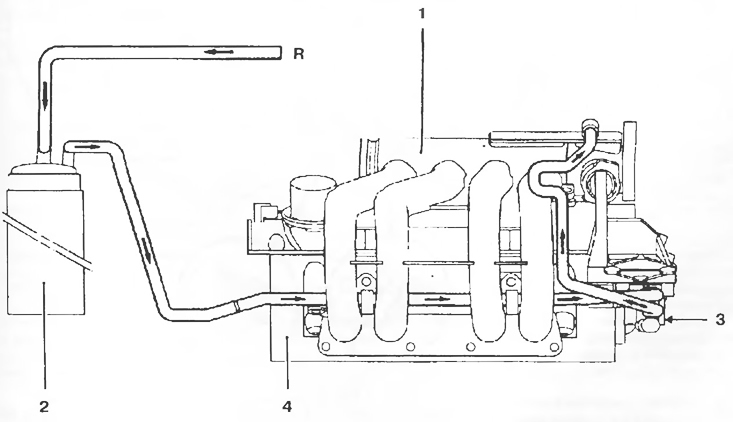
Figure 2.119a. Schematic diagram of the fuel vapor recovery system:

Figure 2.119a. Schematic diagram of the fuel vapor recovery system:
1 - Intake manifold;
2 - Fuel vapor absorber;
3 - Electromagnetic valve with cyclic opening control;
4 - Cylinder head;
R - Pipe coming from the fuel tank.


Conditions for emptying the absorber


1. Coolant temperature is above +15°C.

2. Air temperature is above +10°C.

Solenoid valve


The solenoid valve for draining the canister is mounted on the front of the engine on a lifting eye.
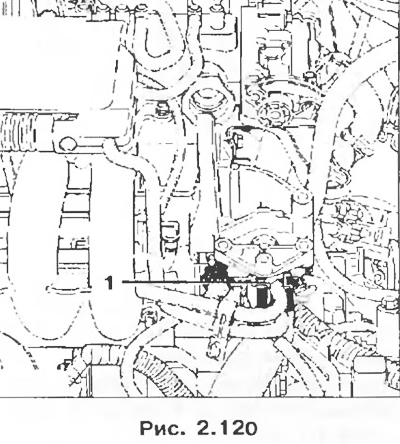
The solenoid valve for draining the canister is mounted on the front of the engine on a lifting eye.


Fuel vapor absorber


The absorber is located in the wheel arch of the front right wheel.
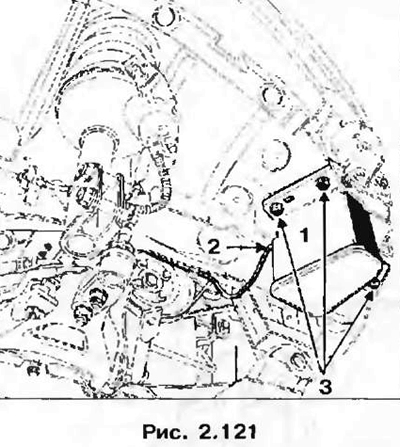
The absorber is located in the wheel arch of the front right wheel.


To remove the absorber:


  • from the engine compartment side, disconnect the pipe connecting the absorber to the manifold;
  • from underneath the car, remove the mudguard from the wheel arch;
  • disconnect pipe 2 connecting the absorber to the fuel tank;
  • unscrew the three bolts 3 securing the absorber 1 and remove it.

Original version on our portal renaultbook
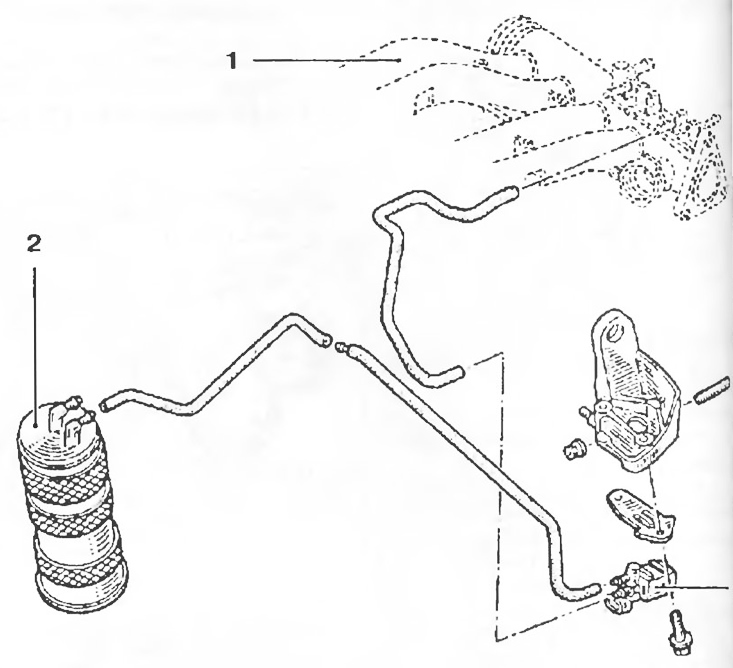
Figure 2.119b. Fuel vapor recovery system diagram

Figure 2.119b. Fuel vapor recovery system diagram
This article is available on: russian, bulgarian, belarusian, ukrainian, serbian, croatian, romanian, polish, slovak, hungarian
Article has been reviewed by editor: Fedoseev Denis
Share with friends:
Previous
Kangoo 1: Petrol engine D7F
Next

Coolant temperature sensor
Coolant Temperature Management
Cooling system pump
Cooling system
Crank mechanism
Oil vapor recovery system
Exhaust manifold
Exhaust gas system
Generator — General Information
Starter — General Information
Other articles on other Renault models

➽ Replacing the fuel vapor recovery system canister Renault Logan 1 (2004-2012, petrol)
➽ Replacing the fuel vapor recovery system canister Renault Sandero 1 (2007-2012, petrol)
➽ Functional diagram of the fuel supply system Renault Duster 1 (2009-2017)
➽ Technical characteristics of engines for diagnostic procedures… Renault Fluence 1 (2009-2020, petrol)
➽ Description of the fuel system design Renault Laguna 2 (2001-2007)
Link to this article in different formats
Reviews and comments of visitors
No comments yet


Add two numbers 31 + 39


Kangoo 1 (1997-2007) 
  • General information
  • User manual
  • Maintenance
  • Power unit
  • Petrol engine D7F
  • Petrol engine E7J
  • Diesel engine F8Q
  • Transmission
  • Clutch
  • Car gearbox
  • Drive shafts
  • Chassis, running gear
  • Car suspension
  • Steering
  • Brake system
  • Body and interior
  • Exterior and interior
  • Doors, locks and windows
  • Electrical equipment
  • Equipment and devices
  • Electrical circuits
RenaultBook.ru © 2018–2026 | Mobile version | News and articles | Sitemap: EN BG BY UA RS HR RO PL SK HU | Administration | Site search | Bookmark
Duster 1 (2009-2017) | Fluence 1 (2009-2020, petrol) | Kangoo 1 (1997-2007) | Laguna 2 (2001-2007) | Logan 1 (2004-2012, petrol) | Logan 2 (2012-2020) | Megane 1 (1995-2002) | Megan 2 (2002-2009, petrol) | Sandero 1 (2007-2012, petrol) | Scenic 1 (1996-2003) | Symbol 1 (1999-2008, petrol) | Symbol 2 (2008-2013, petrol) | Renault 19 (1988-1996) | Espace I and II (1984-1996) | Espace III (1996-2002) | Clio 1 (1990-1998) |
We want your visit to be comfortable 😌 and use cookies 🍪 to do so.