English Русский
Български
Беларускі
Український
Српски
Hrvatski
Română
Polski
Slovenský
Magyar
Bookmark Contacts Articles Sitemap
Company vehicles Peugeot Company vehicles Opel Company vehicles Skoda Company vehicles Land Rover Company vehicles Mitsubishi Company vehicles Volkswagen Company vehicles Honda
RenaultBook.ru


Duster   Fluence   Kangoo   Laguna   Logan   Megane   Sandero   Scenic   Symbol   Clio   Other
Sandero 1 (2007-2012, petrol)

Replacing the fuel vapor recovery system canister (Renault Sandero 1)

  • Main
  • Sandero
  • Sandero 1 (2007-2012, petrol)
  • Power unit
  • Fuel and exhaust system
  • Replacing the fuel vapor recovery system canister
0
The fuel vapor recovery system prevents fuel vapors from escaping from the fuel system into the atmosphere, which have an adverse effect on the environment.

The system uses a method of vapor absorption by a carbon adsorber. The adsorber is installed in the niche of the right front wheel and is connected by pipelines to the fuel tank and the engine intake tract.

An electromagnetic purge valve is located on the adsorber body, which switches the operating modes of the system based on signals from the engine control unit.

Fuel vapors from the fuel tank are constantly removed through a pipeline and accumulate in an adsorber filled with activated carbon (adsorbent). Regeneration occurs when the engine is running (recovery) adsorbent by purging the adsorber with fresh air entering the system under the action of vacuum transmitted through the pipeline from the inlet pipe to the adsorber cavity when the purge valve opens. The control unit regulates the degree of purge of the adsorber depending on the engine operating mode, sending a signal with a variable pulse frequency to the valve.

Fuel vapors from the adsorber enter the engine intake pipe through a pipeline and burn in the cylinders.

Malfunctions of the fuel vapor recovery system lead to unstable idle speed, engine stalling, increased toxicity of exhaust gases and deterioration of the vehicle's driving performance.

The fuel vapor recovery system canister is removed for inspection or replacement if a persistent smell of gasoline appears due to a leak in the canister or if the canister purge valve fails.


You will need: a 13 mm wrench and a flat-blade screwdriver.

1. Disconnect the wire from the negative terminal of the battery.

[Article reprinted from the website RenaultBook.ru]

2. Remove the right engine splash guard (see "Removal and installation mudguards and engine crankcase protection").
2. Remove the right engine splash guard (see «Removal and installation mudguards and engine…


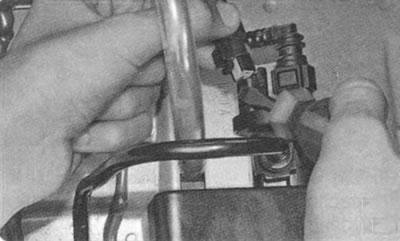
3. Disconnect the wiring harness connector from the canister purge valve...
3. Disconnect the wiring harness connector from the canister purge valve...


4. ...and the discharge line.
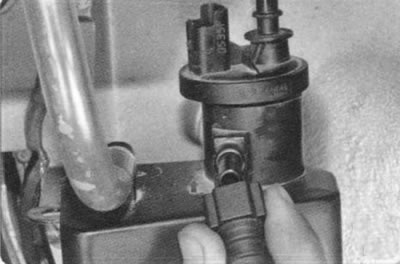
4. ...and the discharge line.


5. Disconnect the supply line.
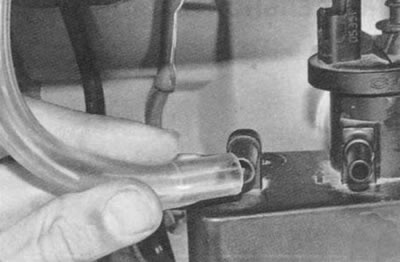


5. Disconnect the supply line.


6. Disconnect the ventilation hose from the adsorber fitting.
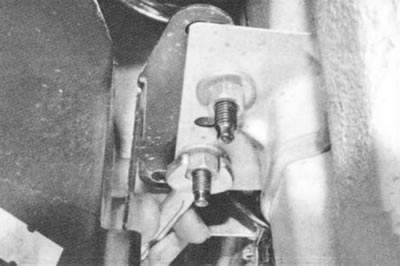
6. Disconnect the ventilation hose from the adsorber fitting.


7. Unscrew the two nuts securing the adsorber bracket.

8. Remove the canister assembly with the bracket.

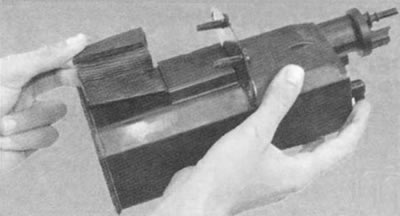
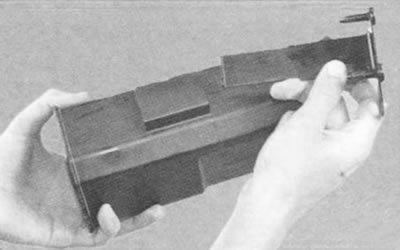
Helpful advice. If necessary, you can remove the adsorber without the bracket. To do this...

Helpful advice. If necessary, you can remove the adsorber without the bracket. To do this...


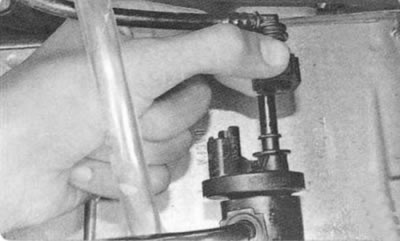
...move the adsorber up (for clarity, shown on a removed adsorber) until the rubber retainer comes out of its eye.

...move the adsorber up (for clarity, shown on a removed adsorber) until the rubber retainer comes…


Remove the retainer...

Remove the retainer...


...and remove the adsorber from the bracket.
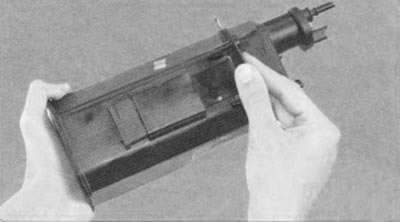

9. Install the parts in the reverse order of removal.
This article is available on: russian, bulgarian, belarusian, ukrainian, serbian, croatian, romanian, polish, slovak, hungarian
Article has been reviewed by editor: Podkrepilov Maxim
Share with friends:
Previous
Sandero 1: Fuel and exhaust system
 

Replacing the throttle cable
Adjusting the throttle cable tension
Replacing the idle speed control valve
Removal and installation the throttle assembly
Removal and installation the fuel rail
 
Other articles on other Renault models

➽ Replacing the fuel vapor recovery system canister Renault Logan 1 (2004-2012, petrol)
➽ Fuel vapor recovery system Renault Kangoo 1 (1997-2007)
➽ Functional diagram of the fuel supply system Renault Duster 1 (2009-2017)
➽ Technical characteristics of engines for diagnostic procedures… Renault Fluence 1 (2009-2020, petrol)
➽ Description of the fuel system design Renault Laguna 2 (2001-2007)
Link to this article in different formats
Reviews and comments of visitors
No comments yet


Add two numbers 25 + 36


Sandero 1 (2007-2012, petrol) 
  • General information
  • Structure of car
  • User manual
  • Troubleshooting
  • Maintenance
  • Practical advice
  • Power unit
  • Engine repair
  • Lubrication system
  • Cooling system
  • Fuel and exhaust system
  • Transmission
  • Clutch
  • Manual gearbox
  • Automatic gearbox
  • Drive shafts
  • Chassis, running gear
  • Front suspension
  • Rear suspension
  • Steering
  • Brake system
  • Wheels and tires
  • Body and interior
  • Exterior (external elements)
  • Interior (internal elements)
  • Doors, locks and windows
  • Car body care
  • Heater and air conditioner
  • Security system
  • Electrical equipment
  • Equipment and devices
  • Headlights and lighting
  • Power devices
  • Ignition system
  • Electrical diagrams
RenaultBook.ru © 2018–2026 | Mobile version | News and articles | Sitemap: EN BG BY UA RS HR RO PL SK HU | Administration | Site search | Bookmark
Duster 1 (2009-2017) | Fluence 1 (2009-2020, petrol) | Kangoo 1 (1997-2007) | Laguna 2 (2001-2007) | Logan 1 (2004-2012, petrol) | Logan 2 (2012-2020) | Megane 1 (1995-2002) | Megan 2 (2002-2009, petrol) | Sandero 1 (2007-2012, petrol) | Scenic 1 (1996-2003) | Symbol 1 (1999-2008, petrol) | Symbol 2 (2008-2013, petrol) | Renault 19 (1988-1996) | Espace I and II (1984-1996) | Espace III (1996-2002) | Clio 1 (1990-1998) |
We want your visit to be comfortable 😌 and use cookies 🍪 to do so.