
English Русский
Български
Беларускі
Український
Српски
Hrvatski
Română
Polski
Slovenský
Magyar
Bookmark Contacts Articles Sitemap
Company vehicles Peugeot Company vehicles Opel Company vehicles Skoda Company vehicles Land Rover Company vehicles Mitsubishi Company vehicles Volkswagen Company vehicles Honda
RenaultBook.ru


Duster   Fluence   Kangoo   Laguna   Logan   Megane   Sandero   Scenic   Symbol   Clio   Other
Logan 1 (2004-2012, petrol) Logan 2 (2012-2020)

Engine diagnostics by the appearance of spark plugs (Renault Logan 1)

  • Main
  • Logan
  • Logan 1 (2004-2012, petrol)
  • General information
  • Faults en route
  • Engine diagnostics by the appearance of spark plugs
0
Contents: 1. Normal candle. 🠛 2. Soot deposits. 🠛 3. Oil deposits. 🠛 4. Metal-containing plaque. 🠛 5. Early ignition. 🠛 6. Detonation. 🠛 7. Mechanical damage. 🠛

1. Normal candle.
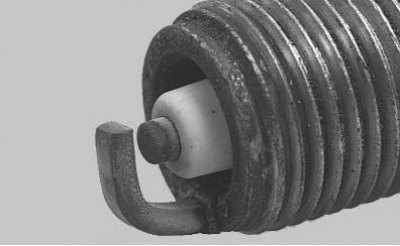


1. Normal candle.


Brown or grayish-yellowish color and slight wear of the electrodes. Exact match of the heat value of the spark plug to the engine and operating conditions.

Note: When replacing spark plugs with new ones, install spark plugs with the same characteristics from those recommended by the manufacturer.


2. Soot deposits.
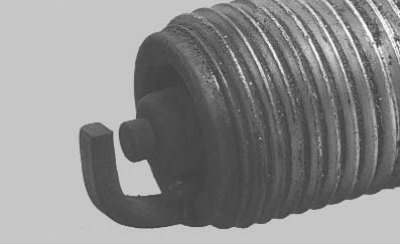


2. Soot deposits.


Dry soot deposits indicate a rich air-fuel mixture or late ignition. Causes misfires, difficult starting and erratic engine operation. Check for clogged air filter, coolant temperature and intake air temperature sensors.


Note: Use a "hotter" spark plug.


3. Oil deposits.
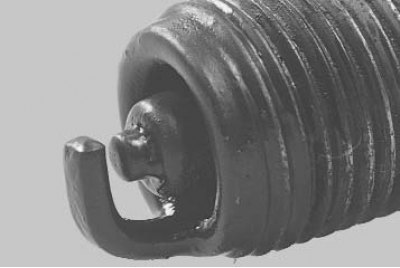


3. Oil deposits.


Oily electrodes and spark plug insulator. Cause: oil getting into the combustion chamber. Oil gets into the combustion chamber through valve guides or piston rings. Causes difficult starting, cylinder misfires and "twitching" of the running engine. Repair of the cylinder head and piston group of the engine is required. Replace the spark plugs.

4. Metal-containing plaque.
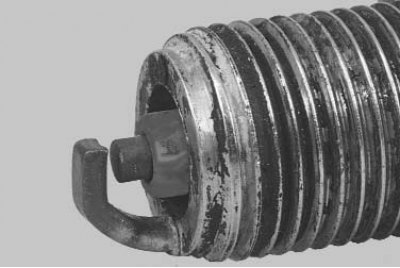


4. Metal-containing plaque.


Brick-red iron oxide deposits on the insulator skirt from anti-knock iron-containing additives (ferrocene) to gasoline. They are deposited in an even, dense layer. When the engine is running under heavy load, under the influence of high temperature and pressure in the combustion chamber, the oxides are reduced to conductive paths of pure iron, shorting the central electrode to ground. This causes misfires and, as a result, a drop in engine power and increased fuel consumption. In addition, the catalytic converter of exhaust gases can be damaged, overheating greatly when gasoline that has not burned in the engine cylinders gets into it. The deposit is practically impossible to remove mechanically and does not burn out during prolonged movement at high speed. If this deposit appears on new spark plugs after a short mileage, change the refueling location.


Article reprinted from the website www.Renaultbook.ru

Note: If you cannot immediately replace the spark plugs with new ones, try to remove this deposit by soaking the spark plugs with their insulator skirts in phosphoric acid or a rust converter for ten minutes (contains orthophosphoric acid). After this, clean off the plaque with a non-metallic brush (you can use an old toothbrush) and wash the spark plugs first with water and then with gasoline.


5. Early ignition.
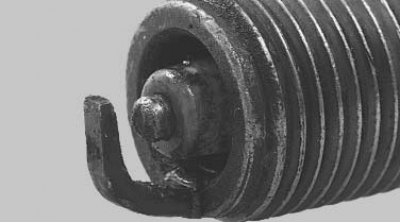


5. Early ignition.


Melted electrodes. The insulator is white, but may be contaminated due to spark misfires and deposits from the combustion chamber. May cause engine damage. It is necessary to check the spark plug type, the cleanliness of the injector nozzles and fuel filter, the operation of the cooling and lubrication systems.

6. Detonation.
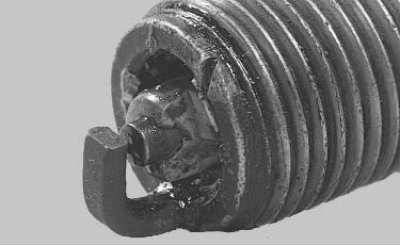


6. Detonation.


The insulator may be cracked or chipped. This may cause damage to the piston. Make sure the octane rating of the gasoline is correct.


7. Mechanical damage.


Damage can be caused by foreign objects entering the combustion chamber, and if a plug is used that is too long, its electrodes can snag the piston. This causes the plug to fracture, disable the cylinder and can damage the piston. Remove the foreign object from the cylinder and/or replace the plug.
This article is available on: russian, bulgarian, belarusian, ukrainian, serbian, croatian, romanian, polish, slovak, hungarian
Article has been reviewed by editor: Podkrepilov Maxim
Share with friends:
Previous
Logan 1: Faults en route
Next

Engine misfires
Idle speed is gone
Fuel injection system faults
Checking the engine fuel system
Checking the ignition system
The car moves in jerks
The car accelerates poorly
The engine stalled while driving
Oil pressure dropped
Engine overheating
Other articles on other Renault models

➽ Diagnostics of engine condition by external condition of spark… Renault Sandero 1 (2007-2012, petrol)
➽ Spark plugs Renault Fluence 1 (2009-2020, petrol)
➽ Diagnostics of the injection system of a gasoline engine… Renault Laguna 2 (2001-2007)
➽ Spark plugs (all engines) Renault Megan 2 (2002-2009, petrol)
➽ Spark plugs — replacement Renault Scenic 1 (1996-2003)
Link to this article in different formats
Reviews and comments of visitors
No comments yet


Add two numbers 16 + 44


Logan 2 (2012-2020) 
  • General information
  • Faults en route
  • Daily checks
  • Governing bodies
  • Maintenance
  • Power unit
  • Petrol engines 1.2 l
  • Petrol engines 1.6 l
  • Diesel engines 1.5 l
  • Cooling system
  • Lubrication system
  • Power and control system
  • Intake and exhaust system
  • Engine electrical equipment
  • Transmission
  • Clutch
  • Car gearbox
  • Drive shafts
  • Chassis, running gear
  • Suspension and wheels
  • Brake system
  • Steering
  • Body and interior
  • Exterior (external elements)
  • Interior (internal elements)
  • Safety system
  • Heating and air conditioning
  • Electrical equipment
  • Equipment and devices
  • Wiring diagrams (sedan)
  • Wiring diagrams (wagon)
Logan 1 (2004-2012, petrol) 
  • General information
  • Vehicle device
  • User manual
  • Faults en route
  • Daily maintenance
  • First maintenance
  • Second maintenance
  • Driver tips
  • Power unit
  • Engine repair
  • Lubrication system
  • Cooling system
  • Power and exhaust system
  • Transmission
  • Clutch
  • Car gearbox
  • Drive shafts
  • Chassis, running gear
  • Front suspension
  • Rear suspension
  • Steering
  • Brake system
  • Wheels and tires
  • Body and interior
  • Exterior (external elements)
  • Interior (internal elements)
  • Doors, locks and windows
  • Body Care
  • Electrical equipment
  • Equipment and devices
  • Headlights and lighting
  • Power devices
  • Electrical circuits
RenaultBook.ru © 2018–2026 | Mobile version | News and articles | Sitemap: EN BG BY UA RS HR RO PL SK HU | Administration | Site search | Bookmark
Duster 1 (2009-2017) | Fluence 1 (2009-2020, petrol) | Kangoo 1 (1997-2007) | Laguna 2 (2001-2007) | Logan 1 (2004-2012, petrol) | Logan 2 (2012-2020) | Megane 1 (1995-2002) | Megan 2 (2002-2009, petrol) | Sandero 1 (2007-2012, petrol) | Scenic 1 (1996-2003) | Symbol 1 (1999-2008, petrol) | Symbol 2 (2008-2013, petrol) | Renault 19 (1988-1996) | Espace I and II (1984-1996) | Espace III (1996-2002) | Clio 1 (1990-1998) |
We want your visit to be comfortable 😌 and use cookies 🍪 to do so.