



Contents: Cleaning 🠛 Inspection 🠛
Cleaning
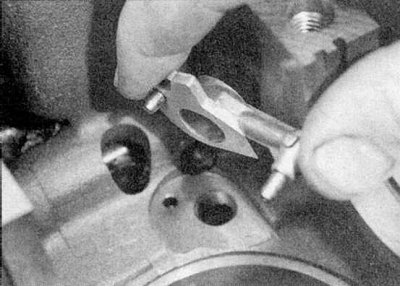
1. For complete cleaning, it is necessary to remove the plugs. Drill a small hole in them, then screw in a screw and remove the plugs using pliers or a sliding hammer. Remove the external components and sensors as well (if you haven't done so yet), making a note of their location. Where fitted, unscrew the drive belt tensioner bracket, coolant pipe and oil cooler from the cylinder block. On diesel engines, remove the piston oil jets at the base of each cylinder by unscrewing the mounting bolts (refer to the accompanying illustration).
2. Clean the cylinder block from any remaining gasket or sealant, being careful not to damage the surfaces.
3. If the block is very dirty, it must be cleaned with steam.
4. After steam cleaning, all oil holes and crankcase passages should be flushed. Run warm water through the internal passages until the water that flows out is clear. Dry the passages thoroughly with compressed air and apply a thin layer of oil to all contact surfaces to prevent corrosion. Also lubricate the cylinder walls with oil.
5. If the crankcase is not very dirty, clean it with hot soapy water and a stiff brush. Regardless of the cleaning method used, be sure to thoroughly clean all oil holes and passages, and then dry all components well. Protect the cylinder walls from corrosion.
(Article reprinted from the website: RenaultBook)
6. All tapped holes must be clean and dry to ensure accurate tightening torques during assembly. Run a suitable tap along each hole thread to clean and restore any rust, deposits or sealant. When finished, blow compressed air through the holes again to remove any dirt particles that may have appeared during this process. Also clean the threads of the cylinder head bolts and the main bearing cap bolts.
7. Install the main bearing caps and hand tighten the bolts.
8. Coat the contact surfaces of the new plugs with sealant and install them into the cylinder block.
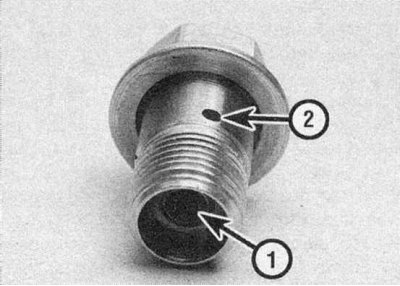
9a. On diesel engines, check the mesh filter (1).
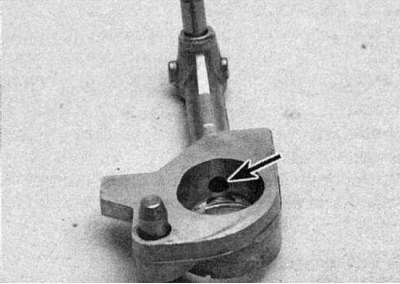
9b. Check the lubrication holes (2) in the nozzles themselves (refer to the illustrations). If necessary, clean them, then install the nozzles and tighten and tighten the mounting bolts to the torque specified in the Specifications. The protrusion on the nozzle must enter the corresponding hole in the cylinder block.
10. If the engine is not going to be assembled immediately, cover it with a large plastic bag.
Inspection
1. Inspect the crankcase parts for cracks and corrosion. Check the integrity of the threads in the holes. If there are signs of internal coolant leakage, have a specialist diagnose the block using special equipment. If defects are found, repair (if possible) or replace the unit.
2. Check the cylinder walls/liners for nicks and notches. Cylinder wear usually shows up as a step at the top of the cylinder that marks the end of the piston stroke.
3. Measure the diameter of each cylinder at the top (just below the wear step), in the central and lower part of the cylinder, parallel to the crankshaft axis.
4. Then measure the diameter of each cylinder at those three locations, but perpendicular to the crankshaft axis. If the difference between any of the measurements is more than 0.20 mm (i.e. there is ovality or conicity), then it is necessary to consider the issue of resharpening.
5. Repeat this procedure on the remaining cylinders.
6. If the cylinder walls are heavily worn or in case of ovality or taper, it is necessary to purchase new cylinder liners (e7J engine) or bore the cylinder block (all other engines). New pistons will also be required during assembly (repair dimensions in case of cylinder boring).
7. If the cylinders are in good condition, then it may only be necessary to replace the piston rings.
8. Before assembling the engine, it is necessary to hone the cylinders. This requires a special tool. As a result, the bearing surface of the piston rings increases, and accordingly, the tightness between the piston and the cylinder improves. There are two types of hones designed for use with a drill. "Bottle hone" - a hard, cylindrical brush with hard stones glued to the bristles. And a regular hone with hard stones mounted on spring-loaded supports. For an inexperienced mechanic, satisfactory results can be obtained using a "bottle hone". Honing is done as follows; You will need the tool described above, a wrench, a drill, a clean rag, oil and safety glasses. Mount the tool in the drill. Lubricate the cylinder bore with oil, insert the tool into the bore, squeezing the stones. Turn on the drill and move it up and down in the cylinder. Ideally, the honing lines should intersect at an angle of 60°, although some piston ring manufacturers may specify a different angle. Use oil. Do not remove more material than necessary. When finished, do not remove the tool from the bore while it is rotating; slide it down until the attachment stops, then remove the tool by rotating it manually in the normal direction.
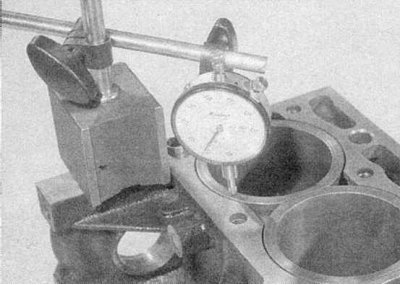
9a. Before installing the cylinder liner in the E7J engine, it is necessary to check their protrusion and install a new lower sealing ring. Insert the liner without the lower sealing ring into the cylinder block and press it down. Using a micrometer, check that the protrusion of the liner above the upper surface of the cylinder block corresponds to the data given in the Specifications (refer to the illustrations).
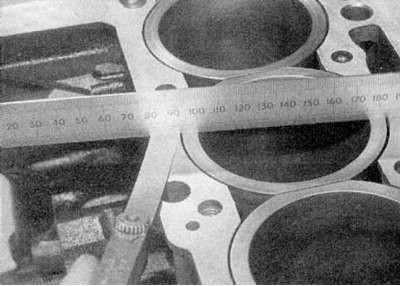
9b. The check can be done with feeler gauges (for engine E7J). Please note that there is also a limit (refer to the Specifications at the beginning of this Chapter) difference in protrusion between two adjacent sleeves. If new sleeves are installed, they may be selected so that all values are within the specified limits.
10. Reinstall all external components and sensors as noted prior to removal.