



Contents: Cleaning 🠛 Inspection and maintenance 🠛
A complete cleaning of the cylinder head components and valves followed by a detailed inspection will allow you to determine what procedures need to be performed during an engine overhaul.
Cleaning
1. Remove all traces of the old gasket from the cylinder head.
2. Clean any carbon deposits from the combustion chambers and bores, then thoroughly wash the cylinder head with kerosene or a suitable solvent.
3. Scrape off most of the carbon deposits from the valves, then use a wire brush to remove any remaining carbon deposits from the valve heads and stems.
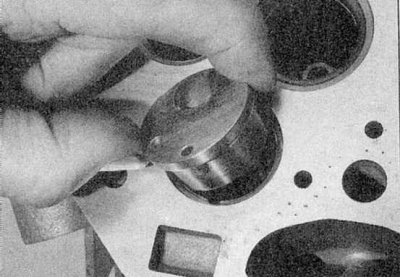
4. On F8Q engines, swirl chambers must be removed if they are loose (mark the location of the cameras so that they can be installed in their original place) (refer to the accompanying illustration).
5. If the head is extremely dirty, it should be cleaned with steam. Finally, make sure that all oil holes and oil channels are clean.
Note: Perform all inspection procedures before concluding that you need to go to a repair shop for regrinding. Make a list of all components that require regrinding.
Inspection and maintenance
Cylinder head
1. Carefully inspect the head for cracks and other damage, as well as coolant leaks. If cracks are found, replace the head.
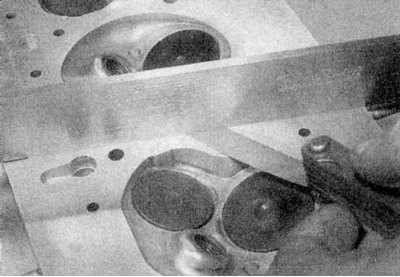
2a. Using a straightedge and feeler gauge, check the cylinder head surface for distortion. On F8Q engines, ensure that the straightedge does not pass over the swirl chambers, as they may protrude above the cylinder head seating surface. If the distortion exceeds the limit specified in the Specifications, the manufacturer does not recommend grinding the surface, and the only solution is to replace the cylinder head.
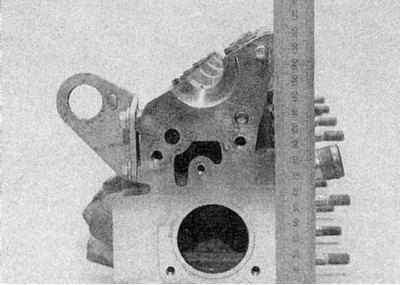
2b. Check that the overall height of the cylinder head corresponds to the value specified in the Specifications (refer to the illustrations).
3. Inspect all valve seats. If they are badly pitted, cracked or burnt, have them reground by a specialist. If the pitting is minor, it can be removed by grinding the head and valve seat with a special fine-grained paste as described below. Note that on diesel engines, valve seats can only be ground to a limited depth to avoid loss of compression. Using a micrometer, ensure that the depth of the valve below the cylinder head seating surface is within the limits given in the Specifications in Part C of this Chapter (refer to the accompanying illustration).
4. If the valve guides are worn (the valve moves along the horizontal axis), replace the guides. A micrometer can be used to determine the lateral movement of the valve. Install a new valve in the guide and check its lateral play to determine whether the valve or the guide itself is worn. If new guides are required, the valves must also be replaced. This work is best left to a specialist, as there is a risk of damaging the cylinder head if it is not done skillfully.
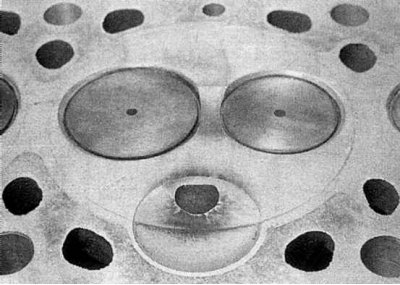
5a. On F8Q engines, inspect the swirl chambers for burnt areas or cracks. If necessary, the chambers can be replaced.
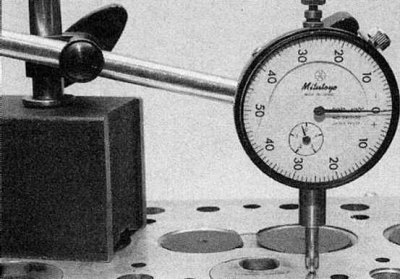
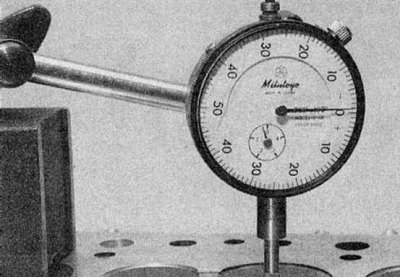
5b. Using a micrometer, check that the swirl chambers do not protrude from the head more than the specifications. Zero the micrometer on the cylinder head surface, then measure the swirl chamber protrusion (refer to the illustrations).
6. Where applicable, inspect the tappet seats in the cylinder head for signs of wear. If excessive wear is present, the cylinder head must be replaced.
(This note was copied from the resource: renaultbook)
7. Inspect the working surfaces of the camshaft bearings in the cylinder head (and bearing caps/fasteners where used). If worn, the head must be replaced.
Valves
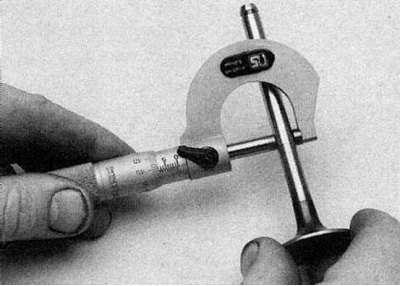
1. Inspect each valve head for pitting, burns, cracks and general wear. Check the valve stem for scratches and worn areas.
Rotate the valve and inspect it for signs of deformation. Inspect the end of each stem for pitting and signs of excessive wear. If the valve appears to be in good condition, measure the stem diameter in several places with a micrometer (refer to the accompanying illustration). Any significant difference in the data obtained indicates that the valve stem is worn, meaning that the valve must be replaced. If the valves are not damaged, they should be lapped to ensure a tight fit to the seats.
2. To grind the valves, turn the cylinder head over, placing wooden blocks under each end to provide clearance for the valve stems.
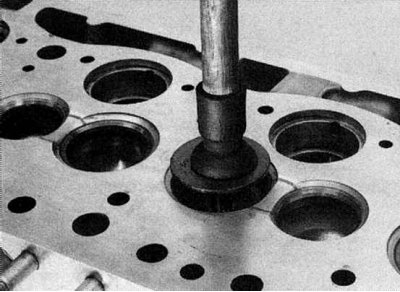
3. Apply the appropriate grade of lapping paste to the valve seat surface and attach a special suction cup to the valve head. Rotate the valve back and forth half a turn to grind the valve head against the seat, occasionally lifting the valve to redistribute the paste (refer to the accompanying illustration). Installing a weak spring under the valve head will make the job much easier. If a coarse grinding paste is used, work until the contact surfaces of the seat and valve become dull and matte, then wipe off the compound and repeat the process with a fine-grained paste. When the seat and valve surfaces acquire an even light gray color, lapping is considered complete. Do not lap the valves longer than necessary, this will lead to an unwanted deepening of the seat into the cylinder head. When all the valves are lapped, carefully wash off all traces of grinding paste using kerosene or a suitable solvent.
Valve components
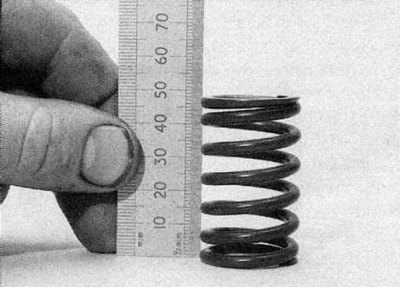
1. Inspect the valve springs for signs of damage and discoloration, and measure their free length with a ruler (refer to the accompanying illustration), or compare with a new spring.
2. Place each spring on a flat surface and check them for deformation using a square. If any of the springs are damaged, distorted or weak, purchase a new complete set of springs. It is recommended that the springs be replaced after each removal during an engine overhaul, regardless of their condition.
3. Where applicable, check tappets and adjusting washers for scratches, corrosion (especially on washers) and wear. Replace all components as necessary.
Rocker Arm Components - E7J and K7M Engines
1. Inspect the rocker arm contact surfaces for pits, scratches, or other signs of wear. Disassemble the rocker shaft and inspect the rocker arms, pivot pins, and contact surfaces in the same manner. Measure the inside diameter of each rocker arm and check that it fits on the shaft. Clean out the oil passages in each rocker arm using a piece of wire. Replace the rocker arms or pivot pins if necessary.
Oil deflector caps
1. The oil seals should be replaced after each removal.