
English Русский
Български
Беларускі
Український
Српски
Hrvatski
Română
Polski
Slovenský
Magyar
Bookmark Contacts Articles Sitemap
Company vehicles Peugeot Company vehicles Opel Company vehicles Skoda Company vehicles Land Rover Company vehicles Mitsubishi Company vehicles Volkswagen Company vehicles Honda
RenaultBook.ru


Duster   Fluence   Kangoo   Laguna   Logan   Megane   Sandero   Scenic   Symbol   Clio   Other
Megane 1 (1995-2002) Megan 2 (2002-2009, petrol)

Disassembling the cylinder head (Renault Megane 1)

  • Main
  • Megane
  • Megane 1 (1995-2002)
  • Power unit
  • Overhaul of engines
  • Disassembling the cylinder head
0
Contents: Petrol engines 🠛 Diesel engines 🠛 All engines 🠛
Note: Given that special tools are required to remove and inspect the head, it is recommended that you purchase a new or reconditioned component from an engine rebuilder. This may ultimately be cheaper than rebuilding the head yourself.


Warning! On F7R engines, the exhaust valves contain sodium to improve heat transfer. These valves CANNOT BE DISPOSED with their contents. It is better to cut them in half and soak them in water (4 valves will require 10 liters). Observe the necessary safety precautions.


Petrol engines


1. Remove the rocker shaft (1.4 and 1.6 l engines), camshafts and tappets.

Diesel engines


1. Remove the brake vacuum pump (refer to Chapter Brake system), fuel injectors and fuel pump if removed with the cylinder head and camshaft and tappets.

All engines


All engines


This note was copied from the resource: www.RENAULTBOOK.ru

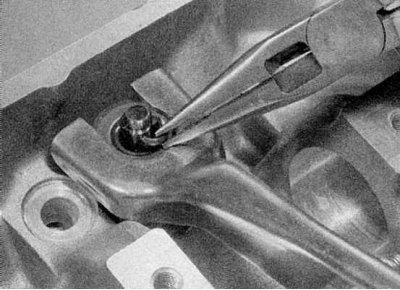
1a. Using a puller, compress the valve springs one by one and remove the crackers.
1a. Using a puller, compress the valve springs one by one and remove the crackers.


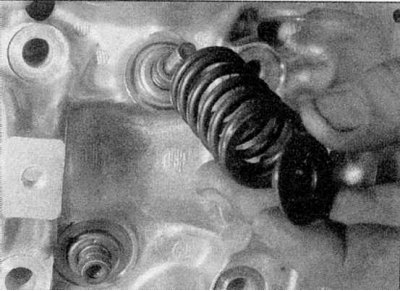
1b. Then release the puller and remove the cover, spring.


1b. Then release the puller and remove the cover, spring.


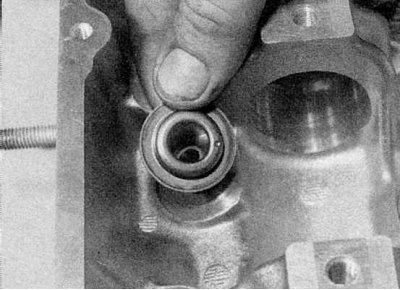
1c. Remove the spring support (refer to the illustrations).
1c. Remove the spring support (refer to the illustrations).


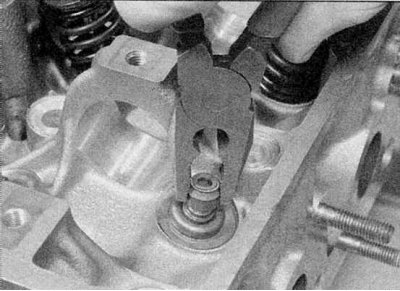
2a. Remove the oil seal from the top of the valve guide.
2a. Remove the oil seal from the top of the valve guide.


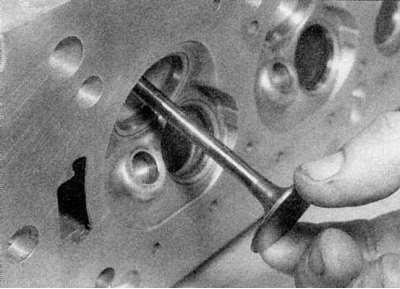
2b. Then remove the valve through the combustion chamber (refer to the illustrations).
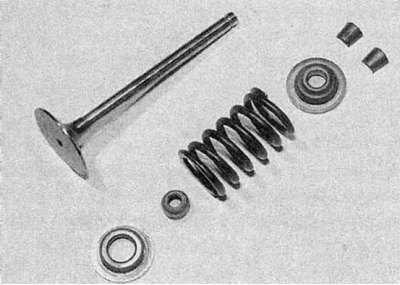
2b. Then remove the valve through the combustion chamber (refer to the illustrations).


3a. It is very important to store valves and related components together in the correct sequence if they are to be used again.
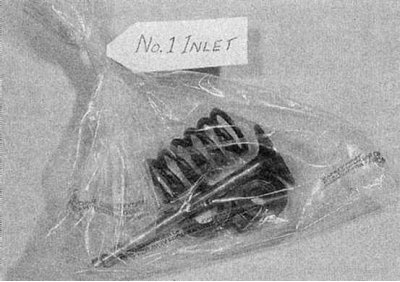


3a. It is very important to store valves and related components together in the correct sequence if…


3b. To do this, place them in labeled plastic bags (refer to the illustrations).
This article is available on: russian, bulgarian, belarusian, ukrainian, serbian, croatian, romanian, polish, slovak, hungarian
Article has been reviewed by editor: Fedoseev Denis
Share with friends:
Previous
Megane 1: Overhaul of engines
Next

Disassembly sequence — engine overhaul
Removal and installation of diesel engine and gearbox
Removal and installation of gasoline engine and automatic transmission
Removal and installation of a petrol engine and manual transmission
Engine Removal Methods and Precautions
Cleaning, inspection and maintenance of the cylinder head and valves
Cylinder head assembly
Removal, condition check and installation of the flywheel and drive…
Replacing the left (flywheel side) crankshaft oil seal
Removal and installation the oil pan (K7M with aluminum pan)
Other articles on other Renault models

➽ Disassembling the cylinder head Renault Logan 2 (2012-2020)
➽ Cylinder head cover Renault Duster 1 (2009-2017)
➽ Cylinder head gasket for K4M engine Renault Fluence 1 (2009-2020, petrol)
➽ Tightening the cylinder head bolts Renault Kangoo 1 (1997-2007)
➽ Removal the cylinder head gasket (K4M engines) Renault Laguna 2 (2001-2007)
Link to this article in different formats
Reviews and comments of visitors
No comments yet


Add two numbers 15 + 12


Megan 2 (2002-2009, petrol) 
  • User manual
  • Introduction to manual
  • Controls and instruments
  • Salon equipment
  • Operation and driving
  • Maintenance and care
  • Power unit
  • Engine repair
  • Fuel system
  • Injection system
  • Intake and exhaust system
  • Starting and charging system
  • Cooling system
  • Decreased toxicity
  • Transmission
  • Clutch
  • Mechanical gearbox
  • Automatic gearbox
  • Wheel drive mechanism
  • Chassis, running gear
  • Suspension and wheels
  • Steering
  • Brake system
  • Body and interior
  • Exterior (external elements)
  • Interior (internal elements)
  • Doors, locks and windows
  • Heating and air conditioning
  • Electrical equipment
  • Equipment and devices
  • Headlights and lighting
  • Electrical circuits
Megane 1 (1995-2002) 
  • General information
  • User manual
  • Maintenance
  • Power unit
  • Petrol engines 1.4/1.6 l
  • Petrol engines 2.0 l
  • Diesel engines 1.9 l
  • Overhaul of engines
  • Cooling system
  • Fuel system (petrol)
  • Fuel system (diesel)
  • Decreased toxicity
  • Charge and launch systems
  • Ignition system (petrol)
  • Preheat system (diesel)
  • Transmission
  • Clutch
  • Mechanical gearbox
  • Automatic gearbox
  • Drive shafts
  • Chassis, running gear
  • Brake system
  • Car suspension
  • Steering
  • Body and interior
  • Exterior (external elements)
  • Interior (internal elements)
  • Doors, locks and windows
  • Electrical equipment
  • Equipment and devices
  • Electrical circuits
RenaultBook.ru © 2018–2026 | Mobile version | News and articles | Sitemap: EN BG BY UA RS HR RO PL SK HU | Administration | Site search | Bookmark
Duster 1 (2009-2017) | Fluence 1 (2009-2020, petrol) | Kangoo 1 (1997-2007) | Laguna 2 (2001-2007) | Logan 1 (2004-2012, petrol) | Logan 2 (2012-2020) | Megane 1 (1995-2002) | Megan 2 (2002-2009, petrol) | Sandero 1 (2007-2012, petrol) | Scenic 1 (1996-2003) | Symbol 1 (1999-2008, petrol) | Symbol 2 (2008-2013, petrol) | Renault 19 (1988-1996) | Espace I and II (1984-1996) | Espace III (1996-2002) | Clio 1 (1990-1998) |
We want your visit to be comfortable 😌 and use cookies 🍪 to do so.