



Contents: Removal 🠛 Installation 🠛
Note: Renault recommends that the engine and transmission be lowered from the engine compartment.
Removal
1. Disconnect the ground cable from the battery (refer to Chapter Engine electrical equipment).
Warning: If the car radio in your car is coded, make sure you know the code before disconnecting the battery.
2. Remove the radiator as described in Chapter Cooling and heating system.
3. Drain the transmission fluid as described in Chapter Maintenance.
4. If necessary, drain the engine oil.
5. Remove the hood as described in Chapter Body.
6. Set the handbrake, then jack up the front of the car and support it on axle stands. Remove both front wheels. Where fitted, remove the engine undershield.
7. Remove the front wheel arch liners.
8. Unscrew the rods securing the subframe to the body on each side of the car.
9. Remove the front brake calipers from the steering knuckles as described in Chapter Brake system, and tie them to the body.
10. On models with ABS, unscrew the wheel speed sensors and remove them from the steering knuckles.
11. Remove the front bumper as described in Chapter Body.
12. Remove the exhaust pipe and catalytic converter, following the procedure described in Chapter Power and exhaust systems.
13. Remove the sound signal as described in Chapter On-board electrical equipment.
14. Remove the air cleaner assembly as described in Chapter Power and exhaust systems.
15. Unscrew the ground cable from the bulkhead.
16. Disconnect the manifold pressure sensor hose from the intake manifold and disconnect the electrical wiring from the sensor.
17. Remove the expansion tank and attach it to the engine/transmission assembly.
18. Disconnect the gas pedal cable from the throttle body.
19. Disconnect the electrical wiring from the downshift mechanism.
20. Disconnect the brake booster unit hose from the intake manifold.
21. Remove the top and side covers from the relay box on the left side of the engine compartment, then release the relay board and wiring ties and move the wiring to the engine.
22. Disconnect the electrical wiring from the automatic transmission control unit on the left side of the engine compartment.
23. Disconnect the carbon canister hose from the solenoid valve on the intake manifold.
24. Disconnect the starter power cable from the battery. To do this, remove the battery (Chapter Engine electrical equipment) and disconnect the wiring harness, then release the cable from the cover/sealing ring in the engine compartment bulkhead panel. Also disconnect the fuel injection system supply wire.
25. Loosen the clamps and disconnect the fuel supply and return hoses from the fuel line.
26. Disconnect the heater hoses from the thermostat housing.
27. Disconnect the gear selector control from the transmission (refer to Chapter Transmission).
28. Remove the auxiliary drive belt (refer to Chapter Maintenance).
29. Remove the pulley from the power steering pump as described in Chapter Suspension and steering.
30. Remove the three power steering pump mounting bolts and, where applicable, the four air conditioning compressor mounting bolts. Move the pump and compressor aside, but do not disconnect the pipes.
31. Release the A/C low pressure line from the lower engine/transmission mount.
32. Remove the left engine/transmission mount. But first, insert a wooden wedge between the transmission and the left side of the subframe to support the weight of the transmission. On K7M engines, loosen the lower mount nut from the subframe and the upper mount nut from the bracket. On F3R engines, loosen the nut from the top of the mount, then use a mallet to tap out the through-strut.
33. Remove the right engine/transmission bracket.
34. Attach the winch to the lifting eyes and lift the engine slightly.
35. Turn away (but don't take it off) nut from the rear linkage block of the rear engine/transmission mount, then unscrew and remove the bolt of the front part of the linkage. Unscrew the rear mount bracket from the transmission.
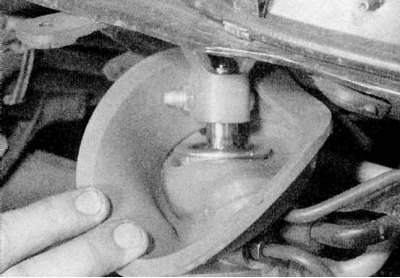
36. Set the front wheels to the straight ahead position. Working in the engine compartment, slide the rubber sealing ring back, then loosen the eccentric bolt securing the steering column base to the steering gear and remove the steering column (refer to Chapter Suspension and steering) (refer to the accompanying illustration).
Caution! On models with an airbag, it is important not to damage the sliding contact of the airbag below the steering wheel. Before removing the steering column, the steering wheel must be locked using a special tool.
(Text provided by an online resource renaultbook)
37. Loosen the four bolts securing the subframe to the bottom at the corners so that it drops by 10 mm.
38. Loosen the bolts securing the two reinforcing brackets to the bottom.
39. Loosen the steering gear mounting bolts as much as possible. The two reinforcing brackets must be left in place.
40. Remove the bolts and heat shields from underneath the gear shift lever, then unhook the return spring from the gear shift rod.
41. Turn the rod back and secure it in this position.
42. Remove the speed/crankshaft position sensor, disconnect the electrical wiring and free it from the subframe.
43. Prepare a dolly with wooden blocks to support the subframe and check that the engine/transmission assembly is securely supported. Renault mechanics use a special dolly (Mot. 1040-01) and supporting tools Mot. 1159 and Mot. 1159-02.
44. Remove the bolts securing the subframe to the underbody, noting the location of the spacers and washers. Don't forget to remove the bolts securing the power steering tube to the subframe.
45. Unscrew the bolts of the upper fastening of the front suspension strut from the towers.
46. Raise the car body, then release the handbrake and move the car backwards. Then lower the car to the ground and set the handbrake.
47. Have an assistant move the lower portions of the suspension struts outward while simultaneously freeing the drive shafts from the transmission. Tie up the drive shafts.
48. Once again, ensure that all components that may interfere with removal of the engine/transmission assembly have been removed or separated. Remove the assembly from the subframe.
Installation
1. Install in the reverse order, tightening all nuts and bolts to the torque specified in the Specifications. When securing the subframe to the underbody, screw 100 mm long rods into the nuts to adjust the position of the bolt holes. With the front of the subframe aligned, insert the rear bolts, then remove the rods and insert the front bolts. When connecting the steering column to the steering gear, refer to Chapter Suspension and steering. Bring the fluid level in the power steering hydraulic system to the normal level. Fill the engine with oil and the cooling system with coolant as described in Chapter Maintenance. Fill the automatic transmission as described in Chapter Transmission. Before performing a test drive, press the brake pedal several times to bring the brake pads to their normal position.