



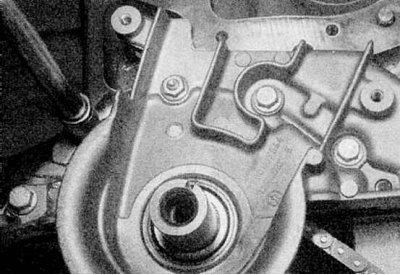
2. Unscrew the lower inner cover of the timing belt (where is available), then unscrew the fastening nuts/bolts and remove the oil seal housing and the crankshaft oil seal itself from the drive belt side (refer to the accompanying illustration).
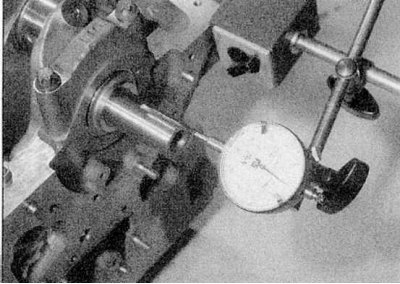
3. Before removing the crankshaft, check its axial clearance with a micrometer (refer to the accompanying illustration). Push the crankshaft fully to one side and then set the micrometer to zero. Pull the crankshaft fully to the other side and check the end play. The result can be compared to the Specifications to determine if new thrust washers are required.
4. If you don't have a micrometer, you can use feeler gauges. First push the crankshaft toward the flywheel/drive plate, then insert a feeler gauge between the crankshaft pin #2 counterweight and the center main bearing thrust washer (e7J and K7M engines), or between the counterweight of the crankshaft journal No.1 and the thrust washer of the main bearing No.2 (all other engines).
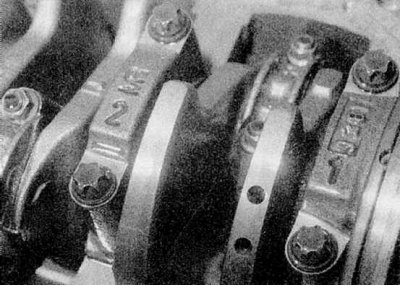
5. The main bearing caps should have numbers on the base. If they do not, number the cap and crankcase using a punch, as was done for the connecting rods and their caps (refer to the accompanying illustration).
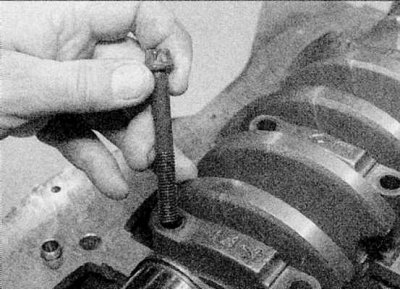
6. Loosen the main bearing cap mounting bolts and remove the caps together with the liners (refer to the accompanying illustration). Note that on all engines except the E7J and K7M, the main bearing cap No.1 is secured with internally splined bolts and is sealed with sealant.
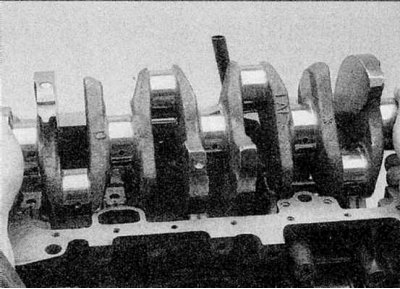
7. Carefully lift the crankshaft out of the crankcase (refer to the accompanying illustration).
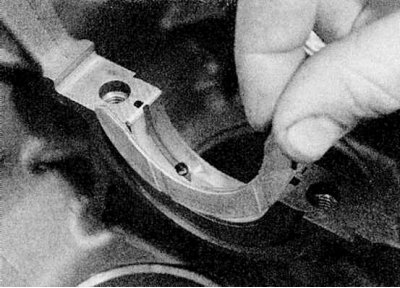
8. Remove the thrust washers from each side of the center main bearing (e7J and K7M engines) or main bearing No.2 (all other engines), then remove the upper halves of the liners from the crankcase (refer to the accompanying illustration).
9. Remove the crankshaft oil seal from the flywheel/drive plate side.