
English Русский
Български
Беларускі
Український
Српски
Hrvatski
Română
Polski
Slovenský
Magyar
Bookmark Contacts Articles Sitemap
Company vehicles Peugeot Company vehicles Opel Company vehicles Skoda Company vehicles Land Rover Company vehicles Mitsubishi Company vehicles Volkswagen Company vehicles Honda
RenaultBook.ru


Duster   Fluence   Kangoo   Laguna   Logan   Megane   Sandero   Scenic   Symbol   Clio   Other
Renault 19 (1988-1996) Espace I and II (1984-1996) Espace III (1996-2002)

Pistons and connecting rods — assembly (Renault Espace I)

  • Main
  • Renault
  • Espace I and II (1984-1996)
  • Power unit
  • Engine repair
  • Pistons and connecting rods — assembly
0
Contents: Turbocharged diesel engine 🠛 V6 Engine 🠛 Petrol 4-cylinder engines 🠛
1. Carefully inspect all parts described in the previous chapter. The assembly process is described separately for each group of engines.

Turbocharged diesel engine


2. Lubricate the piston pin hole, assemble the piston with the connecting rod (see illustration), the position of the lubrication hole in the connecting rod bearing relative to the recess in the piston bottom should be as shown in the figure.
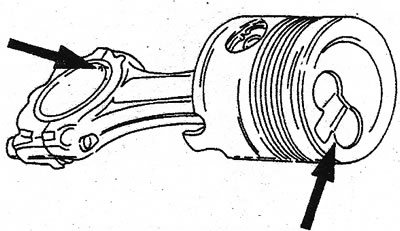
13.2 Guidelines for assembling pistons and connecting rods of a diesel engine

13.2 Guidelines for assembling pistons and connecting rods of a diesel engine


3. Push the piston pin into the hole with your finger, then put on the retaining rings on the left and right. Make sure that the rings fit exactly into the grooves.

4. Put the piston rings on the pistons. The top ring has a "Top" mark. This side should be visible from above. The piston ring lock size is preset and cannot be changed. Lubricate the piston rings well and install them on the piston so that each subsequent lock is 120° from the previous one (see illustration).

V6 Engine
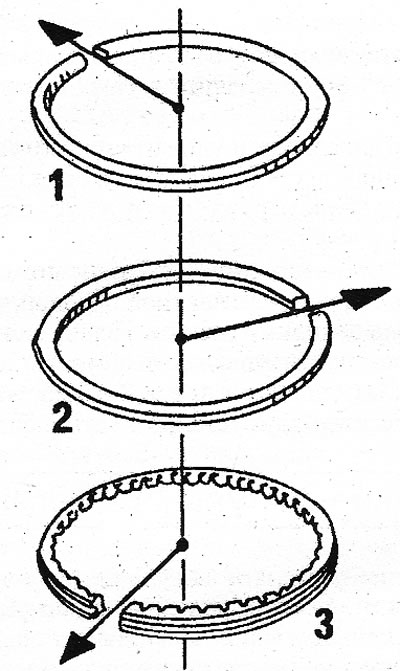


13.4 Piston ring locks must be positioned as shown

13.4 Piston ring locks must be positioned as shown


5. The V6 piston and connecting rod assembly is the same as described for the turbo diesel engine, as retaining rings are also used to install the piston pins. However, note the following differences:

6. On the bottom of the piston there is a mark "Vom" (usually "AU") (see illustration). Install the pistons and connecting rods of cylinders 1 through 3 so that the raised edge of the connecting rod is located on the side opposite the "Yot" mark.
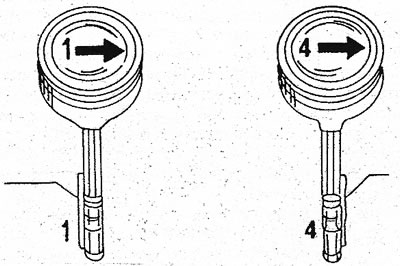
13.6 V6 piston and connecting rod assembly guides. Note how the raised surfaces of the connecting…

13.6 V6 piston and connecting rod assembly guides. Note how the raised surfaces of the connecting rods are positioned in relation to the "Vorn" markings

1. Cylinders 1 to 3; 4. Cylinders 4 to 6


7. When assembling cylinder sets 4 through 6, the connecting rod rise must be on the same side as the "Uot" mark. The illustration shows the piston/connecting rod sets of each cylinder bank. Cylinders 1 through 3 are on the left when viewed from the flywheel side.

8. Assemble the pistons and connecting rods as described for the diesel engine. To warm up the pistons, you can put them in hot water. Make sure that the retaining rings are inserted correctly. Evenly distribute the ring cuts around the perimeter of the piston (see illustration 13.4). Install rings marked "Thor" or "Haut" so that the marks are read from above.


9. After assembly, check all six sets again.

Petrol 4-cylinder engines


10. Place the connecting rods on the hotplate. Only their heads should be on the hotplate (see illustration). For connecting rods with fusible pins, constantly monitor the temperature, it should not exceed 250°C. Install the connecting rod cap so that there is a gap of 1.0 mm between the bearing surface and the connecting rod cap.
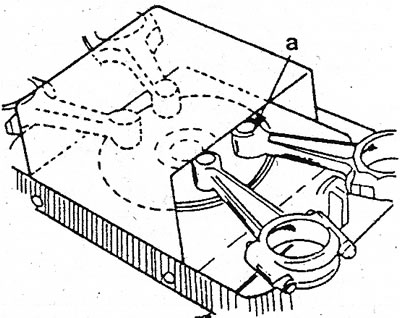
13.10 Heating the connecting rods. Only the «a» heads can be on the hotplate

13.10 Heating the connecting rods. Only the "a" heads can be on the hotplate


11. Assemble the pistons and connecting rods for installation. The arrows in the piston crown should point toward the flywheel. The oil injection hole in the connecting rod should be on the same side as the oil filter. For connecting rods without an oil hole, the recess for the liner in the connecting rod bearing should be on the side of the oil filter.

12. Install the sleeve on the protrusion, position the piston over the mounting sleeve and secure as shown (see illustration).

[Information is located on the website: RenaultBook]
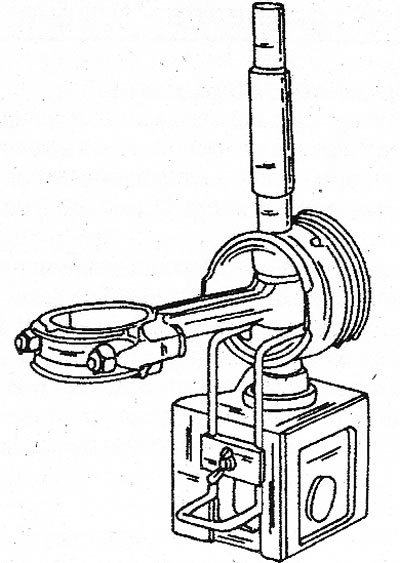
13.12 Pressing in the piston pin

13.12 Pressing in the piston pin


13. Place the piston pin on the punch and screw the conical guide washer on the other side without tightening it. Lubricate the pin and punch thoroughly.

14. Quickly remove the connecting rod from the hotplate and insert it into the piston.

15. Insert the pin. If necessary, move the connecting rod back and forth to avoid skewing. Push the piston pin all the way in. A special tool will ensure precise pressing of the pin. After a few seconds, remove the piston from the support and make sure that the piston moves freely on the pin after the latter has cooled down. Installation should be done as quickly as possible so that the connecting rod head does not have time to cool down. t < 1

16. Remove the installation punch from the piston and install the remaining pistons in the manner described above.

17. Using an oil can, spray engine oil onto the pin installation area. Make sure the pistons can move easily.

18. Install the rings into the piston grooves one by one. Both top rings should be installed with the "Top" mark facing up. Double check each ring before installing, as it is easy to make a mistake. Use a special tool to install the piston rings. Three thin metal plates can also be used. The rings can easily break, so install them with great care.

19. Lubricate the piston rings well and place them on the outside of the piston, evenly distributing the ring locks around the piston perimeter. The locks should be spaced 120° apart from each other, (see illustration 13.4).
This article is available on: russian, bulgarian, belarusian, ukrainian, serbian, croatian, romanian, polish, slovak, hungarian
Article has been reviewed by editor: Fedoseev Denis
Share with friends:
Previous
Espace I and II: Engine repair
Next

Pistons and connecting rods — check
Pistons and connecting rods — separation
Pistons and connecting rods — removal
Pistons and connecting rods — general description
Pre-chambers (diesel engine) — general description
Pistons and connecting rods — installation
Cylinder Block and Liner — General Description
Crankshaft and bearings — inspection
Flywheel (drive pulley) — removal and installation
Crankshaft seals — replacement
Other articles on other Renault models

➽ Assembly of connecting rods with pistons of the K4M engine Renault Fluence 1 (2009-2020, petrol)
➽ Pistons and connecting rods Renault Logan 2 (2012-2020)
➽ Setting the position of the pistons in relation to the… Renault Megan 2 (2002-2009, petrol)
➽ Connecting rod bearing shell Renault Duster 1 (2009-2017)
➽ Beam rods Renault Kangoo 1 (1997-2007)
Link to this article in different formats
Reviews and comments of visitors
No comments yet


Add two numbers 43 + 29


Renault 19 (1988-1996) 
  • General information
  • Maintenance
  • Power unit
  • Engine repair
  • Exhaust system
  • Cooling system
  • Supply system
  • Single-point injection
  • Multi-point injection
  • Diesel injection system
  • Transmission
  • Clutch
  • Car gearbox
  • Chassis, running gear
  • Car suspension
  • Steering
  • Brake system
  • Wheels and tires
  • Body and interior
  • Exterior (external elements)
  • Interior (internal elements)
  • Heating and ventilation
  • Electrical equipment
  • Equipment and devices
  • Headlights and lighting
  • Ignition system
  • Power devices
  • Electrical circuits
Espace I and II (1984-1996) 
  • General information
  • Introduction to the guide
  • Troubleshooting
  • Power unit
  • Engine repair
  • Cooling system
  • Carburetor fuel system
  • Injection fuel system
  • Diesel fuel system
  • Ignition system
  • Transmission
  • Clutch
  • Car gearbox
  • Drive shafts
  • Chassis, running gear
  • Brake system
  • Steering
  • Front suspension
  • Rear suspension
  • Body and interior
  • Exterior (external elements)
  • Interior (internal elements)
  • Doors, locks and windows
  • Electrical equipment
  • Equipment and devices
  • Electrical circuits
Espace III (1996-2002) 
  • General information
  • Introduction to the manual
  • User manual
  • Power unit
  • Petrol engines F3R
  • Petrol engines Z7X
  • Diesel engines G8T
  • Diesel engines G9T
  • Transmission
  • Clutch
  • Mechanical gearbox
  • Automatic gearbox
  • Drive shafts
  • Chassis, running gear
  • Steering
  • Front suspension
  • Rear suspension
  • Brake system
  • Body and interior
  • Exterior (external elements)
  • Interior (internal elements)
  • Doors, locks and windows
  • Heating and ventilation
  • Electrical equipment
  • Equipment and instruments
  • Power devices
  • Electrical circuits
RenaultBook.ru © 2018–2026 | Mobile version | News and articles | Sitemap: EN BG BY UA RS HR RO PL SK HU | Administration | Site search | Bookmark
Duster 1 (2009-2017) | Fluence 1 (2009-2020, petrol) | Kangoo 1 (1997-2007) | Laguna 2 (2001-2007) | Logan 1 (2004-2012, petrol) | Logan 2 (2012-2020) | Megane 1 (1995-2002) | Megan 2 (2002-2009, petrol) | Sandero 1 (2007-2012, petrol) | Scenic 1 (1996-2003) | Symbol 1 (1999-2008, petrol) | Symbol 2 (2008-2013, petrol) | Renault 19 (1988-1996) | Espace I and II (1984-1996) | Espace III (1996-2002) | Clio 1 (1990-1998) |
We want your visit to be comfortable 😌 and use cookies 🍪 to do so.