
English Русский
Български
Беларускі
Український
Српски
Hrvatski
Română
Polski
Slovenský
Magyar
Bookmark Contacts Articles Sitemap
Company vehicles Peugeot Company vehicles Opel Company vehicles Skoda Company vehicles Land Rover Company vehicles Mitsubishi Company vehicles Volkswagen Company vehicles Honda
RenaultBook.ru


Duster   Fluence   Kangoo   Laguna   Logan   Megane   Sandero   Scenic   Symbol   Clio   Other
Renault 19 (1988-1996) Espace I and II (1984-1996) Espace III (1996-2002)

Pistons and connecting rods — check (Renault Espace I)

  • Main
  • Renault
  • Espace I and II (1984-1996)
  • Power unit
  • Engine repair
  • Pistons and connecting rods — check
0
1. Carefully inspect all parts. If there are scratches or other signs of wear, replace.

2. Slide the piston rings into the grooves (see illustration). Using a feeler gauge, determine the gap between the ring surface and the piston groove surface. If the gap is more than 0.15 mm, the ring or piston is worn out.
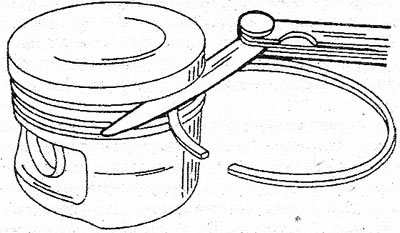
12.2 Measuring the gap size of piston rings in piston grooves

12.2 Measuring the gap size of piston rings in piston grooves


3. Next, insert all the piston rings in order, starting from the top of the liner. To measure the piston ring gap, insert a feeler gauge into the gap between both ends of the ring. Piston rings with too large a ring gap cannot be reinstalled.

4. To determine the clearance of the working surface of the cylinder, measure the diameter of the hole. The hole must be measured in the longitudinal and transverse directions and at three depths of the liner. This is how the largest and smallest diameters are found. Write down the values. Now subtract the piston diameter from the diameter of the hole. The measurement is made in the right corner in relation to the piston pin hole. The difference is the cylinder clearance, which should be within 0.023 - 0.047 mm. If the cylinder clearance is larger, install a new liner.


You can find the original at this link renaultbook.ru

5. Check the piston pins and bores for wear or damage.

6. Using a special device, check the connecting rods for deformation, since bent or twisted connecting rods do not contribute to the smooth operation of the engine.
This article is available on: russian, bulgarian, belarusian, ukrainian, serbian, croatian, romanian, polish, slovak, hungarian
Article has been reviewed by editor: Fedoseev Denis
Share with friends:
Previous
Espace I and II: Engine repair
Next

Pistons and connecting rods — separation
Pistons and connecting rods — removal
Pistons and connecting rods — general description
Pre-chambers (diesel engine) — general description
Valve clearances — adjustment
Pistons and connecting rods — assembly
Pistons and connecting rods — installation
Cylinder Block and Liner — General Description
Crankshaft and bearings — inspection
Flywheel (drive pulley) — removal and installation
Other articles on other Renault models

➽ Setting the position of the pistons in relation to the… Renault Fluence 1 (2009-2020, petrol)
➽ Pistons and connecting rods Renault Logan 2 (2012-2020)
➽ Setting the position of the pistons in relation to the… Renault Megan 2 (2002-2009, petrol)
➽ Connecting rod bearing shell Renault Duster 1 (2009-2017)
➽ Oil vapor recovery system — check Renault Kangoo 1 (1997-2007)
Link to this article in different formats
Reviews and comments of visitors
No comments yet


Add two numbers 29 + 18


Renault 19 (1988-1996) 
  • General information
  • Maintenance
  • Power unit
  • Engine repair
  • Exhaust system
  • Cooling system
  • Supply system
  • Single-point injection
  • Multi-point injection
  • Diesel injection system
  • Transmission
  • Clutch
  • Car gearbox
  • Chassis, running gear
  • Car suspension
  • Steering
  • Brake system
  • Wheels and tires
  • Body and interior
  • Exterior (external elements)
  • Interior (internal elements)
  • Heating and ventilation
  • Electrical equipment
  • Equipment and devices
  • Headlights and lighting
  • Ignition system
  • Power devices
  • Electrical circuits
Espace I and II (1984-1996) 
  • General information
  • Introduction to the guide
  • Troubleshooting
  • Power unit
  • Engine repair
  • Cooling system
  • Carburetor fuel system
  • Injection fuel system
  • Diesel fuel system
  • Ignition system
  • Transmission
  • Clutch
  • Car gearbox
  • Drive shafts
  • Chassis, running gear
  • Brake system
  • Steering
  • Front suspension
  • Rear suspension
  • Body and interior
  • Exterior (external elements)
  • Interior (internal elements)
  • Doors, locks and windows
  • Electrical equipment
  • Equipment and devices
  • Electrical circuits
Espace III (1996-2002) 
  • General information
  • Introduction to the manual
  • User manual
  • Power unit
  • Petrol engines F3R
  • Petrol engines Z7X
  • Diesel engines G8T
  • Diesel engines G9T
  • Transmission
  • Clutch
  • Mechanical gearbox
  • Automatic gearbox
  • Drive shafts
  • Chassis, running gear
  • Steering
  • Front suspension
  • Rear suspension
  • Brake system
  • Body and interior
  • Exterior (external elements)
  • Interior (internal elements)
  • Doors, locks and windows
  • Heating and ventilation
  • Electrical equipment
  • Equipment and instruments
  • Power devices
  • Electrical circuits
RenaultBook.ru © 2018–2026 | Mobile version | News and articles | Sitemap: EN BG BY UA RS HR RO PL SK HU | Administration | Site search | Bookmark
Duster 1 (2009-2017) | Fluence 1 (2009-2020, petrol) | Kangoo 1 (1997-2007) | Laguna 2 (2001-2007) | Logan 1 (2004-2012, petrol) | Logan 2 (2012-2020) | Megane 1 (1995-2002) | Megan 2 (2002-2009, petrol) | Sandero 1 (2007-2012, petrol) | Scenic 1 (1996-2003) | Symbol 1 (1999-2008, petrol) | Symbol 2 (2008-2013, petrol) | Renault 19 (1988-1996) | Espace I and II (1984-1996) | Espace III (1996-2002) | Clio 1 (1990-1998) |
We want your visit to be comfortable 😌 and use cookies 🍪 to do so.