



Contents: Rocker Arm Mechanism - All Engines 🠛 Valves 🠛 Valve seats 🠛 Valve springs 🠛 Valve guide bushings 🠛 Cylinder head gaskets 🠛
Rocker Arm Mechanism - All Engines
1. Check the rocker shaft for scratches or excessive wear and replace if necessary. Lubricate all parts generously and install them on the rocker shaft in the order of assembly, if the same parts are to be installed.
2. On a gasoline engine, place the #5 pivot bracket on the rocker shaft and rotate the shaft so that the oil holes are on the bottom surface. Fasten the pivot bracket with a new safety pin to the shaft. Refer to Illustration 5.8 when assembling the shaft.
3. On a turbocharged diesel engine (see illustration 5.26) place the hinge bracket "E" on the rocker shaft and rotate the shaft so that the oil holes are on the lower surface. Secure the hinge bracket with the bolt on the shaft. Then install in the following order: inlet rocker arm, spring, exhaust rocker arm, the next hinge bracket with the protrusion towards the flywheel and then install all the remaining parts in the same order. Insert the new filter (2) into the shaft (1) and tighten the plug (3) to a tightening torque of 20 Nm.
4. For V6 engines, lubricate all parts and install them on the axle one by one. If the same parts are installed, pay attention to their markings. Make sure that the valve clearance adjustment bolts are on the correct side and do not mix up the spacers. The strongest spacer is closer to the end of the rocker shaft.
Valves
5. Clean the valves, preferably with a wire brush. Inspect the valve surface for scale, grooves, or other signs of wear. If the wear is minor, you can grind the valve chamfer. Remove only a minimal layer of metal, leaving enough material in the form of a clearly defined cylindrical belt.
6. Measure the valve stem diameter and the inner bore diameter of the guide bushing. If these values exceed the permissible values, replace the stem and bushing.
Valve seats
7. Valve seats can be cut back to their original angles. If this work is done carefully, there is no need to grind the valves. Treat the surface of the seat with a grinding device. After grinding, check the concentricity of the working chamfer of the valve seat relative to the guide bushing of the stem. The correct fit of the valve in the seat is shown on the left (see illustration). Turbocharged diesel engine
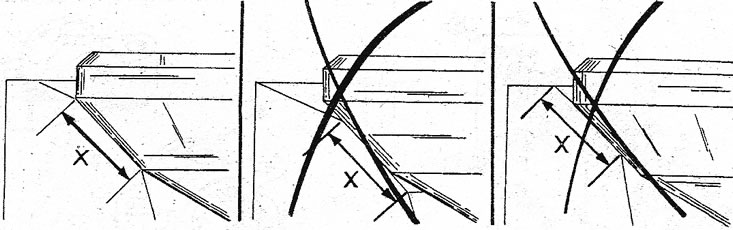
6.7 The correct position of the valve in the seat is shown on the left. Both other options are incorrect positions
8. The following measurement is taken after machining the valve seat:
a) Insert the valves in order into the well-machined seats and press firmly.
b) Measure the distance from the top of the valve head to the cylinder head surface using a dial micrometer or feeler gauge (see illustration). The valve head surfaces should be recessed at least 0.8-1.15 mm into the head surface. This value is very important, because otherwise the valves will hit the pistons. If necessary, replace the cylinder head.
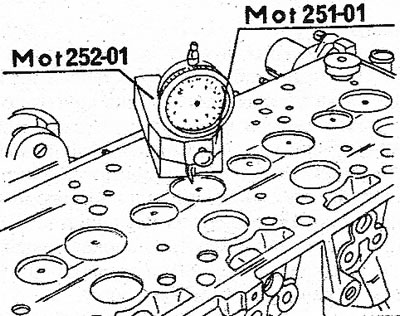
6.8 Measuring the valve installation height. The valve surfaces must be flush with the cylinder head surface.
Valve springs
9. Use a special device to check the valve springs. If you do not have such a device, compare the spring you are using with the new one. To do this, insert both springs into a vice and slowly compress them. If both springs are compressed equally, they have approximately the same elasticity. If the old spring is compressed more than the new one, replace it.
10. Install the springs one by one on a smooth surface so that their closed parts are at the bottom. Install a steel angle next to the spring. Measure the gap between the spring and the angle at the top, it should be no more than about 2.0 mm. Otherwise, the spring is worn out.
Valve guide bushings
11. Wipe the bushings with a rag soaked in gasoline. It is better to clean the inner surface of the bushing by installing a wire brush in a drill.
12. Check the valve guide bushings for wear using a small punch. If the punch fits into the hole, the bushing must be replaced. If there is no punch of the appropriate diameter, you can use a valve. To do this, insert the valve into the bushing. Measure the gap between the valve and the bushing. Although there is no specific value, it is generally accepted that the gap can be no more than 1.0-2.0 mm. The outer diameter of the repair bushing is increased (marked with one or two grooves on the outside, see specifications) therefore, to insert a new bushing, it is necessary to ream the hole in the cylinder head. Measure the size of the bushing protrusion above the spring plate area to drive in the new bushing to the same size. The installation size for different engines is determined in accordance with the illustrations. It is very important to measure the places indicated by the arrows.
13. For a V6 engine, measure the distance between the chamfer of the guide bushing and the valve seat (see illustration). For the inlet valve (A) it should be 30 mm, for the outlet valve (B) - 26 mm. New valve guide bushings are pressed in to the specified dimensions.
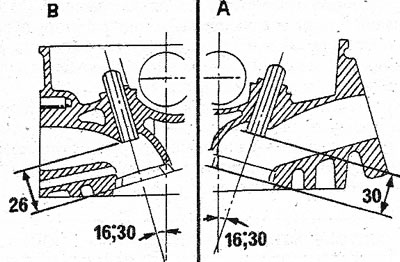
6.13 Sectional view of the cylinder head of the V6 engine. The mounting bushings must be pressed in to the specified value A Inlet valve B Outlet valve
14. The stepped ends of the guide bushings must point in the direction shown in the figure, i.e. towards the top of the cylinder head.
15. For a turbocharged diesel engine, measure the clearance between the inner chamfers of the valve guides and the cylinder head surface (see illustration). All bushings should have a clearance of 32.5 mm. The stepped end of the bushing should be facing the valve seat.
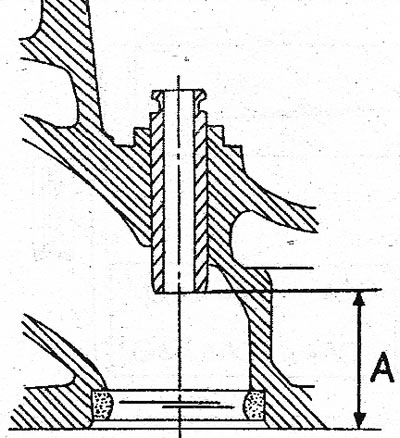
6.15 Sectional view of the cylinder head of a turbocharged diesel engine. The clearance "A" of the installation of the guide bushings corresponds to 32.5 mm
16. For a 4-cylinder petrol engine, the clearance is measured as shown in the illustration. The clearance of the guide bushing for the inlet valve is 33.20 mm, for the inlet valve - 32.00 mm. The stepped ends of the guide bushings must be turned toward the valve seats.
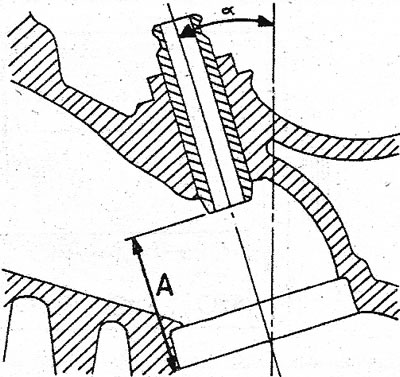
6.16 Sectional view of the cylinder head of a 4-cylinder petrol engine. The gap "A" is achieved in accordance with the description in the text
17. The guide bushes on the V6 engine and on the petrol 4-cylinder engine are installed at an angle, i.e. the cylinder head must be turned accordingly to press the guide bushes vertically. While pressing the guide bushes, constantly measure the clearance. After installation, ream the hole in the pressed bush to a diameter of 8 mm. This ensures the prescribed clearance for the valve stems. Installation of the valves is carried out in the opposite order to removal. Please note the following points:
18. Lubricate all valve parts thoroughly.
19. Install the valve springs with the flat surface of the coil facing the cylinder head.
20. The intake and exhaust valve crackers are the same, but must be installed on the same valves if they are to be reinstalled.
21. Place the thrust washer and springs onto the valve guide. Install the spring retainer and compress the valve with a puller until the valve cotters can be inserted into the groove of the stem (with pliers). After installing the valve crackers, tap the valve chamfer with a rubber mallet. If the crackers are installed incorrectly, the spring plate, springs, etc. will fly out. For this reason, cover the valve with a cloth in advance.
22. Install the camshafts. Do not reverse the two shafts on a V6 engine. On a four-cylinder engine, install the key correctly in the camshaft groove.
Information is located on the website (RenaultBook.ru)
23. Carry out further assembly of the cylinder head in accordance with the engine assembly instructions. Installation of the toothed drive belt will be described below.
Cylinder head gaskets
24. Remember that both gaskets on the V6 engine are different. Only the appropriate gasket is always installed on the corresponding head. The gasket thickness of the turbocharged diesel engine should be set as described earlier. When selecting a gasket for a gasoline 4-cylinder engine, its volume is taken into account.