
English Русский
Български
Беларускі
Український
Српски
Hrvatski
Română
Polski
Slovenský
Magyar
Bookmark Contacts Articles Sitemap
Company vehicles Peugeot Company vehicles Opel Company vehicles Skoda Company vehicles Land Rover Company vehicles Mitsubishi Company vehicles Volkswagen Company vehicles Honda
RenaultBook.ru


Duster   Fluence   Kangoo   Laguna   Logan   Megane   Sandero   Scenic   Symbol   Clio   Other
Renault 19 (1988-1996) Espace I and II (1984-1996) Espace III (1996-2002)

Pistons and connecting rods — removal (Renault Espace I)

  • Main
  • Renault
  • Espace I and II (1984-1996)
  • Power unit
  • Engine repair
  • Pistons and connecting rods — removal
0
1. Removing the pistons with the engine installed on the vehicle is done as follows:

2. Disconnect the battery and drain the coolant from the cooling system.

3. Drain the engine oil.

4. Remove the cylinder block following the instructions for the appropriate engine. Also remove the valve timing mechanism (mark all details).

5. Remove the oil pump sprocket with chain on the V6 engine, oil pan (together with the plate, if installed), oil pump and drive shaft on a 4-cylinder engine, oil feed pipe on a diesel engine, oil suction pipe, mesh element of the oil suction pipe on a V6 engine.

6. Check the markings on the connecting rods and their caps. If not, they must be numbered. Cap No.1 is located on the flywheel side of the engine (see illustration). Punch all the parts (No. 1 - one notch, No.2 - two notches, etc.)
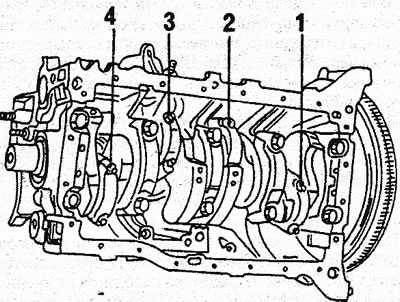
10.6 Numbering order of connecting rod bearings on a four-cylinder engine

10.6 Numbering order of connecting rod bearings on a four-cylinder engine


7. Loosen the connecting rod nuts and remove the cover. Start with one of the two crankshaft journals at BDC.

8. Remove the inserts and place them in the lid.

9. Using a punch, push the piston, connecting rod and sleeve assembly out. Immediately install the cap on the connecting rod.


10. Remove the other kits in the same way.

[The text is available on this website RenaultBook.ru]

11. All parts are covered with a protective film, which must be removed before assembly. Before cleaning, remove each set from the packaging and mark the parts with the letters A, B, C and D (or numbers 1,2,3 and 4). This will come in handy if the same parts are to be installed again.
This article is available on: russian, bulgarian, belarusian, ukrainian, serbian, croatian, romanian, polish, slovak, hungarian
Article has been reviewed by editor: Fedoseev Denis
Share with friends:
Previous
Espace I and II: Engine repair
Next

Pistons and connecting rods — general description
Pre-chambers (diesel engine) — general description
Valve clearances — adjustment
Cylinder head — assembly
Cylinder head — disassembly
Pistons and connecting rods — separation
Pistons and connecting rods — check
Pistons and connecting rods — assembly
Pistons and connecting rods — installation
Cylinder Block and Liner — General Description
Other articles on other Renault models

➽ Assembly of connecting rods with pistons of the K4M engine Renault Fluence 1 (2009-2020, petrol)
➽ Pistons and connecting rods Renault Logan 2 (2012-2020)
➽ Setting the position of the pistons in relation to the… Renault Megan 2 (2002-2009, petrol)
➽ Connecting rod bearing shell Renault Duster 1 (2009-2017)
➽ Beam rods Renault Kangoo 1 (1997-2007)
Link to this article in different formats
Reviews and comments of visitors
No comments yet


Add two numbers 34 + 38


Renault 19 (1988-1996) 
  • General information
  • Maintenance
  • Power unit
  • Engine repair
  • Exhaust system
  • Cooling system
  • Supply system
  • Single-point injection
  • Multi-point injection
  • Diesel injection system
  • Transmission
  • Clutch
  • Car gearbox
  • Chassis, running gear
  • Car suspension
  • Steering
  • Brake system
  • Wheels and tires
  • Body and interior
  • Exterior (external elements)
  • Interior (internal elements)
  • Heating and ventilation
  • Electrical equipment
  • Equipment and devices
  • Headlights and lighting
  • Ignition system
  • Power devices
  • Electrical circuits
Espace I and II (1984-1996) 
  • General information
  • Introduction to the guide
  • Troubleshooting
  • Power unit
  • Engine repair
  • Cooling system
  • Carburetor fuel system
  • Injection fuel system
  • Diesel fuel system
  • Ignition system
  • Transmission
  • Clutch
  • Car gearbox
  • Drive shafts
  • Chassis, running gear
  • Brake system
  • Steering
  • Front suspension
  • Rear suspension
  • Body and interior
  • Exterior (external elements)
  • Interior (internal elements)
  • Doors, locks and windows
  • Electrical equipment
  • Equipment and devices
  • Electrical circuits
Espace III (1996-2002) 
  • General information
  • Introduction to the manual
  • User manual
  • Power unit
  • Petrol engines F3R
  • Petrol engines Z7X
  • Diesel engines G8T
  • Diesel engines G9T
  • Transmission
  • Clutch
  • Mechanical gearbox
  • Automatic gearbox
  • Drive shafts
  • Chassis, running gear
  • Steering
  • Front suspension
  • Rear suspension
  • Brake system
  • Body and interior
  • Exterior (external elements)
  • Interior (internal elements)
  • Doors, locks and windows
  • Heating and ventilation
  • Electrical equipment
  • Equipment and instruments
  • Power devices
  • Electrical circuits
RenaultBook.ru © 2018–2026 | Mobile version | News and articles | Sitemap: EN BG BY UA RS HR RO PL SK HU | Administration | Site search | Bookmark
Duster 1 (2009-2017) | Fluence 1 (2009-2020, petrol) | Kangoo 1 (1997-2007) | Laguna 2 (2001-2007) | Logan 1 (2004-2012, petrol) | Logan 2 (2012-2020) | Megane 1 (1995-2002) | Megan 2 (2002-2009, petrol) | Sandero 1 (2007-2012, petrol) | Scenic 1 (1996-2003) | Symbol 1 (1999-2008, petrol) | Symbol 2 (2008-2013, petrol) | Renault 19 (1988-1996) | Espace I and II (1984-1996) | Espace III (1996-2002) | Clio 1 (1990-1998) |
We want your visit to be comfortable 😌 and use cookies 🍪 to do so.