



Contents: V6 Engine 🠛 Adjustment on 4-cylinder engines 🠛 Petrol 4-cylinder engines (except…🠛 J7R and J7T engines 🠛 Turbocharged diesel engine 🠛
1. Adjustment on 4-cylinder engines is carried out in the same way as on V6 engines. Remove the cylinder head cover. Adjust the valve clearance in each cylinder in turn. The engine must be cold. The valve clearance value is indicated in the specifications.
V6 Engine
2. From now on, the inlet valve will be designated by the letter "E", and the outlet valve by the letter "A".
3. To adjust the valves of the left cylinder head (see illustration):
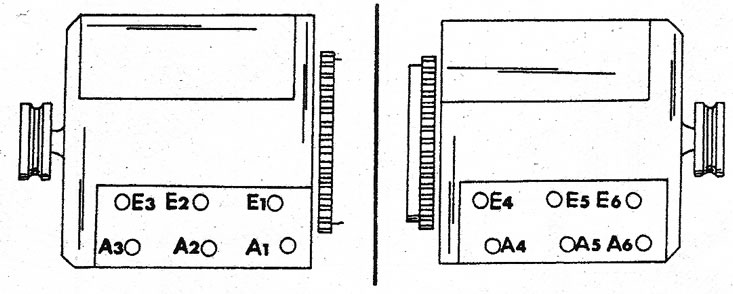
7.3 Position of the intake valves (E) and exhaust valves (A) on both cylinder heads. Counting is done from the engine pulley
a) Turn the crankshaft until the valves of the first cylinder move, i.e. one valve closes and the other opens. In this position of the engine, you can adjust the valves "E3" and "A2".
b) Turn the crankshaft until the valves of the second cylinder move and adjust valves "E1" and "A3".
c) Turn the crankshaft until the valves of the third cylinder move and adjust valves "E2" and "A1".
4. Now adjust the valve clearances of the right cylinder head as follows: (see illustration 7.3):
a) Turn the crankshaft until the valves of the fourth cylinder move and adjust valves "E6" and "A5".
b) Turn the crankshaft until the valves of the fifth cylinder move and adjust valves "E4" and "A6".
c) Turn the crankshaft until the valves of the sixth cylinder move and adjust valves "E5" and "A4".
5. To ensure engine operation, jack up one of the front wheels and engage 5th gear. Thus, by rotating the wheel, you can set the piston to the desired position. To facilitate turning, unscrew the spark plugs. Valve clearance - is measured using a feeler gauge of the appropriate thickness, i.e. 0.10 or 0.25 mm, inserted between the chamfer of the valve stem and the rocker arm. The measuring feeler gauge should have a smooth tip.
6. Use a screwdriver and a ring spanner to adjust. When tightening the bolt, lock it with a lock nut so that the adjustment results do not change. It is also worth mentioning that there is a special tool for adjusting the valve clearance. It holds the tension bolt while the lock nut is removed (see illustration).
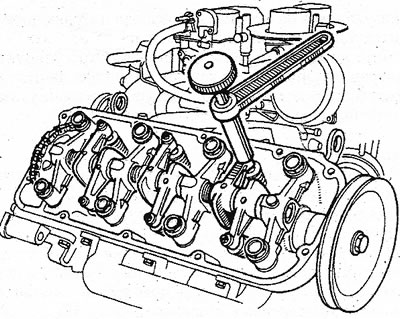
7.6 Device for adjusting valve clearances on a V6 engine
7. There is a second method for adjusting the valve clearance:
a) Set the piston of the first cylinder to TDC. This can be achieved by moving the rocker arms. Both rocker arms should have a small gap. The valves of the fifth cylinder should move.
b) In this engine position, adjust the following valves in accordance with Illustration 7.3: "E1", "E2", "E4" (intake valves) as well as "A 1", "AZ" and "A6" (exhaust valves).
c) Turn the engine half a turn. Now the valves of the fifth cylinder are closed, and the valves of the first cylinder have switched.
d) In this engine position the following valves are adjusted: "E3", "E5" and "E6" (intake valves), as well as "A2", "A4" and "A5" (exhaust valves).
Adjustment on 4-cylinder engines
8. Although the valve adjustment process is identical for all engines, there are some differences between individual engines, as the TDC timing mark on some engines is located on the outside of the camshaft cover, while on others it is on the inside of the timing case. z
Petrol 4-cylinder engines (except JTT and J7R)
9. First of all, find the TDC timing mark. On some engines that do not belong to the mentioned group, (see right illustration) there is a camshaft timing mark. If this happens, adjust the valves as described for the "PT" and "J7R" engines.
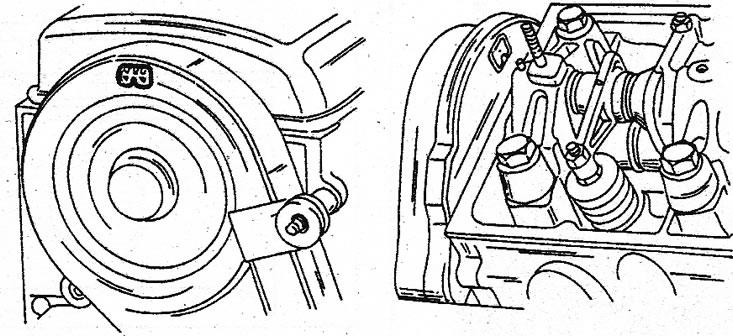
7.9 Left - mark on the outside of the camshaft drive cover. Right - mark for individual cylinders
10. Turn the crankshaft until the valves of the first cylinder are set to TDC. Remove the cylinder head cover and make sure that the valves of the fourth cylinder have moved. To ensure that the engine runs, jack up the front wheel and engage fifth gear. Turn the wheel until you achieve the correct setting. To facilitate rotation, you can unscrew the spark plugs.
11. In this position, adjust the intake valve of the third cylinder and the exhaust valve of the fourth cylinder. Both of these valves are closed.
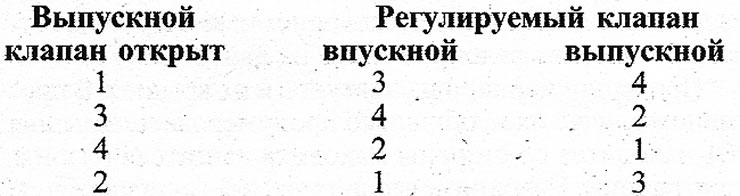
12. Turn the engine again until the next exhaust valve opens and make adjustments according to the following table:
13. The valves can also be adjusted by turning the engine until both valves of the first cylinder are closed, i.e. both rocker arms should have a small gap. Adjust the intake and exhaust valves of this cylinder and turn the engine to open the next pair of valves. The valves close in the order of ignition and if you remember this, the closed valves can be easily found.
14. Measure the valve clearance. To do this, insert a feeler gauge of the appropriate thickness (see specifications) between the valve stem and the rocker arm. The feeler gauge should have a smooth tip.
J7R and J7T engines
15. Turn the crankshaft until the piston of the first cylinder is at TDC. The valves should move. The TDC mark of the first cylinder is on the outer side of the camshaft drive cover, as shown in Illustration 7.9 on the left.
16. Rotate the engine so that the first timing mark on the camshaft pulley, on the inside, is in line with the "protrusion" in the pulley cover.
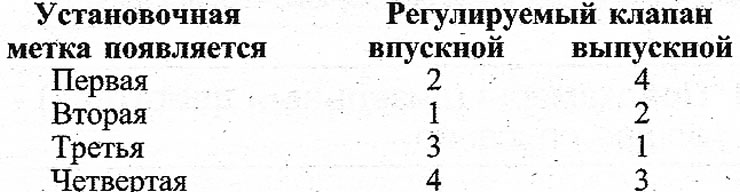
17. In this position, adjust the intake valve of the second cylinder and the exhaust valve of the fourth cylinder.
18. Rotate the crankshaft again until the next alignment mark on the inside of the pulley cover is reached. Installation procedure:
19. You can also adjust the valves as follows. Turn the engine so that both valves of the first cylinder are closed, i.e. both rocker arms have a small gap. Adjust the intake and exhaust valves of this cylinder and turn the engine so that the next pair of valves opens. The valves close in the order of ignition and if you remember this, you can easily find the closed valves. The exhaust and intake valves, when viewed from the drive side, are located in this sequence: intake-exhaust-intake-exhaust, etc.
20. The valve clearance is measured as described earlier.
Turbocharged diesel engine
21. Adjustment of the valves of a turbodiesel engine is carried out in the same way as described for petrol 4-cylinder engines (except J7R and J7T).
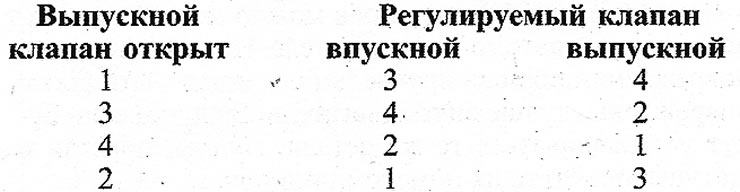
22. On a diesel engine, you can remove the glow plugs or injectors to make the engine easier to turn. Position of individual valves (see illustration).
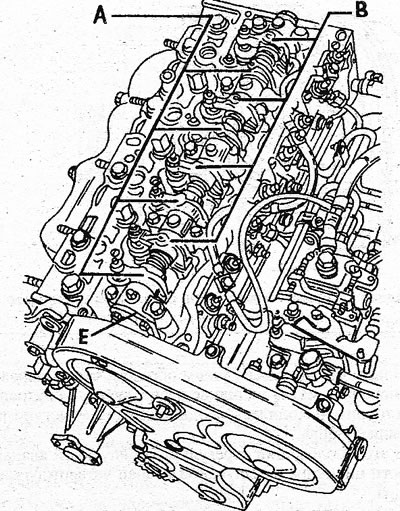
7.22 Location of intake valves (A) and exhaust valves (B) on a diesel engine. On a petrol 4-cylinder engine they are located in the same way