



Caution: To avoid any residual air in the brake system, release the parking brake before starting the bleeding procedure.
The brake system bleeding procedure must be performed after removing or replacing the following components:
- master brake cylinder,
- brake fluid,
- hydroelectronic control unit,
- brake pipes,
- brake hoses,
- brake reservoir,
- brake caliper,
- rear working brake cylinder.
Attention:
- When bleeding the brake system, it is necessary to turn off the ignition to deactivate the solenoids of the electronic control unit.
- The brake fluid level in the reservoir must always be between the "MIN" and "MAX" marks.
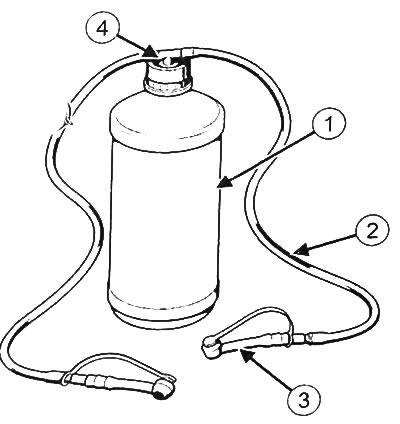
Use a container made by yourself to collect used brake fluid: 1. Container from under the washer fluid (1 liter, 2 pcs.). 2. Transparent hoses with a diameter of 4 mm. 3. Pipettes (4 pcs.). 4. T-shaped outlet (2 pcs.).
Note:
- The new electronic control unit is pre-filled with brake fluid.
- When working on one of the following components, place a spacer on the brake pedal to limit the amount of brake fluid that leaks out and prevent air from entering the master cylinder and brake system hydraulic circuit:
- hydroelectronic control unit;
- pipelines between the hydraulic electronic unit and brake calipers:
- brake hoses;
- brake caliper.
Before performing the bleeding procedure, it is necessary to remove the spacer from the brake pedal.
1. Place the vehicle on a two-post lift.
2. Turn off the ignition.
3. Connect the device for bleeding the hydraulic circuit of the brake system to the reservoir of the master brake cylinder (see the operating instructions for the bleeding device).
4. Create pressure in the brake system circuit.
5. Within three minutes, stabilize the pressure in the hydraulic circuit of the brake system to a range of 1.5-2.0 bar.
6. Without releasing the pressure, close the circuit between the air bleed nipple and the brake fluid reservoir.
Note: The circuit between the bleed nipple and the brake fluid reservoir can be closed in different ways, depending on the equipment used (valve, switch).
7. Connect bleeding containers to six fittings to remove air from the brake mechanisms.
Note: Some calipers are equipped with several bleed nipples. In this case, to perform the bleeding procedure, you must unscrew the nipples one by one.
8. Unscrew the air bleed nipples:
- front left;
- front right;
- rear left;
- rear right.
9. Open the circuit between the air bleed nipple and the brake fluid reservoir and allow the brake fluid to drain to release all air bubbles.
10. Tighten the air bleed screws in the following sequence:
- front left;
- front right;
- rear left;
- rear right.
11. Loosen the front left bleed screw and allow the brake fluid to drain to release any air bubbles, then tighten the screw again.
12. Perform the described procedure on the remaining brake mechanisms:
- front right;
- rear left;
- rear right.
13. Close the air bleed nipples to release the pressure in the brake circuit.
14. Remove the bleeding device from the master cylinder reservoir.
15. Check the travel and resistance of the brake pedal. If these parameters are not within the norm, complete bleeding the brake system with the help of a second person. Begin the bleeding procedure by removing air from the nipple furthest from the master brake cylinder:
- press the brake pedal;
- open the bleed nipple to release air from the brake system;
- close the air bleed nipple;
- release the brake pedal.
16. If necessary, fill the brake fluid reservoir to the required level. Check the tightness of the front and rear air bleed nipples and make sure that the caps are in place.
17. During the road test, apply the brakes sharply to ensure that the brake pedal travels correctly.
18. Remove traces of brake fluid from the vehicle.