



Note:
Verification principle:
- The brake pressure is read from the diagonal contour, after which the values for the front and rear wheels are compared. Both diagonal contours must be checked (front right-rear left and front left-rear right wheels).
- If the pressure value for one or both rear wheels is not within the standard, replace the brake force compensator with a new one.
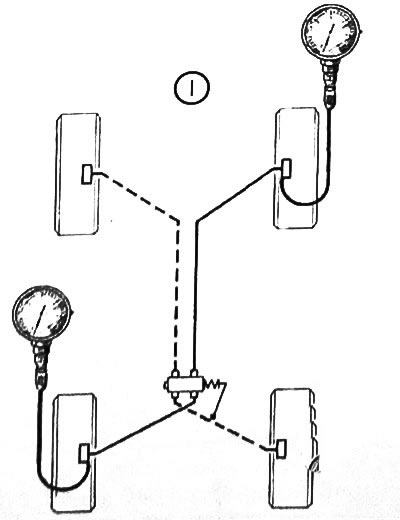
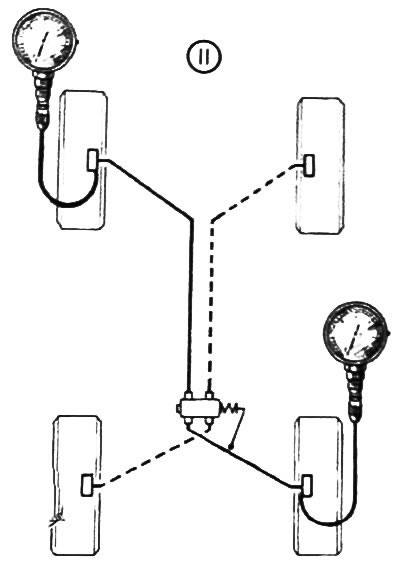
Note: The vehicle must be in running order (the tank is fully filled, the on-board tool and spare tire are in place, there are no passengers or luggage, the driver is behind the wheel).
1. Connect two pressure gauges from the hydraulic brake system testing kit (Fre. 1085) to circuit I (the first one to the front right wheel; the second one - to the rear left wheel).
2. Start the engine.
3. Bleed the pressure gauges using a special device by opening the valves on the pressure gauges.
[Original publication on the website RenaultBook]
4. Gradually press the brake pedal until the pressure on the front wheel reaches 100 bar.
5. Read the pressure value on the rear wheel.
6. Repeat the procedure on contour II (front left and rear right wheels).
7. In case of significant deviation of the obtained values from the norm, replace the compensator with a new one.
Note: The brake pressure values on the rear wheels should be between 37 and 43 bar. The difference in brake pressure values between the two rear wheels should not exceed 4 bar.
8. After disconnecting the pressure gauges from the brake mechanisms, bleed the brake system.