



Contents: Special tool required 🠛 Table 1.11 🠛 Examination 🠛 Adjustment 1 🠛 Adjustment 2 🠛 Table 1.12 🠛
Special tool required
- Fre. 244-03, Fre. 1085-01 Pressure gauge for checking the performance of the brake force regulator.
- Roulette (used to measure the height of the vehicle's bottom control points).
These vehicles are equipped with brake force regulators. Pressure readings are taken by diagonally dividing the brake circuit by comparing the pressure in the rear wheel circuit with the pressure communicated to the front wheel circuit.
The dual-circuit brake force regulator has two completely separate brake force regulators with their own housings, which, when the brake circuit is divided diagonally, act on the circuit of one front and one rear wheel.
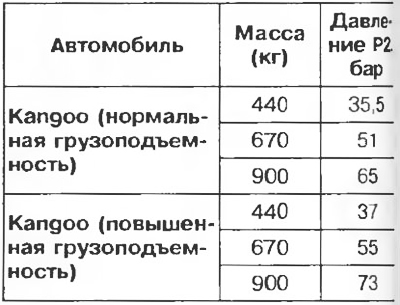
Table 1.11
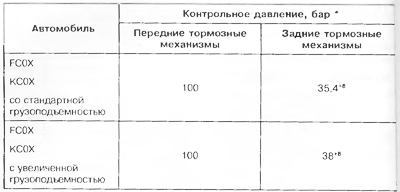
* Checking is carried out with a full fuel tank (driver in a car).
* The check is carried out using two pressure gauges installed diagonally in accordance with the diagonal division of the brake circuits.
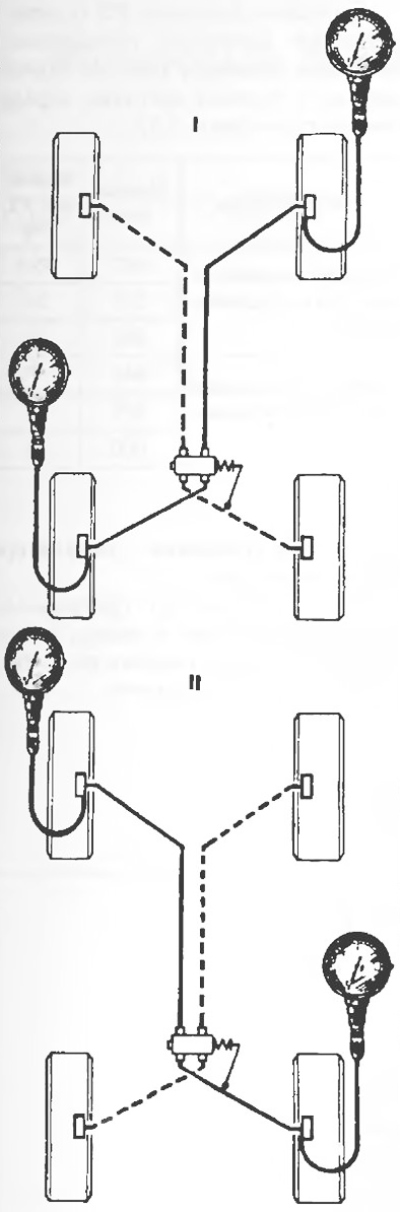
Figure 1.19.
Both circuits must be checked.
I: Front right wheel/Rear left wheel;
II: Front left wheel/Rear right wheel.
Note: Brake force regulators differ depending on the type of rear axle:
- - normal load capacity rear axle: red mark;
- - heavy-duty rear axle: green mark.
Examination
1. Connect two pressure gauges Fre. 244-03 or Fre. 1085-01:
- one at the front right wheel slave cylinder;
- the other one is at the working cylinder of the rear left wheel.
2. Release the pressure from the pressure gauges using nut P.
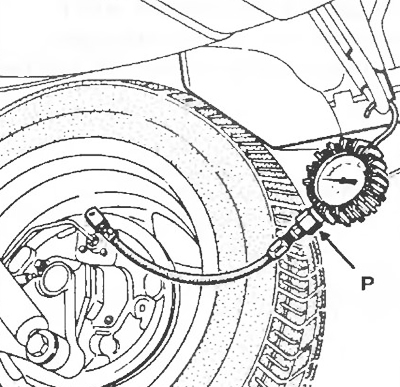
Figure 1.20
3. Gradually press the brake pedal until the required pressure is established in the front wheel circuit (table 1.11). Read the pressure reading and, if necessary, adjust it in the rear wheel circuit.
4. Perform the same operation on the other contour:
- one pressure gauge at the front left wheel working cylinder;
- another pressure gauge is at the working cylinder of the rear right wheel.
[Original of this article on the website RenaultBook]
5. If there is a big difference (values exceed the permissible deviation), then replace the brake force regulator, since its repair is not permitted.
Adjustment 1
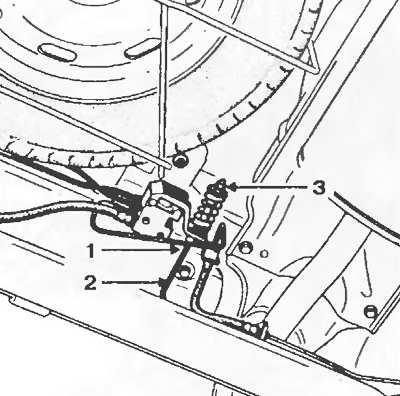
Figure 1.21
1. Checking and adjustment is performed on an unloaded vehicle with a full fuel tank and the driver at the wheel.
After reaching a certain pressure in the front wheel circuit as a result of pressing the brake pedal, immediately record the pressure readings in the rear wheel working cylinder circuit and compare with the control values (table 1.11).
2. Move the pressure lever, loosening the tightening of nut 1 so that lever 2 can be moved.
Caution! Do not change the position of nut 3.
Adjustment 2
1. Preparing the car:
- the car must be left loaded;
- the person who is required to press the brake pedal during the adjustment of the brake force regulator must be in the vehicle when measuring the rolling radius of the rear wheels under load;
- the car must be on a flat horizontal area, clean and level (use a four-post lift if possible).
2. Marking the centers of the rear wheels:
- raise the rear of the car enough to allow the rear wheels to turn;
- touch a piece of chalk to the wheel cap or decorative cap approximately in the center of the wheel;
- spin the wheel fairly quickly with your hand while pressing down firmly on the piece of chalk.
This will allow you to draw concentric circles around the actual center of rotation of the wheel.
- mark the center with a chalk pencil;
- do the same operation on the other rear wheel.
3. Adjusting the air pressure in the rear tires:
- the air pressure must be adjusted on the wheels standing on the floor and with a person in the driver's seat;
- reduce the air pressure in both rear tires to 1.2 bar (use an accurate pressure gauge);
- wait a few minutes for the air in the tires to warm up to the ambient temperature, as the air cools when it is released from the tire and the tire pressure changes;
- bring the pressure to 1.2 bar as accurately as possible.
4. Measuring the rolling radius of a wheel on an unloaded vehicle:
- raise the rear wheels enough so that they no longer deform under the load on the rear axle (until the wheels lift off the floor);
- measure the distance from the floor to the center of the wheel using a tape measure.
5. Measuring the rolling radius of a wheel on a loaded vehicle:
- put the car on wheels;
- measure the distance from the floor to the center of the wheel using a tape measure.
6. Determination of tire deformation:
- determine the difference between the two measurements to obtain the tire deformation value.
7. Perform steps 4, 5 and 6 for the other rear wheel.
8. Determine the average deformation for both tires:
- add the deformation values determined for the two rear wheels and divide the result by half to find the average deformation value.
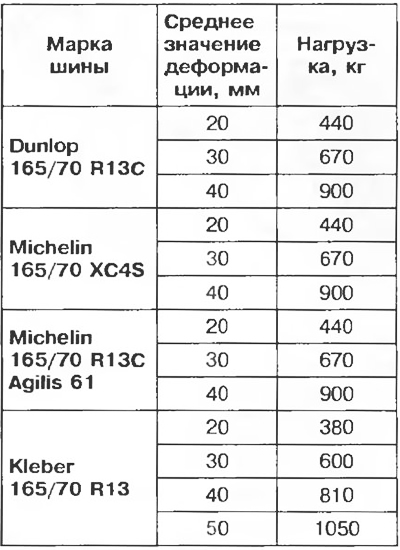
Rear axle load as a function of the determined average tire deformation.
Table 1.12
Output pressure P2 (corresponding to the pressure communicated to the working cylinder of each rear wheel) in the load function determined according to Table 1.12.
9. Adjusting the brake force regulator:
- follow the method suggested for operation if the brake force regulator adjustment is disturbed.