



It is recommended to use a special installation for bleeding the hydraulic drive under pressure. If you do not have one, you can bleed the brake drive by pressing the brake pedal. In this case, you will need an assistant. The efficiency of this method is lower, and labor costs are greater than when using a special installation.
Use only fresh brake fluid for bleeding. Before carrying out the work, make sure that all brake drive units and their connections are tight, clean the cover and the surface around the cover of the compensation tank, thoroughly clean the bleeding nipples. Prepare a reliable tool for unscrewing the nipples - they can firmly "stick" to their place.
If only part of the system has been depressurized and all precautions necessary to minimize fluid loss have been taken, it is sufficient to bleed the air from the relevant circuit only.
If the entire brake system has been depressurized, the bleeding sequence is as follows.
On a vehicle without ABS:
- right rear wheel;
- left front wheel;
- left rear wheel;
- right front wheel.
On a car with ABS:
- right rear wheel;
- left front wheel;
- left rear wheel;
- right front wheel.
While bleeding, constantly monitor the brake fluid level in the reservoir and maintain it at the "MAX" mark.
Bleed the brake mechanisms in the following order:
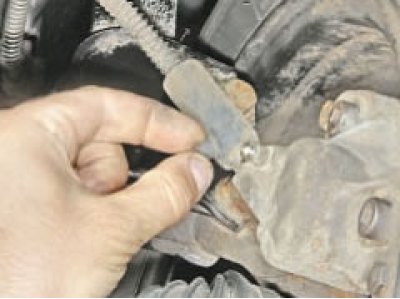
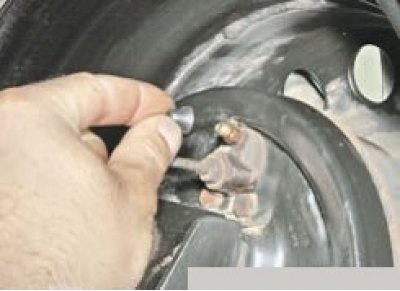
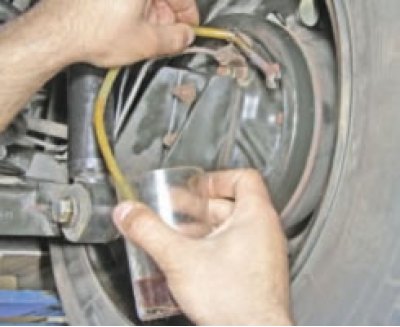
- remove the dust cap from the first in order bleeding nipple on the brake wheel cylinder, put a hose on it to drain the brake fluid, lower the free end of which into a glass container partially filled with liquid;
- ask an assistant to press the brake pedal sharply several times until you feel a "stop" and hold the pedal in this position;
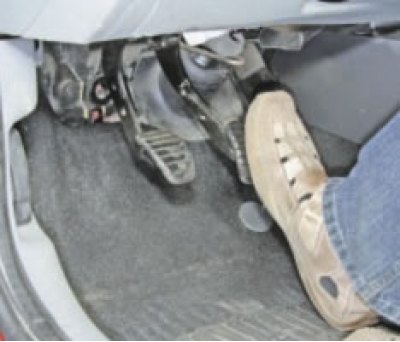
- unscrew the fitting by 1/2–1/3 of a turn using the prepared key - liquid with air bubbles will flow into the vessel from the hose, and the pedal held by the assistant will rest on the floor;
- while the assistant holds the pedal in the depressed position, tighten the nipple; the end of the hose must be constantly immersed in the liquid;
- repeat this operation until the liquid without air bubbles enters the vessel;
- periodically check the fluid level in the expansion tank, adding it to the "MAX" mark;
- keeping the pedal pressed, tighten the fitting until it stops, remove the hose, put on the dirt-protective cap;
- repeat these operations for the remaining brake mechanisms until all the air is released from the system and the brake pedal becomes "hard";
- if, despite bleeding, the pedal remains "soft", then there is still air in the system - it needs to be completely removed. Air may enter the system due to a leak in the hose and pipeline connections, or leaks in the cuffs of the main and working brake cylinders;
- take a test drive, and use caution during this.
Bleeding the brake system using a special tool
Renualt brake system bleeding device.
Caution! On vehicles with a vacuum brake booster, do not press the brake pedal while bleeding the brake system.
1. Bleeding is carried out on a vehicle standing on its wheels.
2. Connect the bleeding device to the brake master cylinder, wheel cylinders and brake force distribution valve.
3. Set the compressed air pressure in the bleeding device to 5 bar.
4. Connect the device to the master cylinder reservoir.
5. Open the brake bleed nipple on the rear right wheel. Bleed the brake fluid for about 20 seconds.
6. Open the brake bleed nipple on the front left wheel. Bleed the brake fluid for about 20 seconds.
Note: Ignore any air bubbles in the bleeder tubes.
6. Open the brake bleed nipple on the rear left wheel. Let the brake fluid drain for about 20 seconds.
7. Open the brake bleed nipple on the front right wheel. Bleed the brake fluid for about 20 seconds.
8. Press the brake pedal several times. The pedal should be "tight". Repeat the bleeding procedure if necessary.
9. Disconnect the bleeding device and check the brake fluid level.