



Warning! Brake fluid is poisonous. Rinse any parts of your body that come into contact with the fluid with plenty of cold running water and seek immediate medical attention if the fluid gets into your mouth or eyes. Some types of brake fluid are flammable and may ignite when in contact with hot components. Take appropriate fire safety measures. Brake fluid is aggressive to paint and plastics - if it gets on such surfaces, rinse off the fluid immediately with plenty of water. In addition, the fluid is hygroscopic (absorbs moisture from the air) - old fluid may be contaminated with water and unsuitable for use. When adding fluid to the system or replacing it, use the recommended type of fluid, pouring it from a freshly opened sealed container.
Models not equipped with ABS
The correct functioning of the brake hydraulic system is possible only if its components are free of air. To remove air from the system, bleed it.
During the bleeding procedure, add only clean, fresh brake fluid of the specified grade Specifications type. Never reuse liquid.
If there is any doubt about the type of fluid in the system, flush the system with clean fluid and replace all seals.
If the brake fluid level in the master cylinder has dropped, find and repair the cause of the leak before continuing.
Park the car on a level spot (not downhill), turn off the ignition and select 1st gear or reverse. Block the wheels and release the handbrake.
Make sure all tubes and hoses are securely attached, couplings are tight, and bleed nipples are closed. Remove dust caps and clean dirt from bleed nipples.
Unscrew the brake hydraulic system reservoir cap and bring the fluid level to the "MAX" line. Screw the cap on and remember to keep the fluid level above the "MIN" line throughout the procedure, otherwise air will get into the system again.
There are a number of one-person brake bleeding kits available on the market. It is recommended that you use one of these kits as they make the job much easier and also reduce the risk of air and fluid being drawn back into the system. If such a kit is not available, use the basic bleeding method (for two people), described in detail below.
If a tool is used, prepare the vehicle as described above and follow the kit manufacturer's instructions. The procedure may vary considerably depending on the type of tool used, but the basic procedure is also described below.
Whatever method you use, be sure to follow the correct pumping sequence.
Pumping sequence
If components of only one circuit have been disconnected or removed (for example, a caliper or a wheel cylinder), only this circuit needs pumping.
If the entire system needs to be bled, proceed in the following sequence:
- a) Rear right brake mechanism.
- b) Front left brake mechanism.
- c) Rear left brake mechanism.
- d) Front right brake mechanism.
Pumping is the main method (for two people)
1. Prepare a clean glass container, a plastic or rubber tube of suitable length that fits tightly onto the bleed nipple. You will need the help of a second person.
2. If not already done, remove the dust cap from the bleed nipple and place the prepared tube onto the nipple. Immerse the other end of the tube in the brake fluid previously poured into the reservoir.
3. Make sure the master cylinder reservoir is full and maintain the fluid level above the "MIN" line throughout the procedure.
4. Ask an assistant to press the brake pedal all the way down several times and then hold it down.
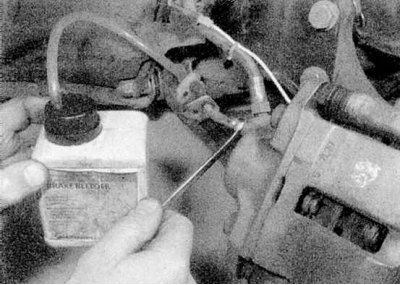
5. Open the bleed nipple approximately one turn (refer to the accompanying illustration). When fluid stops flowing from the nipple, tighten it and have an assistant slowly release the pedal and check the fluid level in the master cylinder reservoir.
6. Repeat this procedure (paragraphs 4 and 5), until the escaping brake fluid is free of air bubbles. If all the fluid has drained from the master cylinder while bleeding the first brake mechanism, refill the master cylinder and bleed the brake again, taking breaks of approximately five seconds between cycles.
7. Tighten the bleed screw, remove the plastic tube and install the dust cap.
8. Repeat the procedure on the remaining brake mechanisms in the sequence indicated above.
Bleeding with a non-return valve device
1. These devices consist of a tube with a non-return valve that prevents air and liquid that has escaped from it from being drawn back into the system. Some kits also include a transparent container.
2. Attach the tube to the bleed nipple and open it. Press the brake pedal slowly and smoothly, then release it slowly. Repeat this action until the fluid coming out of the nipple is free of air bubbles.
3. Be sure to keep the fluid level in the reservoir above the "MIN" line.
Pumping under pressure
1. These devices are powered by compressed air contained in the spare tire chamber. However, note that the air pressure must be reduced (see instructions included with the device).
2. Attach the supplied container filled with brake fluid to the master cylinder reservoir and to the spare tire. Bleed by opening the nipples one at a time (in the given sequence) and draining the liquid until it is free of air bubbles.
3. This method has advantages because the large amount of fluid in the installed reservoir prevents air from entering the master cylinder during bleeding.
4. Bleeding under pressure is especially effective when bleeding "problem" systems (the airlock is stuck in a place where it is difficult to get out) or when completely bleeding the system during the next fluid change.
All methods
1. After bleeding, wash away any spilled fluid and tighten the bleeding nipples as shown in Specifications force and install their dust caps.
2. Check the brake fluid level in the master cylinder reservoir and top it up if necessary (refer to Section Schedule of current maintenance).
3. Pour out the brake fluid that comes out during bleeding; it is not suitable for reuse.
4. Check the elasticity of the brake pedal. If you feel dips when moving it, there is still air in the system and further bleeding is required. If repeated bleeding does not bring a satisfactory result, the master cylinder seals may be worn out.
Models equipped with ABS
Caution! On models equipped with ABS, before disconnecting the brake pipes, disconnect the ground cable from the battery and do not reconnect it until bleeding is complete. Failure to do so may result in air entering the hydraulic unit, which is very difficult to bleed (in some cases it is impossible) to bleed. When disconnecting the battery on Scenic models, refer to Section Charging and starting systems.
Caution: Do not use a pressure bleeding kit on these models.
Before bleeding the brake hydraulic system on models with ABS, it is necessary to perform preparatory procedures and take special precautions. These procedures vary depending on which part of the system has been disconnected.
Information regarding the conventional braking system (except for pumping under pressure) applicable to models equipped with ABS. However, on these models a different bleeding sequence is used:
- a) Left front brake mechanism
- b) Right rear brake mechanism
- c) Right front brake mechanism
- d) Left rear brake mechanism
In addition to this, the following pumping procedures are used.
Bleeding after disconnecting the wheel cylinder/caliper coupling
Note: If more than one caliper/wheel cylinder was removed, perform this procedure on each brake, working in the sequence shown above.
1. Connect a container to the bleed nipple and bring the fluid level in the master cylinder reservoir to the normal level. Remember to keep it above the "MIN" mark throughout the procedure.
2. Open the bleed screw, then have an assistant press the brake pedal all the way down and hold it there. Tighten the screw and have the assistant slowly release the pedal and wait for about 3 seconds. Repeat this procedure at least ten times until the fluid flowing from the bleed screw is free of air bubbles.
3. Again, have your assistant press the brake pedal several times and hold it down. Open the bleeder screw and let the pedal drop to the floor. Tighten the screw and have your assistant slowly release the pedal and wait at least 3 seconds. Repeat this procedure and make sure the fluid that comes out is free of bubbles.
4. Check the elasticity of the brake pedal, then remove the container and bring the fluid level to the normal level (refer to Section Schedule of current maintenance). Make sure the bleed nipple is tightened to the specified torque, then install the dust cap.
Source link is located on (www.RenaultBook.ru)
Bleeding the pressure regulating couplings after disconnection
1. Bleed both rear brakes as described above.
Bleeding after disconnecting the master cylinder coupling
2. If the master cylinder has been disconnected, it must be bled before connecting it to the hydraulic line to prevent air from entering the hydraulic unit. This will require two plugs that are screwed into the holes in the master cylinder.
3. Screw the plugs into the master cylinder ports and tighten them.
4. Fill the cylinder reservoir, then open the rear plug/nipple (first circuit) and ask an assistant to press the brake pedal and hold it in this position. Tighten the plug, then ask the assistant to slowly release the brake pedal and wait about 3 seconds. Repeat this procedure 5-6 times.
5. Repeat the procedure for the front of the master cylinder (second circuit).
6. To prevent fluid from escaping from the cylinder and, therefore, air from entering it, have an assistant lightly press the brake pedal before removing the plugs (approximately 30 mm) and hold it in this position.
7. Remove the plugs from the brake pipes and make sure that both pipes are filled with fluid; if this is not the case, add fluid to them. Quickly remove one of the master cylinder plugs (the brake pedal is held as described in the previous paragraph), connect the brake pipe and tighten the union nut to the specifications given in Specifications force. Repeat the procedure on the second channel of the master cylinder, then wash off the spilled liquid.
8. Refer to the paragraphs above and completely bleed the brake hydraulic system in the sequence indicated above.
Bleeding after disconnecting the hydraulic unit coupling
1. Before connecting the tubes to the hydraulic block, make sure that all ports of the block and the tubes themselves are filled with fluid. Tighten all union nuts to the specified Specifications forcefully and wash away the spilled liquid.
2. Refer to the paragraphs above and completely bleed the brake hydraulic system in the sequence indicated above.