
English Русский
Български
Беларускі
Український
Српски
Hrvatski
Română
Polski
Slovenský
Magyar
Bookmark Contacts Articles Sitemap
Company vehicles Peugeot Company vehicles Opel Company vehicles Skoda Company vehicles Land Rover Company vehicles Mitsubishi Company vehicles Volkswagen Company vehicles Honda
RenaultBook.ru


Duster   Fluence   Kangoo   Laguna   Logan   Megane   Sandero   Scenic   Symbol   Clio   Other
Megane 1 (1995-2002) Megan 2 (2002-2009, petrol)

Charging and Starting Systems — Description and Precautions (Renault Megane 1)

  • Main
  • Megane
  • Megane 1 (1995-2002)
  • Power unit
  • Charge and launch systems
  • Charging and Starting Systems — Description and Precautions
0
Contents: Battery Disconnection - Scenic Models 🠛 Precautions 🠛
The engine electrical system consists primarily of the starting and discharging systems. Since the functions of these systems are related to engine operation, their components are considered separately from the body electrical devices such as external lighting, instruments, etc. The latter are considered in Chapter On-board electrical equipment.

The electrical system is 12-volt with negative ground.

The battery is charged by a generator, which is driven by a belt from the crankshaft pulley.

The starter has a freewheel clutch with preliminary engagement with the traction relay. When the engine is started, the traction relay moves the pinion, bringing it into engagement with the flywheel ring gear before the starter is activated. After the engine is started, the freewheel clutch prevents the transfer of engine rotation to the starter.

Battery Disconnection - Scenic Models
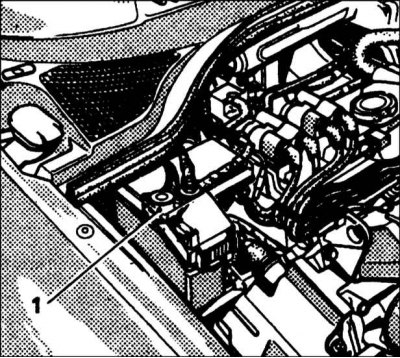


Battery Disconnection - Scenic Models


On Scenic models, the battery is located in a special compartment under the right front seat. To disconnect the battery, you must disconnect the positive battery cable in the additional terminal block. Access to the terminal is obtained after removing the cover (refer to the accompanying illustration).


If the engine is started using heavy gauge jumper cables and a booster battery, use the secondary terminal of the positive red connection, not the battery terminal directly. This also applies when connecting a charger.

Precautions


A more detailed description of the various systems is provided in the relevant Sections of this Chapter.

When working with electrical equipment, extra care must be taken to avoid damaging semiconductor devices (diodes and transistors) and avoid electric shock.

Original publication on the portal (www.RenaultBook.ru)

Always remove rings, watches, etc. before working on an electrical system. Even with the battery disconnected, capacitive discharge may occur if the component's power terminal is accidentally shorted with a metal object. This may cause shock or severe burns.

Do not mix up the battery terminals. Components such as the alternator, electronic control devices or any other semiconductor circuit may be irreparably damaged.

When starting the engine using large-section cables and a starting device or a separate battery, you need to connect the plus to the plus and the minus to the minus. This also applies when connecting the battery to the charger.

Never disconnect battery, alternator, any electrical wiring or instrumentation while the engine is running.

Do not allow the engine to rotate a generator that is disconnected from the electrical system.

Never test the generator's functionality by shorting its output terminals to ground.

When working on the electrical system, make sure the negative battery cable is disconnected.


Before using arc welding on a vehicle, disconnect the battery, alternator, and components such as the electronic ignition control device and fuel injection system to protect them from damage.

Warning! If the radio in your car is coded, make sure you know the code before disconnecting the battery.
This article is available on: russian, bulgarian, belarusian, ukrainian, serbian, croatian, romanian, polish, slovak, hungarian
Article has been reviewed by editor: Fedoseev Denis
Share with friends:
Previous
Megane 1: Charge and launch systems
Next

Engine Starting and Charging System Specifications
Testing and charging the battery
Removal and installation the battery
Testing the charging system
Removal and installation the generator
Checking and overhauling the generator
Other articles on other Renault models

➽ Scheme 1: Starting (manual transmission), charging and ignition… Renault Clio 1 (1990-1998)
➽ Safety precautions when working with ignition systems Renault Scenic 1 (1996-2003)
➽ Scheme 1. Starting and charging system, cooling system fan... Renault Symbol 1 (1999-2008, petrol)
➽ Starting and stopping the engine Renault Duster 1 (2009-2017)
➽ Starting the engine with an additional battery Renault Fluence 1 (2009-2020, petrol)
Link to this article in different formats
Reviews and comments of visitors
No comments yet


Add two numbers 50 + 32


Megan 2 (2002-2009, petrol) 
  • User manual
  • Introduction to manual
  • Controls and instruments
  • Salon equipment
  • Operation and driving
  • Maintenance and care
  • Power unit
  • Engine repair
  • Fuel system
  • Injection system
  • Intake and exhaust system
  • Starting and charging system
  • Cooling system
  • Decreased toxicity
  • Transmission
  • Clutch
  • Mechanical gearbox
  • Automatic gearbox
  • Wheel drive mechanism
  • Chassis, running gear
  • Suspension and wheels
  • Steering
  • Brake system
  • Body and interior
  • Exterior (external elements)
  • Interior (internal elements)
  • Doors, locks and windows
  • Heating and air conditioning
  • Electrical equipment
  • Equipment and devices
  • Headlights and lighting
  • Electrical circuits
Megane 1 (1995-2002) 
  • General information
  • User manual
  • Maintenance
  • Power unit
  • Petrol engines 1.4/1.6 l
  • Petrol engines 2.0 l
  • Diesel engines 1.9 l
  • Overhaul of engines
  • Cooling system
  • Fuel system (petrol)
  • Fuel system (diesel)
  • Decreased toxicity
  • Charge and launch systems
  • Ignition system (petrol)
  • Preheat system (diesel)
  • Transmission
  • Clutch
  • Mechanical gearbox
  • Automatic gearbox
  • Drive shafts
  • Chassis, running gear
  • Brake system
  • Car suspension
  • Steering
  • Body and interior
  • Exterior (external elements)
  • Interior (internal elements)
  • Doors, locks and windows
  • Electrical equipment
  • Equipment and devices
  • Electrical circuits
RenaultBook.ru © 2018–2026 | Mobile version | News and articles | Sitemap: EN BG BY UA RS HR RO PL SK HU | Administration | Site search | Bookmark
Duster 1 (2009-2017) | Fluence 1 (2009-2020, petrol) | Kangoo 1 (1997-2007) | Laguna 2 (2001-2007) | Logan 1 (2004-2012, petrol) | Logan 2 (2012-2020) | Megane 1 (1995-2002) | Megan 2 (2002-2009, petrol) | Sandero 1 (2007-2012, petrol) | Scenic 1 (1996-2003) | Symbol 1 (1999-2008, petrol) | Symbol 2 (2008-2013, petrol) | Renault 19 (1988-1996) | Espace I and II (1984-1996) | Espace III (1996-2002) | Clio 1 (1990-1998) |
We want your visit to be comfortable 😌 and use cookies 🍪 to do so.