



Note: Before proceeding, please refer to the Note provided at the beginning of the Section Bleeding the brake hydraulic system.
Models not equipped with ABS
1. If any tube or hose needs to be replaced, remove the master cylinder reservoir cap and re-tighten it, placing a piece of polyethylene underneath to create a tight seal and prevent fluid loss. Alternatively, pinch the hoses and plug the metal couplings. Place a rag underneath the coupling being disconnected to catch any escaping fluid.
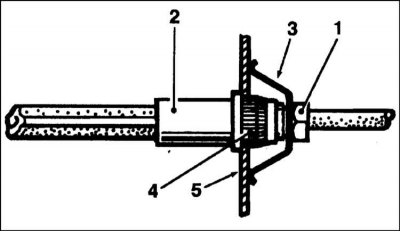
2. If it is necessary to disconnect the hose, unscrew the union nut and remove the spring clip securing the hose to the bracket (refer to the accompanying illustration).
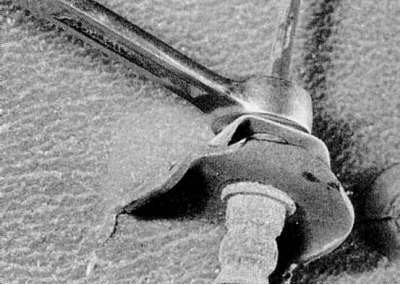
3. To unscrew the connecting nuts, you need a special open-end wrench of the appropriate size (refer to the accompanying illustration). Alternatively, you can use a properly sized double-ended spanner, although if the nuts are corroded, there is a high risk of stripping their chamfers. In this case, use a self-locking spanner and replace the tube and damaged nuts. Be sure to clean the nut before unscrewing it.
4. If the brake pipe needs to be replaced, purchase a ready-made replacement with the connecting nuts installed at a Renault service station. Bend the new pipe to the profile of the original and install it on the car.
5. Do not overtighten the union nuts during installation.
6. Make sure that the tubes and hoses are routed correctly, are not twisted, and are securely fastened with clamps or brackets. Also make sure that the hoses will not catch on adjacent components when moving suspension and/or steering components. After installation, remove the polyethylene from under the reservoir cap (or plugs and clamps) and bleed the brake hydraulic system as described in Section Bleeding the brake hydraulic system. Wash away any spilled liquid and check the system for leaks.
Models equipped with ABS
Caution! On models equipped with ABS, before disconnecting the brake pipes, disconnect the ground cable from the battery and do not reconnect it until bleeding is complete. Failure to do so may result in air entering the hydraulic unit, which is very difficult to bleed (in some cases it is impossible) to bleed. When disconnecting the battery on Scenic models, refer to Section Charging and starting systems.
1. See the paragraphs above, paying attention to the following:
- a) When disconnecting the brake pipe from the hydraulic unit, immediately seal the opened channel of the unit to prevent air from entering it (see Warning). Before connecting the tube to the unit, make sure that both the channel and the tube are filled with liquid (refer to Section Bleeding the brake hydraulic system).
- b) If the brake pipe is separated from the master cylinder, the cylinder must be bled before connecting it to the system (refer to Section Bleeding the brake hydraulic system).
Material taken from an online portal [www.Renaultbook.ru]