



Note: Before you begin, please refer to the Warning given at the beginning Chapter 6.
1. If any tube or hose needs to be replaced, remove the lid of the feed tank and re-tighten it, placing a piece of plastic underneath it (do not damage the level sensor), to achieve a hermetic seal and prevent fluid loss. Alternatively, clamp the hoses and plug the metal fittings. Place a rag under the coupling being disconnected to catch any leaking fluid.
2. If it is necessary to separate the hose, unscrew the tube union nut before removing the spring clip securing the hose to the bracket (see illustrations).
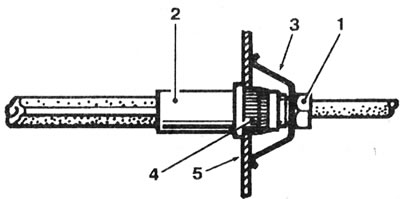
7.2a. Connecting the brake pipe to the hose: 1 - Connecting nut; 2 - Hose; 3 - Spring clip holder; 4 - Tip; 5 - Body.
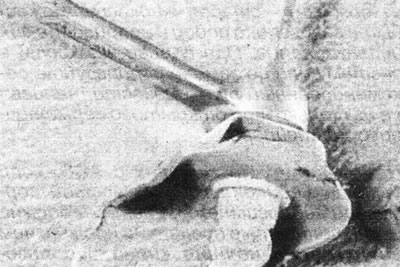
7.2b. Unscrew the tube connecting coupling nut using a special ring spanner.
3. It is preferable to unscrew the connecting nuts with a special ring spanner of the correct size (11 mm/13 mm). Alternatively, you can use a properly sized double-ended wrench, although if the nuts are corroded there is a high risk of stripping the chamfers. In this case, use a self-locking wrench and replace the tube and damaged nuts. Be sure to clean the coupling and surrounding area before disconnecting the coupling. When removing a component with more than one coupling, carefully mark the tubes relative to the couplings.
4. If the brake pipe needs to be replaced, purchase a ready-made replacement with union nuts installed from your Renault dealer. Bend the new tube to the profile of the original and install it on the car.
5. Do not overtighten the union nuts during installation. Specified tightening forces (where given) are not high and it is not necessary to apply excessive force to obtain a secure connection.
6. Make sure that the pipes and hoses are routed correctly, without twisting, and that they are secured with clamps or brackets. In the case of hoses, ensure that they do not come into contact with suspension and steering components, taking into account the maximum displacement of the latter that is possible during movement.
7. After installation, remove the plastic from under the tank lid (or plugs/clamps) and bleed the brake hydraulic system as described in Chapter 6. Wash away any spilled fluid and thoroughly check the system for leaks.
(Text published on the website RENAULTBOOK.ru)