


Share with friends:
Engine cooling, heating and air conditioning Renault Clio 1

Cooling, Heating and Air Conditioning System Specifications
Main characteristics Cooling system type Sealed (pressure above atmospheric), with belt-driven pump; the front-mounted radiator is equipped with an electric fan; on 16-valve models there is an auxiliary electric pump....
Main characteristics Cooling system type Sealed (pressure above atmospheric), with belt-driven pump; the front-mounted radiator is equipped with an electric fan; on 16-valve models there is an auxiliary electric pump....

General description of the cooling system
1. Hermetically sealed cooling system (pressure above atmospheric) includes a belt-driven pump, aluminum cross-flow radiator, expansion tank, electric fan, thermostat and connecting hoses (see illustrations). 1.1a....
1. Hermetically sealed cooling system (pressure above atmospheric) includes a belt-driven pump, aluminum cross-flow radiator, expansion tank, electric fan, thermostat and connecting hoses (see illustrations). 1.1a....

Cooling system hoses — replacement
1. The number, location and type of hoses vary depending on the model, but the same basic procedure is used to replace them. Before you begin work, purchase new hoses and new hose clamps if necessary. Experience shows...
1. The number, location and type of hoses vary depending on the model, but the same basic procedure is used to replace them. Before you begin work, purchase new hoses and new hose clamps if necessary. Experience shows...

Radiator — removal, inspection, cleaning and installation
Note: If the radiator must be removed for more than 48 hours, take precautions against internal corrosion. Either rinse the component with clean water and dry it with compressed air, or fill the radiator with coolant...
Note: If the radiator must be removed for more than 48 hours, take precautions against internal corrosion. Either rinse the component with clean water and dry it with compressed air, or fill the radiator with coolant...
Expansion tank — removal, inspection and installation
Removal 1. Drain some coolant from the system ( see Section 1 ) to empty the expansion tank (the engine must be cold). 2. Loosen the belt securing the tank. Disconnect the hoses and remove the tank. Inspection 3. Clean...
Removal 1. Drain some coolant from the system ( see Section 1 ) to empty the expansion tank (the engine must be cold). 2. Loosen the belt securing the tank. Disconnect the hoses and remove the tank. Inspection 3. Clean...

Thermostat — removal, checking for serviceability and installation
Note: A new thermostat O-ring may be required during installation - see text. 1. On the C-series engine, the thermostat is located at the end of the upper radiator hose (at the water pump) and is held in place by a hose...
Note: A new thermostat O-ring may be required during installation - see text. 1. On the C-series engine, the thermostat is located at the end of the upper radiator hose (at the water pump) and is held in place by a hose...

Electric fan assembly — removal and installation
Removal 1. Disconnect the negative cable from the battery. 2. On models with a D-series engine, remove the three bolts securing the power steering fluid reservoir to the fan shroud, then disconnect the power steering...
Removal 1. Disconnect the negative cable from the battery. 2. On models with a D-series engine, remove the three bolts securing the power steering fluid reservoir to the fan shroud, then disconnect the power steering...

Fan Thermal Switch — checking functionality, removal and installation
1. The fan switch is screwed into the radiator. Checking the serviceability 2. Release the multi-pin connector of the switch and disconnect it (see illustrations). 7.2a. Release the multi-pin connector from its...
1. The fan switch is screwed into the radiator. Checking the serviceability 2. Release the multi-pin connector of the switch and disconnect it (see illustrations). 7.2a. Release the multi-pin connector from its...

Temperature indicator and warning light sensor — checking serviceability, removal and installation
1. The location of the indicator lamp sensor and temperature gauge varies depending on the model. On C series engines it is located on the water pump. On D-series engines, the sensor is located at the rear of the...
1. The location of the indicator lamp sensor and temperature gauge varies depending on the model. On C series engines it is located on the water pump. On D-series engines, the sensor is located at the rear of the...

Water pump — removal and installation
1. If the water pump is leaking or noisy, replace it. C series engines Note: A new gasket will be required during installation. Removal 2. Disconnect the negative cable from the battery, then drain the coolant from the...
1. If the water pump is leaking or noisy, replace it. C series engines Note: A new gasket will be required during installation. Removal 2. Disconnect the negative cable from the battery, then drain the coolant from the...

Auxiliary water pump (models with F7P 16-valve engine) — removal and installation
1. The auxiliary water pump installed on the 16-valve model is electrically driven. It forms part of a system that is designed to reduce the temperature in the engine compartment after the vehicle has stopped. The...
1. The auxiliary water pump installed on the 16-valve model is electrically driven. It forms part of a system that is designed to reduce the temperature in the engine compartment after the vehicle has stopped. The...

Heating system — general description and operation check
General description 1. Heating and ventilation of the cabin operate on the principle of mixing hot and cold air in volumes determined by the position of the regulator on the control panel of these systems. The coolant...
General description 1. Heating and ventilation of the cabin operate on the principle of mixing hot and cold air in volumes determined by the position of the regulator on the control panel of these systems. The coolant...

Heater Components — removal and installation
Assembling the supercharger Removal 1. Disconnect the negative cable from the battery. 2. Remove the wiper arms ( see Section 12 ) and windshield fairing ( Section 11 ). 3. Remove the jack from the engine compartment....
Assembling the supercharger Removal 1. Disconnect the negative cable from the battery. 2. Remove the wiper arms ( see Section 12 ) and windshield fairing ( Section 11 ). 3. Remove the jack from the engine compartment....

Heating system air ducts and deflectors — removal and installation
Removal 1. The side deflectors of the instrument panel are secured with three Phillips-head screws - one on the side and two on the bottom. Remove the screws and take out the deflector (see illustrations). 13.1a. Remove...
Removal 1. The side deflectors of the instrument panel are secured with three Phillips-head screws - one on the side and two on the bottom. Remove the screws and take out the deflector (see illustrations). 13.1a. Remove...

Heater Regulators and Control Cables — removal and installation
Control panel and its backlight lamp Removal 1. Disconnect the negative cable from the battery, then remove the car radio. 2. Remove the car radio cover, which is secured with four screws. 3. Remove the two screws...
Control panel and its backlight lamp Removal 1. Disconnect the negative cable from the battery, then remove the car radio. 2. Remove the car radio cover, which is secured with four screws. 3. Remove the two screws...
Air Conditioning System — general description and precautions
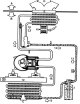
General description 1. Some models are equipped with an air conditioning system. The system allows for rapid reduction of temperature and humidity of incoming air (see illustration). 15.1. Air conditioning system: A -...
General description 1. Some models are equipped with an air conditioning system. The system allows for rapid reduction of temperature and humidity of incoming air (see illustration). 15.1. Air conditioning system: A -...
Air conditioning system — checking operation and maintenance
1. Maintenance is limited to checking the tension and condition of the compressor drive belt, as well as checking through the inspection window for the presence of bubbles in the refrigerant (systems with R12...
1. Maintenance is limited to checking the tension and condition of the compressor drive belt, as well as checking through the inspection window for the presence of bubbles in the refrigerant (systems with R12...

Air conditioning system — removal and installation of components
Warning: Do not disconnect any air conditioning system components until the system is discharged. See precautions given at the end Chapter 15 . 1. This chapter describes actions that can be performed without...
Warning: Do not disconnect any air conditioning system components until the system is discharged. See precautions given at the end Chapter 15 . 1. This chapter describes actions that can be performed without...
This section is available on: russian, bulgarian, belarusian, ukrainian, serbian, croatian, romanian, polish, slovak, hungarian
Other sections on other Renault models
➽ Power unit: Cooling and lubrication system Renault Fluence 1 (2009-2020, petrol)
➽ Power unit: Cooling system Renault Laguna 2 (2001-2007)
➽ Power unit: Cooling system Renault Logan 2 (2012-2020)
➽ Power unit: Cooling system Renault Megane 1 (1995-2002)
➽ Power unit: Cooling system Renault Symbol 2 (2008-2013, petrol)
➽ Power unit: Cooling system Renault Duster 1 (2009-2017)
Link to this section in different formats
TEXTHTMLBB Code
- General information
- Maintenance
- Troubleshooting
- Power unit
- Petrol engines 1.1 l (C)
- Petrol engines 1.2 l (D)
- Petrol engines 1.2/1.4 l (E)
- Petrol engines 1.8 l (F)
- Diesel engines
- Overhaul of engines
- Cooling and heating
- Fuel system (carburetor)
- Central fuel injection
- Distributed fuel injection
- Fuel system (diesel)
- Starting and charging system
- Ignition system (transistor)
- Ignition system (electronic)
- Pre-heating of diesel engines
- Transmission
- Clutch
- Manual gearbox
- Automatic gearbox
- Drive shafts
- Chassis, running gear
- Brake system
- Car suspension
- Steering system
- Body and interior
- Exterior (external elements)
- Doors, locks and windows
- Electrical equipment
- Equipment and devices
- Electrical circuits