
English Русский
Български
Беларускі
Український
Српски
Hrvatski
Română
Polski
Slovenský
Magyar
Bookmark Contacts Articles Sitemap
Company vehicles Peugeot Company vehicles Opel Company vehicles Skoda Company vehicles Land Rover Company vehicles Mitsubishi Company vehicles Volkswagen Company vehicles Honda
RenaultBook.ru


Duster   Fluence   Kangoo   Laguna   Logan   Megane   Sandero   Scenic   Symbol   Clio   Other
Megane 1 (1995-2002) Megan 2 (2002-2009, petrol)

Inspection, removal and installation of the front brake disc (Renault Megane 1)

  • Main
  • Megane
  • Megane 1 (1995-2002)
  • Chassis, running gear
  • Brake system
  • Inspection, removal and installation of the front brake disc
0
Contents: Inspection 🠛 Removal 🠛 Installation 🠛
Note: If one of the discs requires replacement, replace BOTH discs at the same time to ensure equal and effective braking. It is recommended to replace the pads as well.


Inspection


1. Set the handbrake, then jack up the front of the car and secure it on axle stands. Remove the front wheel.

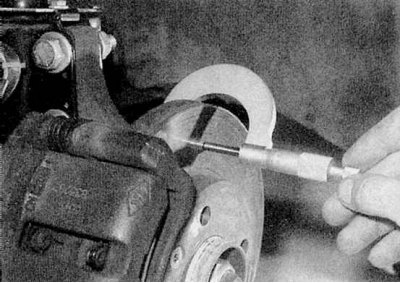
2. Rotate the brake disc slowly and carefully inspect it from both sides. If better access is required to the inner side, remove the brake pads. The presence of shallow scratches in the area covered by the brake pads is quite acceptable - the surface can be sanded with sandpaper. If deep grooves are found in this area, the disc requires replacement.
2. Rotate the brake disc slowly and carefully inspect it from both sides. If better access is…


3. It is quite normal for there to be a protrusion on the periphery of the disc caused by rust or dust adhering to it. This seal can be scraped off. However, if the thickness difference is due to wear of the area covered by the pads, measure the thickness of the disc with a micrometer (refer to the accompanying illustration). Take measurements in several places, both in and outside the contact area with the pads. If at least one of the measurements is equal to or less than the value specified in Specifications minimum thickness, replace the disc.


3. It is quite normal for there to be a protrusion on the periphery of the disc caused by rust or…


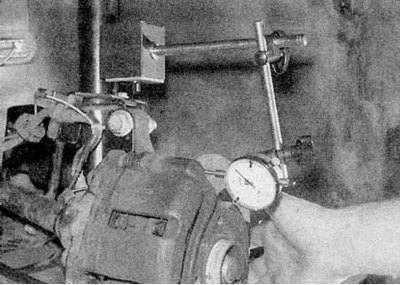
4. If the disc is suspected of being warped, check it for runout using a dial micrometer (refer to the accompanying illustration). Alternatively, slowly rotate the disc and use feeler gauges to take several measurements of the clearance between the disc and a fixed point, such as the caliper mounting bracket. If the measurements obtained are equal to or greater than the specified Specifications maximum, the disc is deformed and must be replaced. However, first check the condition of the hub bearings (Chapter Maintenance and Chapter Suspension and steering). To be absolutely sure, remove the disc, rotate it 180° and reinstall it on the hub, if the disc runout is still excessive, replace the disc.

5. Check the disc for cracks (especially around the wheel bolt holes), other damage and signs of wear. Replace the disc if necessary.

Removal


Removal


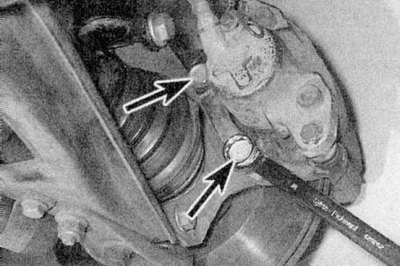
1. Remove the two bolts securing the caliper bracket to the steering knuckle and pull the caliper assembly off the disc along with the pads (refer to the accompanying illustration). Tie the caliper to the front suspension spring with a piece of wire and twine to avoid damaging the brake hose or the brake pad wear sensor wiring.


2. If the disc is not replaceable, mark it and the hub. Unscrew the screws that secure the disc to the hub and remove the disc. If this is not possible, tap the back of the disc lightly with a mallet.

Installation


1. Install in the reverse order of removal, paying attention to the following:
  • a) Clean and dry the contact surfaces of the disc and hub.
  • b) Align the marks made before removal and tighten the disc mounting screws to the specified Specifications effort.
  • c) If a new disc is being installed, use a suitable solvent to remove the protective coating from the disc.
  • d) Before installation, clean the threads of the caliper bracket mounting bolts and coat them with a seizing compound (Renault recommends Lostite Frenbloc). Place the caliper in the working position and tighten the caliper bracket bolts to the specified value Specifications effort.
  • e) Install the wheel, then lower the vehicle to the ground and tighten the wheel bolts to the specified Specifications force. Press the brake pedal several times to move the pads close to the disc.
This article is available on: russian, bulgarian, belarusian, ukrainian, serbian, croatian, romanian, polish, slovak, hungarian
Article has been reviewed by editor: Fedoseev Denis
Share with friends:
Previous
Megane 1: Brake system
Next

Replacing the rear brake pads
Replacing the front brake pads
Replacing brake pipes and hoses
Bleeding the brake hydraulic system
Specifications and description of the brake system
Removal, inspection and installation of rear brake drums
Removal, overhaul and installation of front brake calipers
Removal and installation the rear brake cylinder
Removal, overhaul and installation of the master cylinder
Removal and installation the brake pedal
Other articles on other Renault models

➽ Front brake disc protective cover Renault Duster 1 (2009-2017)
➽ Front brake disc Renault Fluence 1 (2009-2020, petrol)
➽ Front disc brake mechanism Renault Logan 2 (2012-2020)
➽ Removal, checking and installation the front brake disc Renault Symbol 1 (1999-2008, petrol)
➽ Front Disc Brake Caliper — Removal and Installation Renault Espace I and II (1984-1996)
Link to this article in different formats
Reviews and comments of visitors
No comments yet


Add two numbers 13 + 34


Megan 2 (2002-2009, petrol) 
  • User manual
  • Introduction to manual
  • Controls and instruments
  • Salon equipment
  • Operation and driving
  • Maintenance and care
  • Power unit
  • Engine repair
  • Fuel system
  • Injection system
  • Intake and exhaust system
  • Starting and charging system
  • Cooling system
  • Decreased toxicity
  • Transmission
  • Clutch
  • Mechanical gearbox
  • Automatic gearbox
  • Wheel drive mechanism
  • Chassis, running gear
  • Suspension and wheels
  • Steering
  • Brake system
  • Body and interior
  • Exterior (external elements)
  • Interior (internal elements)
  • Doors, locks and windows
  • Heating and air conditioning
  • Electrical equipment
  • Equipment and devices
  • Headlights and lighting
  • Electrical circuits
Megane 1 (1995-2002) 
  • General information
  • User manual
  • Maintenance
  • Power unit
  • Petrol engines 1.4/1.6 l
  • Petrol engines 2.0 l
  • Diesel engines 1.9 l
  • Overhaul of engines
  • Cooling system
  • Fuel system (petrol)
  • Fuel system (diesel)
  • Decreased toxicity
  • Charge and launch systems
  • Ignition system (petrol)
  • Preheat system (diesel)
  • Transmission
  • Clutch
  • Mechanical gearbox
  • Automatic gearbox
  • Drive shafts
  • Chassis, running gear
  • Brake system
  • Car suspension
  • Steering
  • Body and interior
  • Exterior (external elements)
  • Interior (internal elements)
  • Doors, locks and windows
  • Electrical equipment
  • Equipment and devices
  • Electrical circuits
RenaultBook.ru © 2018–2026 | Mobile version | News and articles | Sitemap: EN BG BY UA RS HR RO PL SK HU | Administration | Site search | Bookmark
Duster 1 (2009-2017) | Fluence 1 (2009-2020, petrol) | Kangoo 1 (1997-2007) | Laguna 2 (2001-2007) | Logan 1 (2004-2012, petrol) | Logan 2 (2012-2020) | Megane 1 (1995-2002) | Megan 2 (2002-2009, petrol) | Sandero 1 (2007-2012, petrol) | Scenic 1 (1996-2003) | Symbol 1 (1999-2008, petrol) | Symbol 2 (2008-2013, petrol) | Renault 19 (1988-1996) | Espace I and II (1984-1996) | Espace III (1996-2002) | Clio 1 (1990-1998) |
We want your visit to be comfortable 😌 and use cookies 🍪 to do so.