
English Русский
Български
Беларускі
Український
Српски
Hrvatski
Română
Polski
Slovenský
Magyar
Bookmark Contacts Articles Sitemap
Company vehicles Peugeot Company vehicles Opel Company vehicles Skoda Company vehicles Land Rover Company vehicles Mitsubishi Company vehicles Volkswagen Company vehicles Honda
RenaultBook.ru


Duster   Fluence   Kangoo   Laguna   Logan   Megane   Sandero   Scenic   Symbol   Clio   Other
Symbol 1 (1999-2008, petrol) Symbol 2 (2008-2013, petrol)

Brake hoses — removal and installation (Renault Symbol 2)

  • Main
  • Symbol
  • Symbol 2 (2008-2013, petrol)
  • Chassis, running gear
  • Brake system
  • Brake hoses — removal and installation
0
Contents: Removal 🠛 Installation 🠛
To ensure safe operation, do not twist the hoses or allow the hose to come into contact with moving suspension parts.
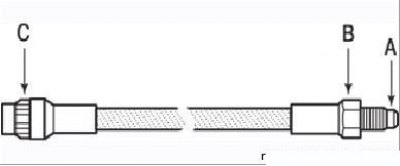
Figure 7.25. Brake hose: A – conical surface of the tip; B – tip nut; C – splined part

Figure 7.25. Brake hose: A – conical surface of the tip; B – tip nut; C – splined part


Hoses are installed on the vehicle without copper sealing washers. Sealing is achieved by contact of conical surfaces A (Figure 7.25) hose tip. When replacing or disconnecting the hose (pipelines) take care to reduce the leakage of brake fluid. To do this, place a rag under the work area. Seal the expansion tank by placing a polyethylene circle of the same diameter under its lid, or install a clamp on the tank hose. When disconnecting the hose, plug the holes with pre-prepared plugs. You can also pinch the disconnected hose to isolate part of the brake system circuit.

For safety reasons, to prevent twisting of brake hoses and the possibility of their contact with suspension parts, the following procedure must be followed.

Removal
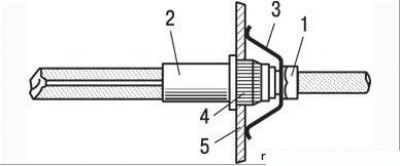


Figure 7.26. Connecting the brake hose to the pipeline: 1 – union nut of the pipeline; 2 – hose; 3…

Figure 7.26. Connecting the brake hose to the pipeline: 1 – union nut of the pipeline; 2 – hose; 3 – spring retainer; 4 – splined part of the hose tip; 5 – connection bracket
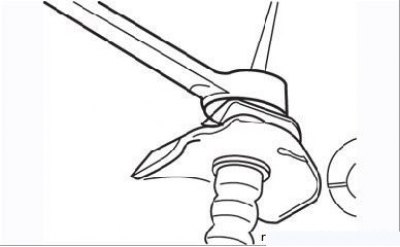


Figure 7.27. Unscrewing the nut connecting the hose to the pipeline with a slotted spanner

Figure 7.27. Unscrewing the nut connecting the hose to the pipeline with a slotted spanner

  • loosen the union nut (Figure 7.26) using a slotted open-end wrench (Figure 7.27) enough to release the spring clip;
  • remove the splined portion of the hose tip from the splined hole in the bracket;
  • if necessary, remove the hose from the front brake caliper.

Installation


  • set the steering wheel to the straight-ahead position;
  • lift the front wheel on the desired side until it is off the ground;
  • screw the hose into the brake caliper hole and tighten the tip to the specified torque;
  • secure the splined hose end to the bracket (see Figure 7.26), without twisting the hose, and make sure that the tip fits freely into the slotted hole of the bracket;
  • install the spring retainer;
  • connect the pipe to the hose, making sure that the hose does not twist when screwing on the union nut. Tighten the union nut to the specified torque;
  • remove air from the hydraulic brake system.
This article is available on: russian, bulgarian, belarusian, ukrainian, serbian, croatian, romanian, polish, slovak, hungarian
Article has been reviewed by editor: Kupriyanov Sergey
Share with friends:
Previous
Symbol 2: Brake system
Next

Vacuum brake booster — removal and installation
Master Brake Cylinder — Removal and Installation
Rear brake cylinder — removal and installation
Rear brake pads — removal and installation
Brake drum — removal and installation
Removal and installation the parking brake lever
Adjusting the handbrake
Replacing the handbrake cable
Brake light switch
Bleeding the brake system
Other articles on other Renault models

➽ Brake hoses Renault Kangoo 1 (1997-2007)
➽ Removal and installation brake hoses Renault Laguna 2 (2001-2007)
➽ Replacing brake hoses Renault Logan 1 (2004-2012, petrol)
➽ Replacing brake pipes and hoses Renault Megane 1 (1995-2002)
➽ Replacement of hydraulic brake hoses and lines Renault Sandero 1 (2007-2012, petrol)
Link to this article in different formats
Reviews and comments of visitors
No comments yet


Add two numbers 29 + 31


Symbol 2 (2008-2013, petrol) 
  • General information
  • User manual
  • Maintenance
  • Power unit
  • Engine repair
  • Cooling system
  • Fuel system
  • Exhaust system
  • Ignition system
  • Transmission
  • Clutch
  • Mechanical gearbox
  • Automatic gearbox
  • Drive shafts
  • Chassis, running gear
  • Front suspension
  • Rear suspension
  • Steering
  • Brake system
  • Body and interior
  • Exterior (external elements)
  • Interior (internal elements)
  • Doors, locks and windows
  • Heating and ventilation
  • Electrical equipment
  • Equipment and devices
  • Headlights and lighting
  • Power devices
  • Electrical circuits
Symbol 1 (1999-2008, petrol) 
  • General information
  • User manual
  • Car care
  • Maintenance
  • Power unit
  • Engine repair
  • Cooling and lubrication system
  • Supply system
  • Exhaust system
  • Ignition system
  • Transmission
  • Clutch
  • Mechanical gearbox
  • Automatic gearbox
  • Drive shafts
  • Chassis, running gear
  • Car suspension
  • Steering
  • Brake system
  • Body and interior
  • Exterior (external elements)
  • Interior (internal elements)
  • Doors, locks and windows
  • Restoration and repair
  • Electrical equipment
  • Equipment and devices
  • Headlights and lighting
  • Power devices
  • Heating and ventilation
  • Electrical circuits
RenaultBook.ru © 2018–2026 | Mobile version | News and articles | Sitemap: EN BG BY UA RS HR RO PL SK HU | Administration | Site search | Bookmark
Duster 1 (2009-2017) | Fluence 1 (2009-2020, petrol) | Kangoo 1 (1997-2007) | Laguna 2 (2001-2007) | Logan 1 (2004-2012, petrol) | Logan 2 (2012-2020) | Megane 1 (1995-2002) | Megan 2 (2002-2009, petrol) | Sandero 1 (2007-2012, petrol) | Scenic 1 (1996-2003) | Symbol 1 (1999-2008, petrol) | Symbol 2 (2008-2013, petrol) | Renault 19 (1988-1996) | Espace I and II (1984-1996) | Espace III (1996-2002) | Clio 1 (1990-1998) |
We want your visit to be comfortable 😌 and use cookies 🍪 to do so.