
English Русский
Български
Беларускі
Український
Српски
Hrvatski
Română
Polski
Slovenský
Magyar
Bookmark Contacts Articles Sitemap
Company vehicles Peugeot Company vehicles Opel Company vehicles Skoda Company vehicles Land Rover Company vehicles Mitsubishi Company vehicles Volkswagen Company vehicles Honda
RenaultBook.ru


Duster   Fluence   Kangoo   Laguna   Logan   Megane   Sandero   Scenic   Symbol   Clio   Other
Renault 19 (1988-1996) Espace I and II (1984-1996) Espace III (1996-2002)

Adjusting the high pressure fuel pump (Renault Espace III)

  • Main
  • Renault
  • Espace III (1996-2002)
  • Power unit
  • Diesel engines G8T
  • Adjusting the high pressure fuel pump
0
Contents: Adjusting Idle Speed and Idle Return 🠛 Fast idle 🠛 Adjusting the fast idle cable 🠛 Slow-down shock absorber 🠛
Attention: It is strongly recommended to follow the sequence of adjustments.


Adjusting Idle Speed and Idle Return


Note: These adjustments must be made on a hot engine after the radiator fan has been turned on twice.

  • Make sure the idle speed lever (1. Fig. 3.15) it actually rests against the end of the idle speed adjustment screw (3).
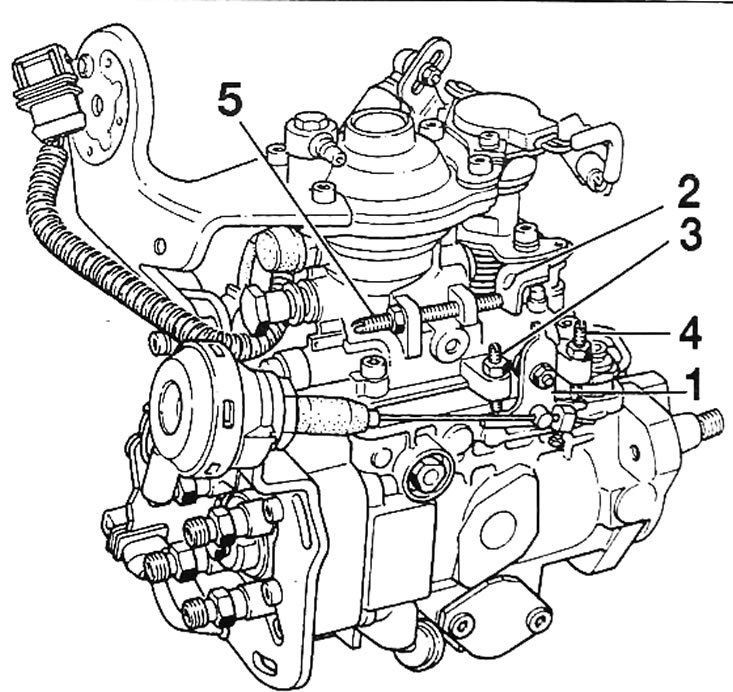
Fig. 3.15. Adjusting modes (g8T714 and G8T716 engine): 1 - idle speed lever; 2 - load lever; 3 -…

Fig. 3.15. Adjusting modes (g8T714 and G8T716 engine): 1 - idle speed lever; 2 - load lever; 3 - idle speed adjustment stop screw; 4 - fast idle speed adjustment screw; 5 - residual flow limiting screw

  • Loosen the residual flow limiting screw (5) by two turns.
  • Turn the screw (3) to adjust the idle speed of the crankshaft engine to 725±50 min⁻¹
  • Place a 1 mm thick feeler gauge between the end of the residual flow adjustment screw (5) and the load lever (2).
  • By turning the residual flow limiting screw (5), set the crankshaft speed 10-20 min⁻¹ higher than the idle speed.
  • Take out a 1 mm thick feeler gauge, sharply increase the engine speed several times and let it slowly return to idle.
  • If necessary, use the adjusting screw to adjust the engine idle speed.
  • Press and release the accelerator pedal several times, selecting the G31* mode on the Renault XR 25 instrument.

Caution: Any adjustment of the residual flow limitation screw requires rechecking using the Renault XR 25 tool.


Fast idle


Note: This adjustment must be made on a hot engine after the previous adjustments have been made.

  • Manually set the idle speed (1) and fast idle speed levers to the end of the fast idle speed adjustment screw (4).
  • Check that the engine crankshaft speed at fast idle speed stabilizes at 850±25 min⁻¹ and, if necessary, adjust it by turning the adjusting screw (4).

Note: To adjust the fast idle speed on vehicles equipped with air conditioning, it is sufficient to connect the pneumatic circuit to the atmosphere.


Adjusting the fast idle cable


Note: This adjustment must be made on a hot engine after the previous adjustments have been made.

  • Make sure the idle speed lever rests against the end of the adjusting screw.
  • Keeping the rope taut, secure it at a distance (X. Fig. 3.16) from the idle speed lever, which is respectively equal to:

- version without air conditioning system: X = 5±1 mm;

- version with air conditioning system: X = 2±1 mm.
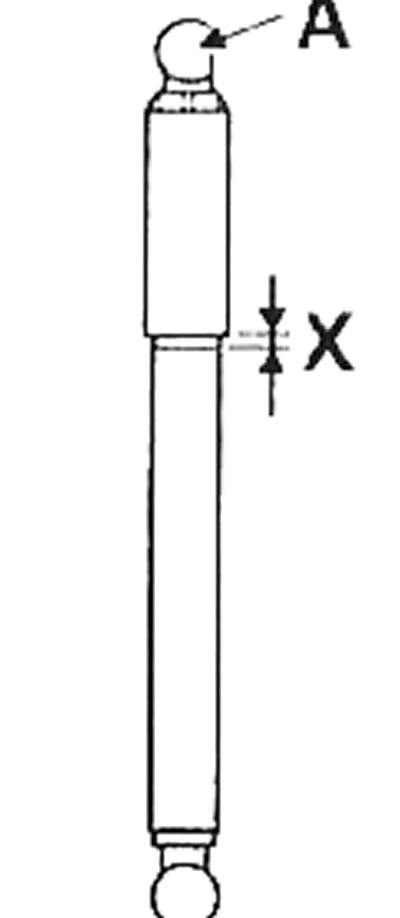
Fig. 3.16. Deceleration shock absorber: A - upper shock absorber hinge; X - adjustment gap

Fig. 3.16. Deceleration shock absorber: A - upper shock absorber hinge; X - adjustment gap


Slow-down shock absorber


  • The deceleration damper smoothly transfers the force from the accelerator pedal to the load lever.
  • After the previous adjustments, it is necessary to adjust the length of the deceleration damper. Lever (1, Fig. 3.15) must rest against the adjusting screw (3).
  • Using paint applied to the shock absorber body, mark the position of the top of the shock absorber.
  • Press on the upper shock absorber hinge until the adjustment gap of X=2 mm is obtained (Fig. 3.16).

(The original can be found on the website: RenaultBook)
This article is available on: russian, bulgarian, belarusian, ukrainian, serbian, croatian, romanian, polish, slovak, hungarian
Article has been reviewed by editor: Trofimova Anastasia
Share with friends:
Previous
Espace III: Diesel engines G8T
Next

Glow plugs
Checking the injector
Injector body
Adjusting the injection timing of the high-pressure fuel pump
High pressure fuel pump
Replacing the load potentiometer
Engine management system
Control of engine preheating and postheating
KSB injection timing advance system
ALFB Load Accounting System
Other articles on other Renault models

➽ High pressure fuel pump (HPFP) Renault Duster 1 (2009-2017)
➽ High pressure fuel pump Renault Kangoo 1 (1997-2007)
➽ Flushing the high-pressure fuel pump (HPFP) Renault Laguna 2 (2001-2007)
➽ High pressure fuel pump Renault Logan 2 (2012-2020)
➽ Checking the electric fuel pump (all engines) Renault Fluence 1 (2009-2020, petrol)
Link to this article in different formats
Reviews and comments of visitors
No comments yet


Add two numbers 10 + 35


Renault 19 (1988-1996) 
  • General information
  • Maintenance
  • Power unit
  • Engine repair
  • Exhaust system
  • Cooling system
  • Supply system
  • Single-point injection
  • Multi-point injection
  • Diesel injection system
  • Transmission
  • Clutch
  • Car gearbox
  • Chassis, running gear
  • Car suspension
  • Steering
  • Brake system
  • Wheels and tires
  • Body and interior
  • Exterior (external elements)
  • Interior (internal elements)
  • Heating and ventilation
  • Electrical equipment
  • Equipment and devices
  • Headlights and lighting
  • Ignition system
  • Power devices
  • Electrical circuits
Espace I and II (1984-1996) 
  • General information
  • Introduction to the guide
  • Troubleshooting
  • Power unit
  • Engine repair
  • Cooling system
  • Carburetor fuel system
  • Injection fuel system
  • Diesel fuel system
  • Ignition system
  • Transmission
  • Clutch
  • Car gearbox
  • Drive shafts
  • Chassis, running gear
  • Brake system
  • Steering
  • Front suspension
  • Rear suspension
  • Body and interior
  • Exterior (external elements)
  • Interior (internal elements)
  • Doors, locks and windows
  • Electrical equipment
  • Equipment and devices
  • Electrical circuits
Espace III (1996-2002) 
  • General information
  • Introduction to the manual
  • User manual
  • Power unit
  • Petrol engines F3R
  • Petrol engines Z7X
  • Diesel engines G8T
  • Diesel engines G9T
  • Transmission
  • Clutch
  • Mechanical gearbox
  • Automatic gearbox
  • Drive shafts
  • Chassis, running gear
  • Steering
  • Front suspension
  • Rear suspension
  • Brake system
  • Body and interior
  • Exterior (external elements)
  • Interior (internal elements)
  • Doors, locks and windows
  • Heating and ventilation
  • Electrical equipment
  • Equipment and instruments
  • Power devices
  • Electrical circuits
RenaultBook.ru © 2018–2026 | Mobile version | News and articles | Sitemap: EN BG BY UA RS HR RO PL SK HU | Administration | Site search | Bookmark
Duster 1 (2009-2017) | Fluence 1 (2009-2020, petrol) | Kangoo 1 (1997-2007) | Laguna 2 (2001-2007) | Logan 1 (2004-2012, petrol) | Logan 2 (2012-2020) | Megane 1 (1995-2002) | Megan 2 (2002-2009, petrol) | Sandero 1 (2007-2012, petrol) | Scenic 1 (1996-2003) | Symbol 1 (1999-2008, petrol) | Symbol 2 (2008-2013, petrol) | Renault 19 (1988-1996) | Espace I and II (1984-1996) | Espace III (1996-2002) | Clio 1 (1990-1998) |
We want your visit to be comfortable 😌 and use cookies 🍪 to do so.